
Evidence-led turf selection
Texas Hybrid Bluegrass
The category is real. The performance shortcut is not. This guide is for homeowners nationwide. Texas describes a parent species—not where the homeowner has to live. It separates the two parent species, the hybrid category, named cultivars such as HB 128, seller-linked commercial names such as SPF-30, blends such as RODEO, and the lot-specific product that reaches your lawn.
The fast answer
Buy the cultivar, not the word “hybrid.”
Texas hybrid bluegrass is a cool-season interspecific breeding category. Twin City Seed identifies SPF-30 as HB 128; the HB 128 patent separately records an F1 Texas bluegrass × Kentucky bluegrass pedigree. Independent evidence does not prove that every hybrid uses less water, looks better during drought, or outperforms Kentucky bluegrass. Use site conditions to screen the category, then require exact-cultivar evidence under comparable conditions before expecting performance. A current lot tag can verify declared identity; it cannot forecast the lawn result.[1][10][12][5][22]
Core rule
Category ≠ cultivar
Hybrid ancestry never transfers one cultivar’s trial result to another.
SPF-30 identity
Seller-linked to HB 128
The patent proves HB 128 pedigree; the seller connects SPF-30 to that name.
SPF-30 trial record
2 New Jersey tables
Those exact-entry results do not become a national rank or a forecast for a different climate.
Evidence boundary
No universal ranking
Site and cultivar evidence must match before a trial result can inform expectations.
How to read this guide
Labels name the kind of support behind each statement. Supplier claims remain useful for pedigree, features, and instructions, but they never masquerade as an independent trial.
The 90-Year Lawn Experiment
SPF-30 connects to a documented Texas × Kentucky bluegrass pedigree, but seller identity is not independent performance proof.
Buy the cultivar, not the category: match its name to a trial, then read the current seed tag. Hybrid does not mean drought-proof.
Read the transcript
This lawn experiment took about ninety years to reach a seed bag.
More than a century ago, breeders began crossing Texas bluegrass with Kentucky bluegrass. But the idea stayed experimental for decades.
The first commercial hybrid, Reveille, did not arrive until 1998.
Another named hybrid, HB 128, has a documented pedigree: Texas bluegrass plant 10-10 crossed with Geronimo Kentucky bluegrass. Sellers now identify it as SPF-30.
Here is the twist. Hybrid does not mean drought-proof. Rutgers, Kansas State, and Colorado State show that results change with the cultivar, trial, and outcome measured: performance during drought, or recovery after.
So buy the cultivar, not the category. Match its name to a trial, then read the current seed tag.
Grass has lore. Follow for the next chapter.
Identity before performance
Species → hybrid category → cultivar → blend → product
Kentucky bluegrass (Poa pratensis) and Texas bluegrass (Poa arachnifera) are separate species. Crossing them creates an interspecific hybrid category. A cultivar is one named selection within that breeding landscape. A blend or mixture combines material, and a retail product adds a brand, package, coating, seller, and lot-specific analysis tag.[1][22]
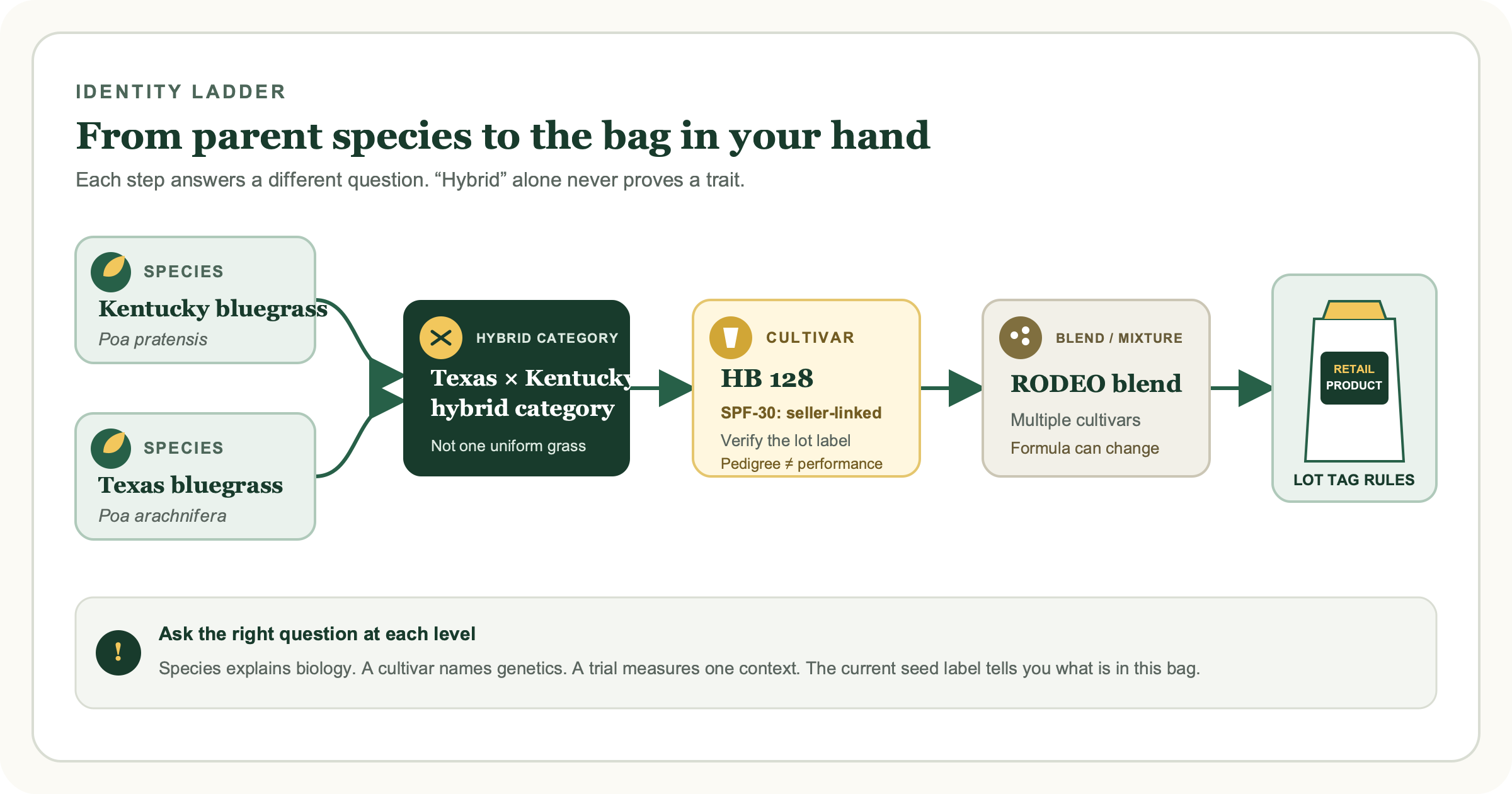
- 1SpeciesA botanical unit. The two parents stay separate species. Examples: Poa pratensis, Poa arachnifera.
- 2Hybrid categoryAn interspecific breeding relationship, not one uniform grass. Examples: Texas × Kentucky hybrid bluegrass.
- 3CultivarA named genetic selection with its own pedigree and evidence. Examples: HB 128 (SPF-30 seller-linked), Reveille, Fahrenheit 90.
- 4Blend or mixtureA blend combines cultivars of one species; a mixture combines species. Examples: RODEO cultivar blend, Tall fescue + bluegrass mixture.
- 5Retail productThe branded bag, coating, lot, seller, size, and current analysis tag. Examples: Outsidepride SPF-30 5 lb, Turf Blue HGT coated blend.
Worked identity case
What exactly is SPF-30?
The safest answer has three layers. First, the HB 128 patent records an F1 selection from Texas bluegrass plant 10-10 and Geronimo Kentucky bluegrass. Second, Twin City Seed identifies SPF-30 as HB 128. Third, the current retail bag still needs its own tag because no independent identity registry or current lot tag connecting the delivered product to HB 128 was found.[10][12][22]
The HB 128 patent records an F1 selection from Texas bluegrass plant 10-10 crossed with Geronimo Kentucky bluegrass.
Evidence boundary: Patent assertions describe the applicant record and do not substitute for an independent homeowner trial.
Twin City Seed identifies SPF-30 as HB 128; that seller record connects the names but is not independent performance proof.
Evidence boundary: Verify the current product and seed-analysis tag because commercial labeling can change.
Rapid establishment, deep or aggressive rhizomes, heat response, drought recovery, and brown-patch resistance are supplier or patent assertions for SPF-30/HB 128.
Evidence boundary: Do not present these features as independently confirmed for a home lawn without exact-cultivar evidence under comparable conditions.
The SPF-30 supplier sheet suggests 10–35% by weight in bluegrass or multi-species blends and 5–15% by weight with turf-type tall fescue.
Evidence boundary: No independent replicated trial supporting those percentages was found; seed count, companion cultivars, and local goals can change the result.
The SPF-30 breeder sheet records SPF 30 (experimental HB 128) as a sister selection to Thermal Blue (experimental HB 129), with similar qualities and improved dark color.
Evidence boundary: A documented sibling relationship explains why the two names are related; it does not make them interchangeable, and Thermal Blue trial results still cannot be read across to SPF-30.
Independent drought work found meaningful differences among named hybrids, and Thermal Blue and Bandera did not consistently outperform the Kentucky bluegrass checks on every measured outcome.
Evidence boundary: The study did not test HB 128/SPF-30, so its results cannot be transferred to SPF-30.
What independent data says
SPF 30 appears in two separate Rutgers trials at Adelphia, New Jersey, with average turf-quality values of 5.1 and 5.2 on a 1–9 scale. One table also records strong relative establishment. The trials differ in establishment year, entries, duration, and LSD, so the values do not create a national rank or a forecast for a different climate.[6][7]
What the supplier says
The supplier describes rapid establishment, deep and aggressive rhizomes, heat and wear tolerance, quick drought recovery, and brown-patch resistance. It suggests 10–35% by weight in bluegrass or multi-species blends and 5–15% with turf-type tall fescue. No independent replicated blend-percentage trial was found, so these remain attributed starting points.[11]
What the evidence does not establish
No exact SPF-30/HB 128 evidence was found that supports a universal result for water use, drought appearance, post-drought recovery, brown patch, pet urine, shade, soil, winter survival, or a fixed days-to-establishment timeline. “Hybrid” cannot fill those gaps, and a trial from one climate does not forecast another.
Cultivar comparison
Compare identities and evidence, not borrowed rankings
A useful comparison says what each name is, where exact-name evidence exists, and what remains unverified. It does not stack scores from different Rutgers or NTEP tables into one leaderboard. Even within a single audited Rutgers table, differences among relevant entries were often smaller than the table’s LSD.[6][7]
Named material
Exact-name evidence matrix
| Name | Identity | Evidence | Homeowner use |
|---|---|---|---|
| HB 128 (sold as SPF-30 by Twin City Seed)Breeder recordRetailer recordIndependent trial | Seller-linked names for a patented F1 Texas × Kentucky hybrid selection. | The patent supplies pedigree and breeder assertions, and the breeder sheet records HB 128 as a sister selection to Thermal Blue (HB 129). SPF 30 appears in two Rutgers New Jersey trial tables with 5.1 and 5.2 average turf quality; one table also records strong establishment. These observations are not a performance guarantee elsewhere.[10][12][11][6] | Best documented identity and easiest reviewed Amazon path; demand a current seed tag and keep supplier features labeled as claims. |
| Fahrenheit 90Extension guidanceRetailer recordIndependent trial | Listed by CSU and its current seller as a Texas-hybrid Kentucky bluegrass cultivar. | It appears in two confirmed Rutgers New Jersey establishment-year trials with average turf quality of 4.4 and 5.1. Those tables should not be collapsed into a universal rank.[1][17][6] | A specialty exact-cultivar path when the current tag confirms identity; no basis here to call it better for a different site. |
| ReveilleIndependent researchIndependent trial | The first commercial Texas × Kentucky hybrid cultivar reported in the peer-reviewed breeding history. | A commercial check in Texas A&M’s multi-location DALBG 1201 registration work; not part of a head-to-head SPF-30 homeowner trial.[9][8] | Historically important and still relevant to taxonomy, but current seed identity and availability need direct verification. |
| Thermal Blue / Thermal Blue BlazeIndependent trialExtension guidanceBreeder record | Related commercial hybrid names that must not be treated as one interchangeable cultivar. | Thermal Blue was tested by Rutgers under drought; Thermal Blue Blaze was a commercial check in the DALBG 1201 registration. Results apply only to the exact named entry. The SPF-30 breeder sheet separately records Thermal Blue (HB 129) as a sister selection to SPF-30 (HB 128).[5][8][1][11] | Useful evidence that hybrid performance varies. The sibling relationship explains why the names travel together but does not let a Thermal Blue result stand in for SPF-30. Confirm which name appears on the label before using any result. |
| Blue GemBreeder recordIndependent trialRetailer recordMethodology | Cultivar NAI-13-9, marketed as Texas hybrid bluegrass on one manufacturer sheet and as Kentucky bluegrass on another; no independent identity registration was found in this audit. | Two manufacturer sheets reproduce different 2018 NTEP subsets for the same cultivar and print different comparator sets, so neither sheet's apparent ranking stands alone — one omits the entry that outscored Blue Gem under Massachusetts traffic stress. Only the SODPRO sheet states a 25% Poa arachnifera final cross. Rutgers separately observed Blue Gem in New Jersey trials, which establishes trial presence, not superiority.[18][19][6][7][14] | Often sold alone or inside blends such as RODEO. Verify its percentage on the lot tag, and treat either sheet's chart as a selected subset rather than a ranking. |
| UnitedBreeder recordRetailer recordIndependent trialMethodology | Poa pratensis selection whose breeder sheet dates it a generation downstream of a Texas × Kentucky F1: the 2010 hybrid plant was pollinated by Midnight selections in 2012, and United was selected from that cross in 2013. | The breeder sheet supplies the pedigree and a reproduced 2018 two-location Northeast table where United (NAI-13-14) means 6.6 against a 0.5 LSD — so its gap to Barvette HGT at 6.5 and Midnight at 6.4 is not statistically distinguishable, and that table prints only a commercial subset. Four Rutgers New Jersey appearances are separate observations.[16][15][6][7][14] | A Texas-lineage Kentucky bluegrass path and a current RODEO component. The sheet resolves the ancestry question in the strict direction: United descends from the F1 but is sold as Poa pratensis, so do not shorten the pedigree into “United is a hybrid.” |
| Barvette HGTBreeder recordIndependent trial | Kentucky bluegrass (Poa pratensis), not a Texas × Kentucky hybrid cultivar. | Barenbrug’s identity material and Rutgers trial entry support the correction. HGT is a branded technology family, and Turf Blue HGT is a multi-cultivar Kentucky-bluegrass blend.[20][21][6] | Compare it as KBG, not HBG. Read the blend label for Barvette and the other cultivar percentages and any coating. |
HB 128 (sold as SPF-30 by Twin City Seed)
Breeder / manufacturer recordRetailer / commerce recordIndependent trial- Identity
- Seller-linked names for a patented F1 Texas × Kentucky hybrid selection.
- Evidence
- The patent supplies pedigree and breeder assertions, and the breeder sheet records HB 128 as a sister selection to Thermal Blue (HB 129). SPF 30 appears in two Rutgers New Jersey trial tables with 5.1 and 5.2 average turf quality; one table also records strong establishment. These observations are not a performance guarantee elsewhere.[10][12][11][6]
- Homeowner use
- Best documented identity and easiest reviewed Amazon path; demand a current seed tag and keep supplier features labeled as claims.
Fahrenheit 90
Extension guidanceRetailer / commerce recordIndependent trial- Identity
- Listed by CSU and its current seller as a Texas-hybrid Kentucky bluegrass cultivar.
- Evidence
- It appears in two confirmed Rutgers New Jersey establishment-year trials with average turf quality of 4.4 and 5.1. Those tables should not be collapsed into a universal rank.[1][17][6]
- Homeowner use
- A specialty exact-cultivar path when the current tag confirms identity; no basis here to call it better for a different site.
Reveille
Independent researchIndependent trial- Identity
- The first commercial Texas × Kentucky hybrid cultivar reported in the peer-reviewed breeding history.
- Evidence
- A commercial check in Texas A&M’s multi-location DALBG 1201 registration work; not part of a head-to-head SPF-30 homeowner trial.[9][8]
- Homeowner use
- Historically important and still relevant to taxonomy, but current seed identity and availability need direct verification.
Thermal Blue / Thermal Blue Blaze
Independent trialExtension guidanceBreeder / manufacturer record- Identity
- Related commercial hybrid names that must not be treated as one interchangeable cultivar.
- Evidence
- Thermal Blue was tested by Rutgers under drought; Thermal Blue Blaze was a commercial check in the DALBG 1201 registration. Results apply only to the exact named entry. The SPF-30 breeder sheet separately records Thermal Blue (HB 129) as a sister selection to SPF-30 (HB 128).[5][8][1][11]
- Homeowner use
- Useful evidence that hybrid performance varies. The sibling relationship explains why the names travel together but does not let a Thermal Blue result stand in for SPF-30. Confirm which name appears on the label before using any result.
Blue Gem
Breeder / manufacturer recordIndependent trialRetailer / commerce recordOfficial methodology- Identity
- Cultivar NAI-13-9, marketed as Texas hybrid bluegrass on one manufacturer sheet and as Kentucky bluegrass on another; no independent identity registration was found in this audit.
- Evidence
- Two manufacturer sheets reproduce different 2018 NTEP subsets for the same cultivar and print different comparator sets, so neither sheet's apparent ranking stands alone — one omits the entry that outscored Blue Gem under Massachusetts traffic stress. Only the SODPRO sheet states a 25% Poa arachnifera final cross. Rutgers separately observed Blue Gem in New Jersey trials, which establishes trial presence, not superiority.[18][19][6][7][14]
- Homeowner use
- Often sold alone or inside blends such as RODEO. Verify its percentage on the lot tag, and treat either sheet's chart as a selected subset rather than a ranking.
United
Breeder / manufacturer recordRetailer / commerce recordIndependent trialOfficial methodology- Identity
- Poa pratensis selection whose breeder sheet dates it a generation downstream of a Texas × Kentucky F1: the 2010 hybrid plant was pollinated by Midnight selections in 2012, and United was selected from that cross in 2013.
- Evidence
- The breeder sheet supplies the pedigree and a reproduced 2018 two-location Northeast table where United (NAI-13-14) means 6.6 against a 0.5 LSD — so its gap to Barvette HGT at 6.5 and Midnight at 6.4 is not statistically distinguishable, and that table prints only a commercial subset. Four Rutgers New Jersey appearances are separate observations.[16][15][6][7][14]
- Homeowner use
- A Texas-lineage Kentucky bluegrass path and a current RODEO component. The sheet resolves the ancestry question in the strict direction: United descends from the F1 but is sold as Poa pratensis, so do not shorten the pedigree into “United is a hybrid.”
Barvette HGT
Breeder / manufacturer recordIndependent trial- Identity
- Kentucky bluegrass (Poa pratensis), not a Texas × Kentucky hybrid cultivar.
- Evidence
- Barenbrug’s identity material and Rutgers trial entry support the correction. HGT is a branded technology family, and Turf Blue HGT is a multi-cultivar Kentucky-bluegrass blend.[20][21][6]
- Homeowner use
- Compare it as KBG, not HBG. Read the blend label for Barvette and the other cultivar percentages and any coating.
What the breeder sheets add — and what they leave open
The RODEO components each have a manufacturer technical sheet. Those sheets settle some identity questions and quietly raise others, because each one reprints its own selection of the same 2018 NTEP season.
Landmark Seed's United sheet records United as an elite seedling selected in 2013 out of a first-generation Texas × Kentucky hybrid plant selected in 2010 and pollinated by Midnight selections in 2012, and sells it as Poa pratensis.
Evidence boundary: That pedigree places United a generation downstream of the interspecific cross, so United is a Midnight-pollinated later-generation selection carrying Texas bluegrass ancestry — not itself an F1 interspecific hybrid, and not a substitute for a cultivar sold as Texas hybrid bluegrass.
In the 2018 two-location Northeast table reproduced on the United sheet, United (NAI-13-14) records 7.5 in Connecticut, 5.7 in New Jersey, and a 6.6 mean, against a published mean LSD of 0.5.
Evidence boundary: United's 6.6 mean is not statistically distinguishable from Barvette HGT at 6.5 or Midnight at 6.4, because both gaps are smaller than the table's own 0.5 LSD. The sheet also states it prints only the highest-rated entry plus commercial entries, so it is a subset, not the full trial.
Blue Gem (experimental NAI-13-9) is documented by two different manufacturer sheets: a SODPRO-branded sheet that calls it Texas hybrid bluegrass and states a 25% Poa arachnifera final cross, and a Columbia River Seed sheet crediting Columbia River Seed and Novel Ag Inc. that markets the same cultivar as Kentucky bluegrass.
Evidence boundary: The two sheets disagree on category naming and on suggested seeding rates, so neither one establishes how a Blue Gem bag will be labeled or which species heading it will be sold under. The lot analysis tag controls.
Both Blue Gem sheets reproduce 2018 NTEP data and both report Blue Gem at 6.1 under Massachusetts traffic stress, but they print different comparison sets: the Columbia River Seed chart shows Finish Line at 6.5 above Blue Gem, while the SODPRO chart omits Finish Line and lists Blue Gem first. Each sheet's mean-quality table also puts Blue Gem at 6.0, atop a six-location comparison on one sheet and below GO-2628 at 6.3 in a ten-location chart on the other.
Evidence boundary: Same cultivar, same trial year, different chosen comparators, opposite impressions of rank. Read the full NTEP report rather than any manufacturer's selected subset.
Two of the three cultivars in the current RODEO blend carry matching NAI experimental numbers — Blue Gem as NAI-13-9 and United as NAI-13-14 — and the Blue Gem sheet credits Novel Ag Inc.
Evidence boundary: No sheet states what the NAI prefix stands for or says the two cultivars share a breeding program. This is the editors' reading of a matching experimental-number convention, not a breeder statement, and it implies nothing about how the blend performs.
Three realistic homeowner paths
Kentucky bluegrass vs HBG vs turf-type tall fescue
These are screening differences, not universal cultivar promises. The best choice still turns on sun, irrigation, desired repair, establishment window, soil, and the exact material on the tag.
Homeowner decision matrix
Trait-by-trait evidence matrix
| Trait | Kentucky bluegrass | Texas hybrid bluegrass | Turf-type tall fescue |
|---|---|---|---|
| Taxonomy | Poa pratensis species; many cultivars and cultivar blends.[2] | Texas × Kentucky interspecific category or Texas-lineage selections; exact pedigree matters.[1] | Schedonorus arundinaceus species; normally sold as named-cultivar blends.[2] |
| Heat response | Growth can slow in high summer heat; cultivar and management matter.[2] | CSU reports category potential in heat, but the evidence base and cultivar response are uneven.[1] | Generally a strong cool-season option for warmer, sunnier sites when established.[2] |
| Drought strategy | Can go dormant and recover when crowns survive; green appearance still requires irrigation.[3] | Do not equate drought survival, appearance during drought, and recovery after rewatering. Exact cultivar evidence controls.[5] | Often uses somewhat less water, but CSU says the advantage can be modest and irrigation management dominates.[3] |
| Recovery and spread | Rhizomes can fill small damaged areas under active growth.[2] | Rhizome claims are cultivar-specific; HB 128’s aggressive-spread description comes from the patent/supplier record.[10] | Traditional bunch-type plants have limited lateral repair; some marketed rhizomatous types still need evidence.[2] |
| Establishment | Typically slower from seed than tall fescue and sensitive to a missed fall window.[2] | SPF-30 is marketed as faster establishing and had one strong Rutgers establishment observation; do not generalize to every HBG.[11][6] | Usually establishes faster from seed and gives a larger seedling sooner.[2] |
| Disease caution | Cultivar and local disease pressure matter; avoid species-wide resistance promises.[2] | Brown-patch resistance for SPF-30 is a supplier claim here, not an independently verified homeowner result.[11] | Brown patch can be a major summer issue, especially with excess nitrogen and moisture.[2] |
| Cold-weather fit | Winter fit depends on cultivar, establishment, exposure, and the site; CSU treats Kentucky bluegrass as a cold-winter regional option, not a national guarantee.[2] | Cold tolerance is not uniform across hybrid cultivars. CSU considers the category usable in Colorado, a regional example that does not guarantee another site.[1] | Winter fit remains cultivar- and site-dependent; exposed, poorly established, or otherwise mismatched turf can thin.[2] |
| Dog and traffic repair | Rhizomes help with small injuries, but concentrated urine can still kill tissue.[4][2] | Potential repair depends on the exact cultivar and active growth; no cultivar is urine-proof.[4][10] | Good wear tolerance but damaged bunches often need reseeding.[4][2] |
Taxonomy
Heat response
- Kentucky bluegrass
- Growth can slow in high summer heat; cultivar and management matter.[2]
- Texas hybrid bluegrass
- CSU reports category potential in heat, but the evidence base and cultivar response are uneven.[1]
- Turf-type tall fescue
- Generally a strong cool-season option for warmer, sunnier sites when established.[2]
Drought strategy
- Kentucky bluegrass
- Can go dormant and recover when crowns survive; green appearance still requires irrigation.[3]
- Texas hybrid bluegrass
- Do not equate drought survival, appearance during drought, and recovery after rewatering. Exact cultivar evidence controls.[5]
- Turf-type tall fescue
- Often uses somewhat less water, but CSU says the advantage can be modest and irrigation management dominates.[3]
Recovery and spread
- Kentucky bluegrass
- Rhizomes can fill small damaged areas under active growth.[2]
- Texas hybrid bluegrass
- Rhizome claims are cultivar-specific; HB 128’s aggressive-spread description comes from the patent/supplier record.[10]
- Turf-type tall fescue
- Traditional bunch-type plants have limited lateral repair; some marketed rhizomatous types still need evidence.[2]
Establishment
- Kentucky bluegrass
- Typically slower from seed than tall fescue and sensitive to a missed fall window.[2]
- Texas hybrid bluegrass
- SPF-30 is marketed as faster establishing and had one strong Rutgers establishment observation; do not generalize to every HBG.[11][6]
- Turf-type tall fescue
- Usually establishes faster from seed and gives a larger seedling sooner.[2]
Disease caution
- Kentucky bluegrass
- Cultivar and local disease pressure matter; avoid species-wide resistance promises.[2]
- Texas hybrid bluegrass
- Brown-patch resistance for SPF-30 is a supplier claim here, not an independently verified homeowner result.[11]
- Turf-type tall fescue
- Brown patch can be a major summer issue, especially with excess nitrogen and moisture.[2]
Cold-weather fit
- Kentucky bluegrass
- Winter fit depends on cultivar, establishment, exposure, and the site; CSU treats Kentucky bluegrass as a cold-winter regional option, not a national guarantee.[2]
- Texas hybrid bluegrass
- Cold tolerance is not uniform across hybrid cultivars. CSU considers the category usable in Colorado, a regional example that does not guarantee another site.[1]
- Turf-type tall fescue
- Winter fit remains cultivar- and site-dependent; exposed, poorly established, or otherwise mismatched turf can thin.[2]
Dog and traffic repair
Site conditions before category
Will hybrid bluegrass fit your lawn?
Start with the conditions and outcome your lawn requires, not the word “hybrid.” These factors narrow what deserves further investigation; none predicts how hybrid bluegrass or SPF-30 will perform at a particular address.
Summer conditions
Screen the site's heat duration, humidity, sun, and recovery expectations before choosing a cultivar. CSU's regional guidance and Rutgers cultivar research identify questions to ask, not a promise that hybrid bluegrass or SPF-30 will outperform at your site.[1][5]
Water plan
Screen whether establishment and summer irrigation fit the household's plan, and separate drought survival from green appearance and recovery. Neither source promises a lower-water result for SPF-30 or any other cultivar at your site.[3][5]
Winter conditions
Screen expected cold, exposure, snow cover, drainage, and planting timing against local cultivar evidence. CSU is a cold-winter regional example, not a nationwide hardiness promise.[1][2]
Candidate checklist
Hybrid bluegrass is a candidate only when all five are true
- 1The site is predominantly sunny.
- 2The goal is a managed cool-season lawn, not a native or xeric conversion.
- 3Irrigation is available for establishment and planned summer maintenance.
- 4The physical lot tag verifies the intended named material, acceptable germination, and contamination limits.
- 5You accept that performance and water savings remain unproven without exact-cultivar evidence under comparable conditions.
Bounded regional example
What Colorado research can—and cannot—tell you
CSU reports potential category advantages for Colorado while stating that its evidence base is limited and irrigation response varies by cultivar. That guidance is useful as a cold-winter regional example. It does not establish national performance, transfer Colorado observations to another climate, or prove that SPF-30 shares the results of cultivars named by CSU.[1]
Lot-level proof
Verify the seed label before opening the bag
The label is the only artifact that can tell you what the received lot declares. Ask for a current tag image before a large order, then photograph the physical tag before opening. Federal labeling rules cover core identity, purity, germination, treatment, and lot disclosures; check any additional requirements that apply where the seed is sold.[22]
- 1IdentityFind every kind and variety. “Hybrid bluegrass” on the front is insufficient; look for SPF-30, HB 128, or another exact cultivar name on the analysis tag.
- 2PercentagesRecord each cultivar and species percentage. A blend stays within one species; a mixture combines species.
- 3Live seedCompare pure seed × germination, not bag weight alone. Coating and inert matter can materially change live-seed value.
- 4ContaminationCheck weed seed, other crop seed, and named noxious weeds. “Zero” is better than a vague quality promise.
- 5FreshnessCheck test date, lot number, origin, and seller. Ask for a current tag image before a large purchase.
- 6TreatmentIdentify coatings, inoculants, fungicides, or other treatments and follow the label.
Automatic rejection rule
If the product is advertised as SPF-30/HB 128 but the tag only says Kentucky bluegrass, VNS, or an unnamed component, the bag does not verify the advertised cultivar identity. Return or clarify it before seeding.
Need the full calculation workflow? Use the Seed Label Lab for pure live seed, coating, contamination, and freshness checks.
Three buying paths
Choose the level of identity you can verify
A seller page is a lead, not the final evidence. Request the current label for any path and do not combine component trial scores into a blend performance claim.
Exact-cultivar path
Buy a named cultivar from a specialty seed seller when identity matters more than checkout convenience.
Verify: Current analysis tag, exact cultivar name, test date, coating, and whether the posted research matches that cultivar.
Inspect the seller path ↗RODEO blend path
A seller-posted three-cultivar blend currently listing United, SPF-30, and Blue Gem.
Verify: The seller says components can change, so treat posted 33/34/33 percentages as a current web formula, not a permanent bag promise.
Inspect the seller path ↗Amazon convenience path
Reviewed ASIN B0842C2HPS
The affiliate exit identifies the reviewed commerce route only. It does not prove agronomic performance, current seller, stock, price, coating percentage, or delivered lot identity.
As an Amazon Associate I earn from qualifying purchases. Full disclosure
Outsidepride SPF-30 Hybrid Bluegrass
Outsidepride
SPF-30 is a Texas × Kentucky bluegrass hybrid sold by Outsidepride with OptiGrowth coating. Its spreading growth is interesting for managed cool-season lawns, but the hybrid name does not establish a low-water lawn or dependable deep-shade performance.
Texas hybrid bluegrass FAQ
Is Texas hybrid bluegrass a cool-season replacement for Bermuda?
Sometimes it fills a different design brief, but it is not a direct swap. Bermuda is warm-season turf that thrives in summer and goes dormant after frost. HBG is cool-season turf. Compare winter color, summer heat, irrigation, shade, traffic, and local planting rules before choosing.[1][2]
Does hybrid bluegrass spread and repair itself?
Many bluegrasses spread by rhizomes, but rate and recovery vary by cultivar, season, water, fertility, and damage. HB 128’s aggressive-rhizome language is a patent and supplier assertion, not a promise that every HBG lawn will close every bare spot.[10][11]
Is Texas hybrid bluegrass drought-proof?
No. Survival, acceptable color during drought, and recovery after rewatering are different outcomes. Independent work shows cultivar differences, while CSU says Colorado irrigation response varies by cultivar.[5][1]
Can hybrid bluegrass survive cold winters?
Cold tolerance is not uniform across the hybrid category. CSU considers commercial hybrid bluegrasses usable in Colorado, but that is a bounded regional example—not a nationwide hardiness-zone claim or a guarantee for a cultivar, lot, or different site. Confirm local cultivar evidence and an appropriate establishment window.[1][2]
Is SPF-30 the same thing as Texas bluegrass?
No. Texas bluegrass is the species Poa arachnifera. Twin City Seed links the commercial name SPF-30 to HB 128; the HB 128 patent separately records that named selection as a Texas bluegrass × Kentucky bluegrass F1 hybrid.[1][10][12]
Can I overseed hybrid bluegrass into tall fescue?
Suppliers publish blend-rate suggestions, but the right percentage depends on seed count, existing stand, target texture, and the exact lot. Mixing by weight can disguise large seed-count differences. Verify the tag and use the supplier rate as a starting claim, not a universal prescription.[11][22]
Glossary
- Cultivar
- A named, selected genetic line. Cultivar evidence belongs to that exact name.
- F1 hybrid
- The first filial generation from two recorded parents. F1 status is pedigree, not a quality grade.
- Hybrid category
- A group defined by crossing relationship. Members can perform differently.
- Blend
- Two or more cultivars of the same species.
- Mixture
- Two or more grass species in one seed product.
- Turf quality
- A composite visual rating whose meaning depends on the trial protocol and scale.
- LSD
- Least significant difference, the threshold used to decide whether two trial values are statistically distinguishable.
- Analysis tag
- The lot-specific legal label reporting seed identity, percentages, germination, contamination, inert matter, test date, and treatment.
How this guide was built
We began with the reviewed SPF-30 research dossier and the stored Rutgers trial proceedings, then checked category, cultivar, site-fit, label, patent, and commerce gaps against primary sources. Every material performance statement is attached to a source ID and evidence class in the guide data.
Trial values were used only with their exact cultivar, site, table, outcome, and statistical limits. Manufacturer and seller statements were retained only when attributed. No hands-on PGS test is claimed. Marketplace links support commerce identity only. Evidence was last checked July 15, 2026.
Known gaps include a current SPF-30 Amazon lot tag, an independent SPF-30 ↔ HB 128 identity crosswalk, exact-cultivar trials across more climates, comparable-site water-use studies, and product-level RODEO performance. See the public research receipts and our review method.
Research sources and boundaries
Each source states what it can and cannot support. A long source list does not erase missing exact-cultivar evidence under comparable conditions.
- [1]Extension guidanceHybrid (Kentucky × Texas) Bluegrasses for Turf Use in Colorado
Colorado State University Extension · checked 2026-07-15
Colorado category guidance; CSU explicitly describes the research base as limited and says cultivar response varies.
- [2]Extension guidanceTurfgrass Species Selection Guidelines
Colorado State University Extension · checked 2026-07-15
Colorado species-level comparison for Kentucky bluegrass and turf-type tall fescue.
- [3]Extension guidanceWater-Wise Landscape Design: Selecting Turf Options
Colorado State University Extension · checked 2026-07-15
Colorado water-use and dormancy context; not a cultivar comparison.
- [4]Extension guidanceDog Urine Damage on Lawns: Causes, Cures and Prevention
Colorado State University Extension · checked 2026-07-15
Colorado repair guidance for urine injury; does not test hybrid-bluegrass cultivars.
- [5]Independent trialDrought Stress Responses and Recovery of Texas × Kentucky Bluegrass Hybrids
Rutgers University / Agronomy Journal · checked 2026-07-15
New Jersey greenhouse/field evidence for Thermal Blue, Bandera, and experimental selections; HB 128/SPF-30 was not tested.
- [6]Independent trialPerformance of Kentucky Bluegrass Cultivars and Selections in New Jersey Turf Trials, 2021
Rutgers Center for Turfgrass Science · checked 2026-07-15
Four single-location Adelphia, New Jersey trials seeded in different years; results are not a national ranking or a forecast for a different climate.
- [7]Official methodologyInterpreting NTEP Data
National Turfgrass Evaluation Program · checked 2026-07-15
Location, test-year, management, and least-significant-difference interpretation rules.
- [8]Independent trialRegistration of DALBG 1201 Hybrid Bluegrass
Texas A&M AgriLife / Journal of Plant Registrations · checked 2026-07-15
Multi-location registration trial identifying Reveille and Thermal Blue Blaze as commercial hybrid checks; not an SPF-30 trial.
- [9]Independent researchChromosome-scale genome assembly of Texas bluegrass and Kentucky bluegrass
G3: Genes, Genomes, Genetics · checked 2026-07-15
Peer-reviewed species and breeding-history context, including Reveille as the first commercial hybrid release in 1998.
- [10]Breeder / manufacturer recordUS Plant Patent PP21,045: HB 128
United States Patent and Trademark Office record · checked 2026-07-15
Pedigree, F1 status, selection history, and applicant assertions; not an independent performance trial.
- [11]Breeder / manufacturer recordSPF-30 Texas Hybrid Bluegrass Technical Sheet
Landmark Seed · checked 2026-07-15
Supplier-stated features and suggested blend percentages; verify against the current bag and local conditions.
- [12]Retailer / commerce recordSPF-30 Texas Hybrid Bluegrass
Twin City Seed · checked 2026-07-15
Seller-stated SPF-30/HB 128 identity and current product description; not independent agronomic proof.
- [13]Breeder / manufacturer recordSPF-30 Hybrid Kentucky Bluegrass
Outsidepride · checked 2026-07-15
Manufacturer product identity and planting statements; current lot analysis still requires the physical label.
- [14]Retailer / commerce recordRODEO Kentucky Bluegrass Blend
Twin City Seed · checked 2026-07-15
Current seller-posted blend formula; the seller says components may change without notice.
- [15]Retailer / commerce recordUnited Kentucky Bluegrass
Twin City Seed · checked 2026-07-15
Seller/breeder ancestry and feature statements; Rutgers provides separate independent trial observations.
- [16]Breeder / manufacturer recordUnited Kentucky Bluegrass Technical Sheet (NAI-13-14)
Landmark Seed · checked 2026-07-20
Breeder-stated pedigree, selection years, production areas, and a reproduced 2018 two-location Northeast turf-quality table. The table is republished by the breeder rather than read from ntep.org, and the sheet states it shows only the highest-rated entry plus commercial entries.
- [17]Retailer / commerce recordFahrenheit 90 TX-Hybrid Kentucky Bluegrass
United Seeds · checked 2026-07-15
Current seller classification and availability path; not independent performance evidence.
- [18]Breeder / manufacturer recordBlue Gem Texas Hybrid Bluegrass Technical Sheet (NAI-13-9)
SODPRO / Jonathan Green, re-hosted by Cascade International Seed · checked 2026-07-20
A SODPRO-branded marketing sheet re-hosted by Cascade International Seed. States a 25% Poa arachnifera final cross and reproduces a different selection of 2018 NTEP tables than the Columbia River Seed sheet for the same cultivar.
- [19]Breeder / manufacturer recordBlue Gem Kentucky Bluegrass Technical Sheet (2018-data edition)
Columbia River Seed / Novel Ag Inc., re-hosted by Twin City Seed · checked 2026-07-20
Breeder-pairing attribution and four reproduced 2018 NTEP-sourced charts (ten-location mean quality, Amherst traffic stress, genetic color, leaf texture). Charts are republished by the marketer rather than read from ntep.org, and Columbia River Seed now publishes a newer edition carrying 2018–2022 data, so treat this edition as dated.
- [20]Breeder / manufacturer recordWhat is HGT?
Barenbrug USA · checked 2026-07-15
Manufacturer identity record: Barvette HGT is Kentucky bluegrass, not a Texas × Kentucky hybrid.
- [21]Breeder / manufacturer recordBarenbrug Frequently Asked Questions
Barenbrug USA · checked 2026-07-15
Manufacturer description of HGT as a multi-cultivar Kentucky-bluegrass blend featuring Barvette HGT.
- [22]Regulatory recordFederal Seed Act
USDA Agricultural Marketing Service · checked 2026-07-15
Federal labeling framework for kind/variety, mixtures, germination, purity, weed seed, inert matter, and treatment.
Related Guides