
How to Choose Grass Seed: A Beginner's Guide
Picking the right grass seed is one of the most important decisions you will make for your lawn. The wrong choice means wasted money, months of effort, and a lawn that struggles no matter how well you maintain it. The right choice means a lawn that practically wants to thrive in your specific conditions. This guide walks you through the decision step by step.
Step 1: Know Your USDA Zone
Your USDA Hardiness Zone tells you the coldest temperatures your area typically reaches in winter. This is the starting point for choosing grass seed because it determines whether you need cool-season or warm-season grass — or a transition zone blend.
Zones 3-5 (Northern US, Upper Midwest, New England): You need cool-season grass. Winters are too harsh for warm-season varieties. Kentucky bluegrass, perennial ryegrass, tall fescue, and fine fescue are your options.
Zones 6-7 (Transition Zone — Mid-Atlantic, Lower Midwest, Pacific Northwest): This is the trickiest zone. Summers are hot enough to stress cool-season grasses, but winters are cold enough to kill warm-season grasses. Tall fescue is usually the best bet here because it handles both heat and cold better than other cool-season species. Some homeowners in zone 7 successfully grow bermuda or zoysia.
Zones 8-10 (Southern US, Gulf Coast, Desert Southwest): Warm-season grasses dominate: bermudagrass, zoysiagrass, St. Augustinegrass, and centipedegrass. Cool-season grasses will fry in your summer heat. Some homeowners overseed bermuda with perennial ryegrass in winter for year-round green color.
Pro Tip
Look up your exact USDA zone at planthardiness.ars.usda.gov. Do not guess — the difference between zone 6b and 7a can determine whether a grass species survives your winter.
Step 2: Cool-Season vs Warm-Season Grass
This is the most fundamental division in turfgrass. Cool-season and warm-season grasses are biologically different and perform best in opposite conditions.
Cool-Season Grasses
Peak growth occurs in spring and fall when soil temperatures are 50-65°F. They stay green through winter in most climates but may go semi-dormant (brown) during hot, dry summers. Best seeding window is late August through mid-October.
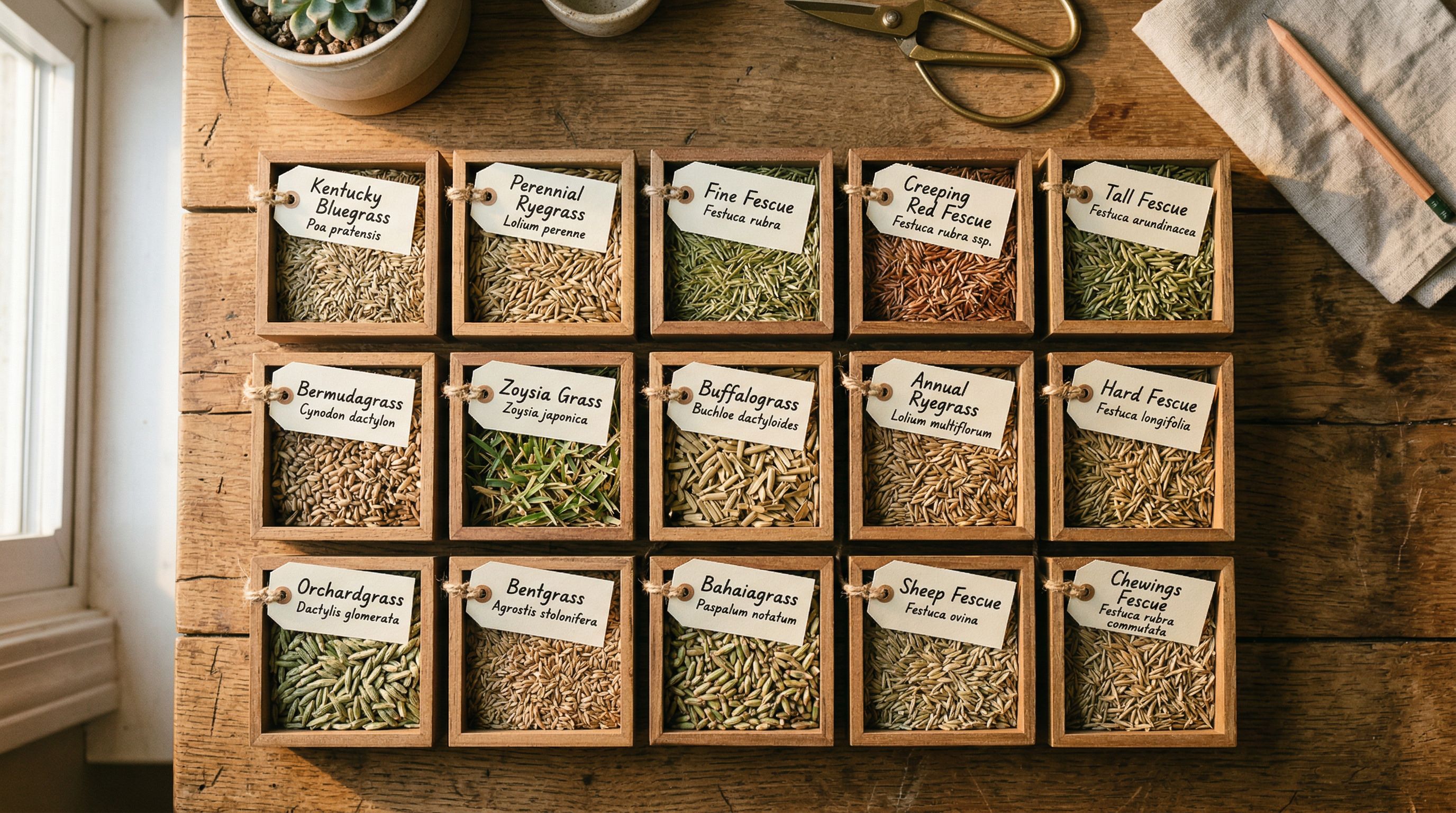
- Kentucky Bluegrass: The classic dark green lawn. Self-repairs through rhizomes. Needs full sun and moderate maintenance.
- Tall Fescue: Tough, drought-tolerant, adaptable. A strong all-around cool-season choice for most homeowners.
- Perennial Ryegrass: Germinates fast (5-7 days). Often blended with other species for quick establishment. Does not handle extreme cold.
- Fine Fescue: Best shade tolerance among the cool-season options. Low maintenance. Soft texture. Does not handle heat or heavy traffic well.
Warm-Season Grasses
Peak growth occurs in summer when soil temperatures are 80-95°F. They go dormant (turn brown) after the first hard frost and do not green up until soil temperatures consistently hit 65°F in spring. Best planted in late spring through early summer.
- Bermudagrass: The most widely planted warm-season grass. Aggressive growth, strong traffic tolerance, full sun required.
- Zoysiagrass: Dense, carpet-like feel. More shade-tolerant than bermuda. Slow to establish but durable once mature.
- St. Augustinegrass: Strong shade tolerance among warm-season grasses. Coarse texture. Only available as sod or plugs (not seed).
Step 3: Assess Your Sun Exposure
After zone, sun exposure is the biggest factor in seed selection. Most lawns have a mix of sun and shade, which is why blends exist.
Full Sun (6+ hours direct sunlight): You have the widest selection. Any species appropriate for your zone will work. This is where Kentucky bluegrass and bermuda really shine.
Partial Shade (3-5 hours direct sunlight): Choose shade-tolerant varieties. For cool-season lawns, tall fescue blends with some fine fescue are ideal. For warm-season, zoysia handles partial shade better than bermuda.
Heavy Shade (under 3 hours): Limited options. Fine fescue for cool-season climates. For warm-season, consider St. Augustine (sod only) or ground covers. Check our shade grass seed guide for detailed recommendations.
Warning
Do not overestimate your sun exposure. Most people think their yard gets more sun than it actually does. Spend a day tracking it — you might be surprised. A yard that "gets sun all morning" often only accumulates 3-4 hours of direct light.
Step 4: Determine Your Use Case
New Lawn from Scratch
Starting fresh gives you the most flexibility. You can choose the ideal species, prepare the soil properly, and seed at the optimal rate. Use a quality blend appropriate for your zone and sun exposure — do not cheap out on seed for a new lawn, since the per-square-foot cost difference between budget and premium seed is small compared to the total cost of soil prep, amendments, and your time. Pair your seed with a starter fertilizer for best results. If you have clay, sandy, or fill soil, your soil type determines which species will thrive — not just your climate zone.
Overseeding an Existing Lawn
Match your existing grass species as closely as possible. If your lawn is tall fescue, use a tall fescue blend. Mixing incompatible species creates an uneven appearance — different green shades, textures, and growth rates. The exception: adding fine fescue to shady areas of an otherwise tall fescue or KBG lawn, where the texture difference is less noticeable under tree canopy.
Patch Repair
For small bare spots, an all-in-one patch repair product that includes seed, mulch, and fertilizer is usually the most convenient option, and the germination rate on small patches makes the extra cost worth it for many homeowners. For larger bare areas (over 100 sq ft), standard seed with topsoil or peat moss is generally more economical.
High-Traffic and Sports Turf
If your lawn takes heavy use from kids, dogs, or sports, prioritize traffic tolerance over appearance. Tall fescue and perennial ryegrass handle wear best in cool-season zones. Bermudagrass is among the toughest warm-season options. KBG recovers from damage well through rhizomes but cannot handle the initial wear as well as fescue.
Step 5: Set Your Budget
Grass seed prices vary based on species, cultivar quality, and coating treatments — and the per-pound price is only part of the real cost once you factor in the labeled seeding rate. Here is roughly what separates the tiers:
Premium
Named cultivar blends with specific genetics selected for color, density, disease resistance, and regional performance. Often include mycorrhizal or moisture-retaining seed coatings. Examples: Jonathan Green Black Beauty Ultra, Barenbrug RTF Water Saver. Worth considering for front yards and smaller lawns where the per-square-foot cost is easier to absorb.
Mid-Range
Solid blends with decent cultivars. The big-box brands (Scotts, Pennington) live here. You get reliable germination, reasonable variety selection, and often a seed coating. This is the sweet spot for most homeowners — good enough quality at a price that does not sting when you are seeding 5,000+ square feet.
Budget
Commodity seed, often older cultivars. KY-31 tall fescue is the classic budget option — it grows aggressively, handles abuse, and costs a fraction of premium seed. The tradeoff is appearance: coarser blades, lighter color, and a less refined look. Fine for large rural properties, erosion control, or back yards where aesthetics are secondary. Not recommended for a front lawn you want to be proud of.
Pro Tip
Compare the total project cost, not just the per-pound sticker price. A premium seed applied at a lighter labeled seeding rate and a budget seed applied at a heavier rate can land closer together in total spend than the per-pound price suggests. Check the current label's application rate and the retailer's current price before deciding whether the quality difference is worth it for your project.
Our Top Recommendations
Based on seed-label review, extension guidance, and long-running owner feedback, here are candidates worth comparing across different categories and use cases. Confirm species, zones, and the current label against your own conditions before buying — catalog specs are a starting point, not a guarantee of fit.
| Spec | Scotts Turf Builder Thick'R Lawn Tall Fescue | Pennington Smart Seed Sun & Shade | Scotts Turf Builder Grass Seed Sun and Shade Mix | Scotts Turf Builder Bermudagrass |
|---|---|---|---|---|
| Brand | Scotts | Pennington | Scotts | Scotts |
| Grass Type | cool-season | cool-season | cool-season | warm-season |
| Species | Tall Fescue Blend | Tall Fescue / Perennial Ryegrass / Kentucky Bluegrass Mix | Perennial Ryegrass / Fine Fescue / Kentucky Bluegrass Blend | Bermudagrass |
| Germination | No germination-only range verified; manufacturer describes visible results in 2–3 weeks | 8–21 days (manufacturer estimate) | 6–12 days to first sprouts (manufacturer estimate) | 7–14 days (manufacturer estimate in suitable warm conditions) |
| Zones | 3, 4, 5, 6, 7 | 3, 4, 5, 6, 7, 8 | 3, 4, 5, 6, 7 | 7, 8, 9, 10 |
| Best For | Thickening an existing tall-fescue lawn with a combined seed, fertilizer and soil-improver application. | Existing or new cool-season lawns with four to six hours of sun and moderate shade, planted in a suitable spring or fall window. | A cool-season lawn with varied light where a blend of bluegrass, perennial ryegrass and fine fescues fits better than choosing only one species. | Full-sun southern lawns being started or thickened during warm soil conditions. |
"Best For" reflects the catalog description — confirm species fit against your own zone, sun, and soil conditions before buying.
Best for Beginners: Scotts Thick'R Lawn Tall Fescue
A unique 3-in-1 product combining grass seed, fertilizer, and soil improver in one bag. Designed for thickening existing tall fescue lawns without separate overseeding and fertilizing steps. The all-in-one approach makes it a straightforward option for beginners who want a simple solution. Works in zones 3-7 with full sun to partial shade.
Scotts Turf Builder Thick'R Lawn Tall Fescue
Scotts
Thick’R Lawn Tall Fescue combines seed, fertilizer and soil improver for an existing thin lawn. This 12-pound bag covers 1,200 square feet. Choose it for improving density where tall fescue already fits; Scotts specifically excludes bare-spot repair and new lawns.
Best Value: Pennington Smart Seed Sun & Shade
A solid balance of quality and price for yards with mixed sun and shade conditions. The water-saving coating is not just marketing — it is designed to reduce watering needs during establishment. Reliable germination and performance for the money. Works in zones 3-8.
Pennington Smart Seed Sun & Shade
Pennington
This review covers the seven-pound Smart Seed Sun & Shade package for fescue, ryegrass and bluegrass lawns, whose artwork shows up to 2,330 sq ft. It combines coated seed and fertilizer for areas receiving four to six hours of sun; check the bag because the current webpage contains conflicting coverage figures.
Most Popular: Scotts Turf Builder Sun & Shade Mix
One of the most widely available grass seeds in America. Scotts has the distribution to keep seed fresh in stores, and the WaterSmart Plus coating is designed to absorb more water than uncoated seed. It is not built around the enthusiast-brand cultivars, but it offers consistently solid performance with the easiest availability.
Scotts Turf Builder Grass Seed Sun and Shade Mix
Scotts
This 5.6-pound Sun & Shade Mix combines Kentucky bluegrass, perennial ryegrass and fine fescues with fertilizer and soil improver. It covers 745 square feet of new lawn or 2,240 of overseeding. The mixed-species approach is useful for varied light, but cannot make every deeply shaded spot a good lawn.
Warm-Season Pick: Scotts Turf Builder Bermudagrass
For zones 7-10 with full sun, bermudagrass is a default choice — and Scotts makes one of the more accessible seeded bermuda options. It establishes faster than zoysia, handles extreme heat, and creates a dense, traffic-tolerant turf. Keep in mind that bermuda goes brown in winter and spreads aggressively into garden beds.
Scotts Turf Builder Bermudagrass
Scotts
Scotts Turf Builder Bermudagrass combines seed, fertilizer and soil improver in one application. The 8 lb package is for sunny warm-season lawns; its 8,000 sq ft headline is overseeding coverage, not a new lawn.
Frequently Asked Questions
Can I mix cool-season and warm-season grass seed?
Not in a permanent blend. They grow at opposite times of year, so one species will always look dormant while the other is active. The one exception is overseeding a warm-season lawn with perennial ryegrass in fall for winter color — the rye dies back naturally when the bermuda or zoysia greens up in spring.
How much grass seed do I need?
For cool-season grasses: 6-8 lbs per 1,000 sq ft for new lawns, 3-4 lbs for overseeding. For bermudagrass: 1-2 lbs per 1,000 sq ft. Always check the bag for species-specific rates. Measure your lawn area before buying to avoid waste or running short.
Does the brand really matter?
Yes, more than most people think. Premium brands use named cultivars that have been tested at university turf trials for specific performance traits (NTEP trials). Budget seed often uses variety-not-stated (VNS) or older cultivars. Check the seed tag on the bag — it legally must list the exact cultivars and their percentages.
What time of year should I plant grass seed?
Cool-season grass: late August through mid-October (fall) is best. Spring (mid-March through April) is second best but brings more weed competition. Warm-season grass: late May through June when soil temperatures are consistently above 65°F. Planting outside these windows dramatically reduces your success rate.