
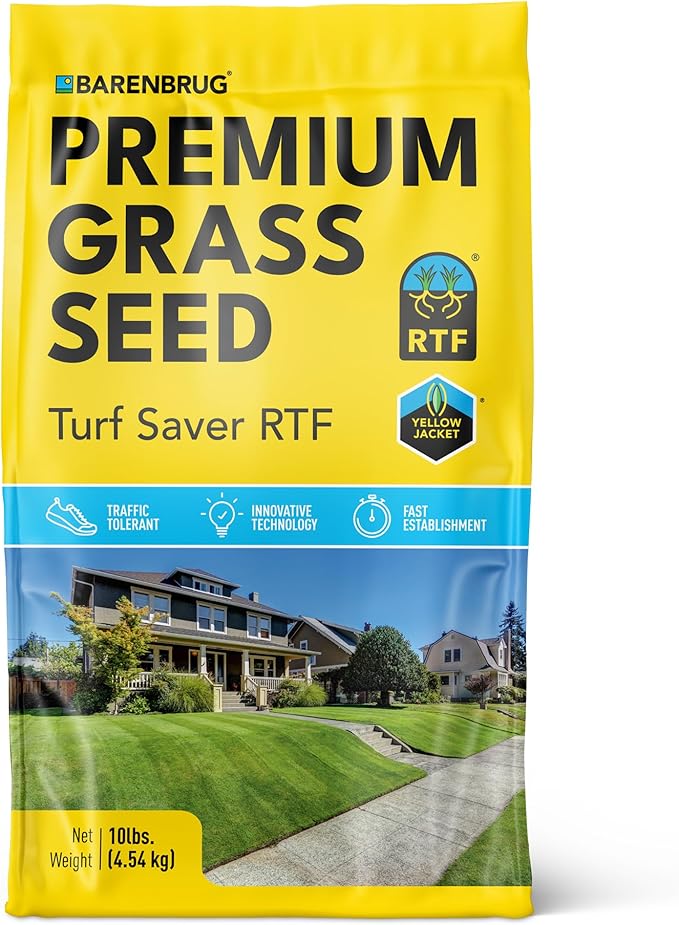
Barenbrug Turf Saver RTF
A tall-fescue blend to consider when you want RTF’s underground spreading habit, with realistic expectations about repair.
- A good fit for
- A lawn suited to tall fescue where the rhizomatous component is a useful extra.
- The tradeoff
- Self-repair is not a promise of bluegrass-like recovery or a guaranteed cut in watering.
We may earn a commission from purchases through our links. How this works
Buy on AmazonResearch-based review · Updated
All tall fescue, with a 60/40 formula
Barenbrug’s 2026 sheet describes 60% traditional turf-type tall fescues and 40% rhizomatous tall fescue. Both portions are tall fescue.[7]
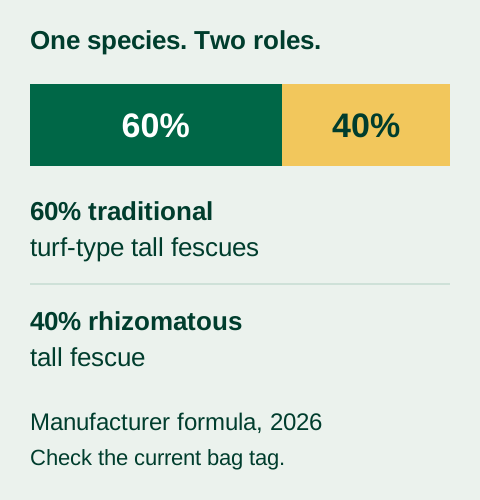
Read the formula and product-identity details
Turf Saver RTF is an all-tall-fescue blend. Barenbrug's current 2026 technical sheet describes 60% traditional turf-type tall fescues and 40% rhizomatous tall fescue. The distinction is within one grass species; this is not a fescue-and-bluegrass mixture. That matters if your goal is to keep a tall-fescue lawn rather than introduce a second species.
The current sheet names Bonfire and Zion among the varieties featured and marks those names subject to availability. Treat that as manufacturer information about the blend, not a guarantee that your delivered bag contains a fixed cultivar list. The seed analysis tag is the place to check names, purity, germination and the test date for the specific lot.
The name on this page is Turf Saver RTF. Barenbrug's store also lists Water Saver RTF separately, and the older research discussed below evaluated a Water Saver blend. Similar branding is not permission to merge their package directions or claim that a study tested today's Turf Saver. Keep the product name, coating option and bag label together when comparing listings.[7][8][9][5]
What the self-repair claim can tell you
- Manufacturer purpose
- RTF is marketed to help damaged turf regain density through rhizomes.[7]
- Independent limit
- The 2009 Kansas State study tested an older Water Saver blend, not the current Turf Saver bag.[9]
Read the recovery evidence in context
RTF stands for rhizomatous tall fescue. Rhizomes are underground stems that can produce new shoots, and Barenbrug markets this feature as a way to help damaged turf regain density. It gives the blend a clear reason to be considered alongside conventional tall fescues. It does not tell you how quickly a dog path or a large bare patch will disappear in your own lawn.
An independent Kansas State study published in 2009 provides a useful caution. It included an older Water Saver RTF blend containing Labarinth, other tall fescues and Kentucky bluegrass. The rhizomatous tall fescues and blend did not establish faster or spread farther than the comparison tall fescues under those study conditions. Kentucky bluegrass showed much stronger lateral expansion. This was not a test of the current Turf Saver formula, so it cannot settle the performance of the bag sold today.
The practical conclusion is modest: choose Turf Saver if tall fescue already suits your lawn and the RTF feature interests you. Do not make the purchase depend on a guaranteed recovery speed or assume that overseeding will never be necessary. A growth mechanism and a measured outcome are different kinds of information.[7][9]
Match the roots to the site
- Restricted soil
- CSU warns that shallow or poor soil can erase tall fescue’s expected irrigation advantage.[3]
- Winter ice
- Minnesota Extension advises against tall fescue where ice accumulates in winter.[2]
- Warm, wet summers
- NC State flags brown patch risk for tall fescue under hot, humid conditions.[10]
Read about water and regional limits
Tall fescue is attractive where deeper roots and useful heat tolerance fit the lawn's conditions. Colorado State describes turf-type tall fescue as drought-resistant and wear-tolerant, with reasonable shade use. But roots need room: the same guidance warns that shallow or poor soil can limit rooting enough for water demand to match or exceed Kentucky bluegrass. Buying a deep-rooted grass does not fix restricted soil by itself.
Barenbrug's technical sheet claims 30% water savings over comparable cool-season turfgrasses. That is an attributed manufacturer claim, not a household watering budget. It should not be translated into 30% less water while germinating seed, or a guaranteed reduction on every soil and in every climate. The sheet itself calls for a moist seedbed throughout germination.
Climate can also change the decision. Minnesota Extension notes tall fescue's drought and traffic tolerance but cautions against areas that hold winter ice. In North Carolina, extension guidance highlights brown patch in warm, humid weather. These are region-specific reasons to look beyond the package's broad stress-tolerance language. Start with your soil, winter conditions and summer disease pressure, then decide whether this tall-fescue blend fits.[3][7][2][10]
Plan pounds and check the coating option
- 1,000 sq ft
- 8–10 lb, using the manufacturer’s technical-sheet rate.[7]
- 2,000 sq ft
- 16–20 lb at that same rate; no extra buffer added.[7]
- Overseeding
- No distinct overseeding rate is given in the cited sheet. Check your bag rather than halve the rate by assumption.[7]
- Coated or uncoated
- Both options appear in Barenbrug’s store; the store says coating contributes to package weight.[8]
Read the quantity and seed-tag guidance
The 2026 Turf Saver technical sheet gives a seeding rate of 8–10 pounds per 1,000 square feet. On that published basis, a 2,000-square-foot project takes 16–20 pounds. The sheet does not give a separately labelled overseeding rate, so we do not invent a reduced one or repurpose another fescue's directions.
Barenbrug's direct store offers both Yellow Jacket-coated and uncoated versions. It says package weight includes coating and directs buyers to the same recommended seeding rate for those options. That is useful manufacturer guidance, but still check the exact bag you buy and the area it covers. Do not compare a coated bag with an uncoated bag simply by headline weight or assume a universal coating percentage.
For a meaningful seed comparison, use the current analysis tag. UMass explains how purity and germination describe different parts of usable seed, and why laboratory germination is not a field-survival guarantee. Measure the lawn first, decide whether it is a new stand or an existing lawn, then resolve any package-specific directions before ordering. The calculation here is a planning example from the technical sheet, not an automatic retail bag recommendation.[7][8][5]
From prepared soil to an established stand
Prepare
Find the cause of thinning and create contact between seed and soil.[4][7]
Keep moisture steady
The technical sheet calls for a moist seedbed through germination, especially after seed first takes up water.[7]
Allow development
A roughly 30-day stand and a fully established lawn are separate manufacturer milestones.[7]
Read the establishment milestones
The most useful part of the technical sheet is its separation of milestones. Barenbrug says germination should begin within 7–14 days and be complete within 21 days. It describes a stand establishing in about 30 days, then explicitly says the full turfgrass establishment process may take six months to a year. First green growth is not the endpoint of the project.
The sheet allows spring or fall seeding, and emphasizes good seed-to-soil contact, avoiding an obstructing thatch layer and keeping the seedbed moist. The planting window should still follow local conditions. Minnesota's renovation advice favors late summer to early fall for its region; North Carolina divides renovation timing between western areas and the Piedmont/coastal plain. A single national date would hide those differences.
Before seeding, diagnose why the old lawn thinned. Correcting compaction, shade or mowing problems may matter more than changing the seed. Then prepare the surface and distribute seed uniformly. Keep moisture consistent through germination and continue to manage the young stand afterward. Rhizomes are not a reason to skip establishment care or return heavy traffic as soon as seedlings appear.[7][4][10]
Keep care expectations realistic
Barenbrug recommends a 2.5–3-inch mowing height in the technical sheet and lists a separate ability to mow lower. Treat the recommendation as distinct from the lowest possible cut. Regional guidance may ask for more height: NC State's summer calendar recommends 3.5 inches for tall fescue. Match maintenance to location and season rather than automatically choosing the shortest number on a specification sheet.
Disease tolerance also does not remove disease risk. NC State describes how warm, humid weather favors brown patch and notes that gray leaf spot can produce similar symptoms. A declining patch needs diagnosis; neither a brand claim nor another seed application identifies its cause. For fertility, Minnesota renovation guidance uses soil testing to determine additional phosphorus and potassium. The point is to support the lawn you have, rather than buy every input associated with a premium seed.
If you want conventional tall fescue without choosing around a repair feature, compare The Rebels. If underground spreading is the overriding priority and Kentucky bluegrass suits your climate and maintenance plan, compare Midnight. Neither alternative is universally better: they answer different reasons you might reject this blend.[7][10][4][6][1][3]
When to choose something else
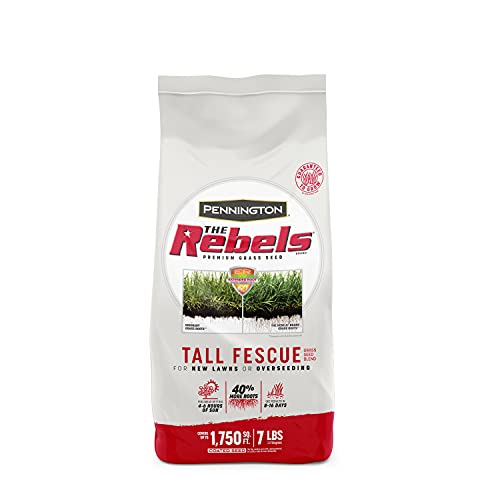
Pennington The Rebels Tall Fescue Mix
A different turf-type tall fescue blend to compare if the RTF repair feature is not the reason you are buying. Pennington specifies 4–6 hours of sun.

Outsidepride Midnight Kentucky Bluegrass
Compare named Midnight if Kentucky bluegrass suits the lawn and you prioritize its spreading habit. Budget for a slower start and ongoing maintenance.
Sources & research notes
This review draws on published product information and grass-selection guidance. We have not conducted a hands-on trial of this product. Species guidance helps explain the choice; it is not a trial of the bag you buy.
- Outsidepride: Midnight Kentucky Bluegrass planting guide
Read 2026-09-23
- University of Minnesota Extension: buying turfgrass seed
Read 2026-09-23
- Colorado State University Extension: turfgrass species selection
Read 2026-09-23
- University of Minnesota Extension: renovating a lawn
Read 2026-09-23
- UMass Extension: understanding the turfgrass seed label
Read 2026-09-23
- Pennington: The Rebels Tall Fescue Grass Seed Blend
Read 2026-09-23
- Barenbrug: Turf Saver RTF technical sheet B010726 (2026)
Read 2026-09-23
- Barenbrug Seed Store: Turf Saver RTF variants
Read 2026-09-23
- St. John et al. (2009): establishment and lateral spread of tall fescue cultivars
Read 2026-09-23
- NC State Extension: tall fescue maintenance calendar
Read 2026-09-23
Ready to compare the bag?
Check the package size and seed tag before ordering.