
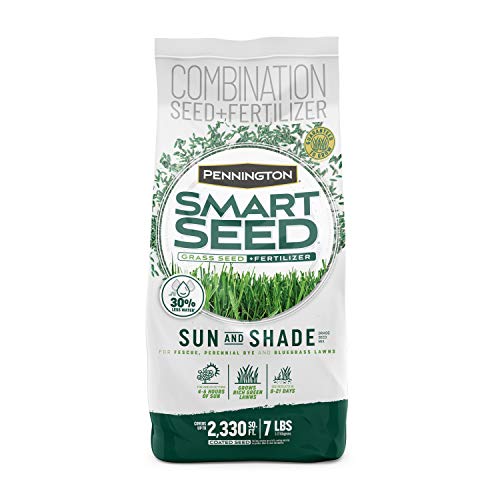
Pennington Smart Seed Sun & Shade
Consider it for a mixed-light cool-season lawn when you want a seed-and-fertilizer format and can verify the exact North package and planting directions.
- A good fit for
- Existing or new cool-season lawns with four to six hours of sun and moderate shade, planted in a suitable spring or fall window.
- The tradeoff
- Package versions and website coverage differ, and the seed mixture still needs preparation, establishment water and locally appropriate care.
We may earn a commission from purchases through our links. How this works
Buy on AmazonResearch-based review · Updated
Identify the North package before comparing coverage
- Southern Sun & Shade
- Item 100543723: 7 lb, up to 1,750 sq ft; a separately described Southern tall-fescue product.[3]
Read the package and formula distinction
The seven-pound package reviewed here is Smart Seed Sun & Shade for fescue, perennial rye and bluegrass lawns. Its official front artwork shows up to 2,330 square feet, coated seed and a seed-plus-fertilizer format. That is a more useful identifier than the short Sun & Shade name, which Pennington also uses for a Southern tall-fescue product.
The manufacturer's catalog makes the distinction explicit. Its seven-pound Sun & Shade entry, item 100543719, lists 2,330 square feet; Southern Sun & Shade, item 100543723, lists 1,750. The catalog is historical product documentation, not proof of current stock, but it helps connect the package artwork to the right version. Do not transfer the Southern coverage figure to this North listing.
Pennington's current product text names tall fescue, perennial ryegrass and Kentucky bluegrass. Package descriptions have changed over time, and the sample back panel leaves the seed-analysis area blank. That is why we do not promise exact cultivar names, percentages or a fixed four-species formula for the delivered lot. Read its seed tag if composition is a deciding factor.[1][2][3][6]
Four to six hours of sun is the useful boundary
Pennington specifies four to six hours of sunlight for this mix. Think of it as a product for a lawn with sun and moderate shade, rather than an answer to any area where other grass has failed. Measure light at grass level during the growing season, including shade from trees and buildings.
A species mixture can combine different characteristics, but that does not mean each component performs equally in every part of the yard. Extension guidance distinguishes the growth and repair habits of tall fescue, perennial ryegrass and Kentucky bluegrass. A mixture is not evidence that the entire stand will quickly fill every damaged patch or stay unchanged as shade and traffic vary.
Before reseeding, identify the reason the old lawn is thin. Compaction, drainage, repeated wear or inadequate light can keep defeating new seed. Where deep shade is the central problem, improving the site or reconsidering the planted surface may matter more than choosing a different retail bag. The manufacturer's moderate-shade specification should remain the boundary of this product recommendation.[1][8][9][5]
Seed coating and fertilizer are conveniences, not a water plan
This is a combination product rather than a bag of uncoated seed alone. Pennington describes a fertilizer-enhanced coating intended to support establishment. That format can simplify the planting purchase, but it does not replace soil preparation, correct spreading or moisture at the seedbed.
The brand also promotes up to thirty percent less water than ordinary grass seed once established. We present that as Pennington's marketing claim, with its established-lawn condition and unspecified ordinary-seed comparison. It is not an independent measurement of this delivered mixture in your yard, and it does not tell you how much water new seedlings will need.
Read the seed analysis and product directions before comparing bag weights or combining treatments. Coating and other material affect what a pound of packaged product represents. The included fertilizer also matters when planning additional feeding: use soil information and local recommendations rather than automatically adding a full separate starter program. Convenience at planting should not become an assumption that the lawn requires no further management.[1][2][6][5]
Use the planting table, while checking the package conflict
- 7 lb, new lawn
- About 778 sq ft using the table’s new-lawn rate.[1]
- 2,000 sq ft, new lawn
- 18 lb at the table’s rate.[1]
- 2,000 sq ft, overseeding
- 6 lb at the table’s rate.[1]
Read the conflicting website figures before buying
Pennington's current planting table specifies nine pounds per 1,000 square feet for new lawns and three pounds for overseeding. Applied to seven pounds, that is approximately 778 square feet of new lawn or 2,330 square feet of overseeding. The latter matches the official seven-pound artwork and catalog headline.
The page's main paragraph, however, discusses a fifteen-pound bag covering 1,250 square feet new or 3,750 overseeding. Those figures imply different rates. We keep that disagreement visible instead of silently combining the most generous numbers. The calculations here follow the nine/three-pound table and the matching seven-pound artwork; confirm the directions on the bag actually supplied before applying seed.
For a 2,000-square-foot area, the table-based quantities are eighteen pounds for new ground or six pounds for overseeding. Separate bare portions from areas that only need thickening, and measure the treated area rather than the entire property. These are packaged-product calculations, not raw-seed or pure-live-seed equivalents, and a coverage headline alone does not establish a planting rate for every version.[1][2][3][6]
Prepare for a mixed stand to develop
Pennington recommends early spring or early fall, with eight to twenty-one days for germination. Use local weather and regional seeding guidance to choose the actual window. An early green response is not the same as a mature lawn, especially when a mixture contains grasses with different establishment speeds.
For new ground, the manufacturer calls for removing debris and loosening and smoothing the surface. For thin existing turf, its instructions add mowing and debris removal before raking. Spread the measured combination product evenly, rake gently and follow the quarter-inch planting-depth specification. Seed left above a layer of debris does not gain good soil contact just because it is coated.
Keep soil moist as needed until the grass sprouts and reaches about three inches, as Pennington directs. Adjust watering to the actual soil and weather instead of treating a fixed daily volume as universal. Limit unnecessary traffic while seedlings develop, and check the label of any weed treatment for its timing around seeding. Do not use the earliest germination estimate as permission to resume every established-lawn routine.[1][5][8]
Choose the mature lawn you are willing to maintain
The product page lists a three-inch mowing height. That is a useful starting point, but the actual mixture, season and site still shape maintenance. Follow local cool-season guidance, keep the mower appropriate for the stand and diagnose persistent weak areas rather than repeatedly adding seed without changing the conditions.
A general sun-and-shade mixture also differs from deliberately choosing a fine-fescue lawn for lighter use and lower inputs. Legacy Fine Fescue combines hard, Chewings and creeping red fescues as raw seed. It is a meaningful alternative when those species fit the climate and lower traffic is expected, rather than simply another bag with shade in its description.
Legacy retains fine fescue's heat and wear limits, so it is not an automatic upgrade. The choice is between different grass compositions and planting formats. Smart Seed's case is a convenient coated seed-and-fertilizer mixture for moderate shade and sun; the final decision should follow the light, existing grass, intended use and verified package directions.[1][4][7][8][5]
When to choose something else
Outsidepride Legacy Fine Fescue Mix
Compare Legacy for a deliberately chosen fine-fescue lawn with modest traffic and suitable climate. Its raw hard, Chewings and creeping-red blend is a different grass and maintenance choice.
Sources & research notes
This review draws on published product information and grass-selection guidance. We have not conducted a hands-on trial of this product. Species guidance helps explain the choice; it is not a trial of the bag you buy.
- Pennington: Smart Seed Sun and Shade product and planting specifications
Read 2026-09-23
- Pennington: 7 lb Smart Seed Sun and Shade package artwork
Read 2026-09-23
- Pennington manufacturer catalog: Smart Seed Sun & Shade and Southern Sun & Shade
Read 2026-09-23
- Outsidepride: Legacy Fine Fescue product and planting guide
Read 2026-09-23
- University of Minnesota Extension: renovating a lawn
Read 2026-09-23
- UMass Extension: understanding the turfgrass seed label
Read 2026-09-23
- Colorado State University Extension: Fine fescues for lawns
Read 2026-09-23
- University of Minnesota Extension: buying turfgrass seed
Read 2026-09-23
- Colorado State University Extension: turfgrass species selection
Read 2026-09-23
Ready to compare the bag?
Check the package size and seed tag before ordering.