
Spring seedhead field guide
Is My Lawn Going to Seed or Is It Poa Annua?
Pale seedheads in May can make a good lawn look like it is falling apart. Sometimes it is normal Kentucky bluegrass, tall fescue, or ryegrass doing spring seedhead things. Sometimes it is Poa annua. And sometimes the seedheads are a distraction from a different problem: Poa trivialis hiding as lime-green, wet, soft patches.
Signature field test
The S.S.S. Test
Do not diagnose from one blurry seedhead. Read the lawn in three passes: seedheads, stolons, then what happens when summer stress arrives.
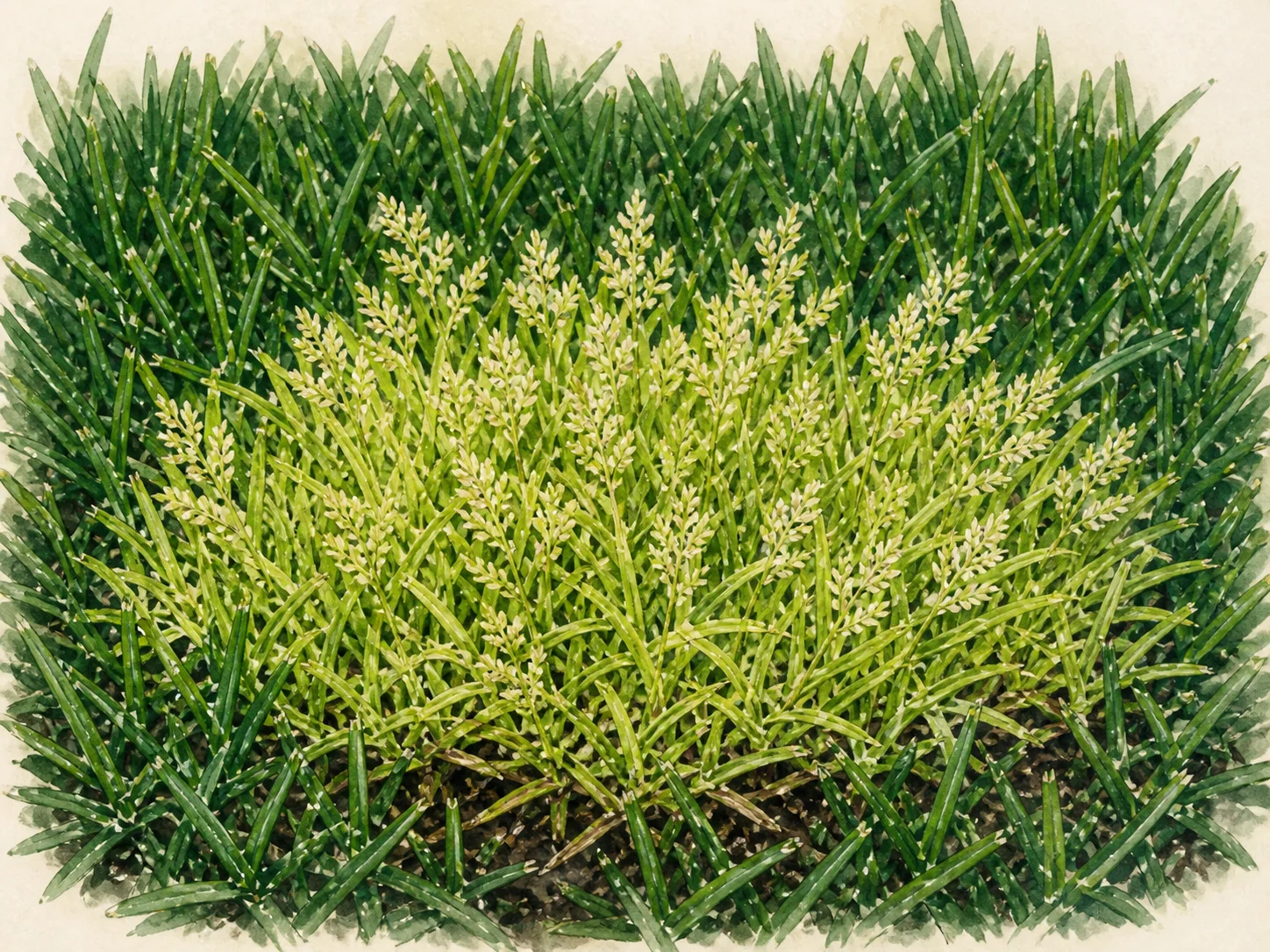 1
1Look for a pale haze sitting low in lighter clumps.
Seedheads
Low, pale, heavy seedheads point toward Poa annua.
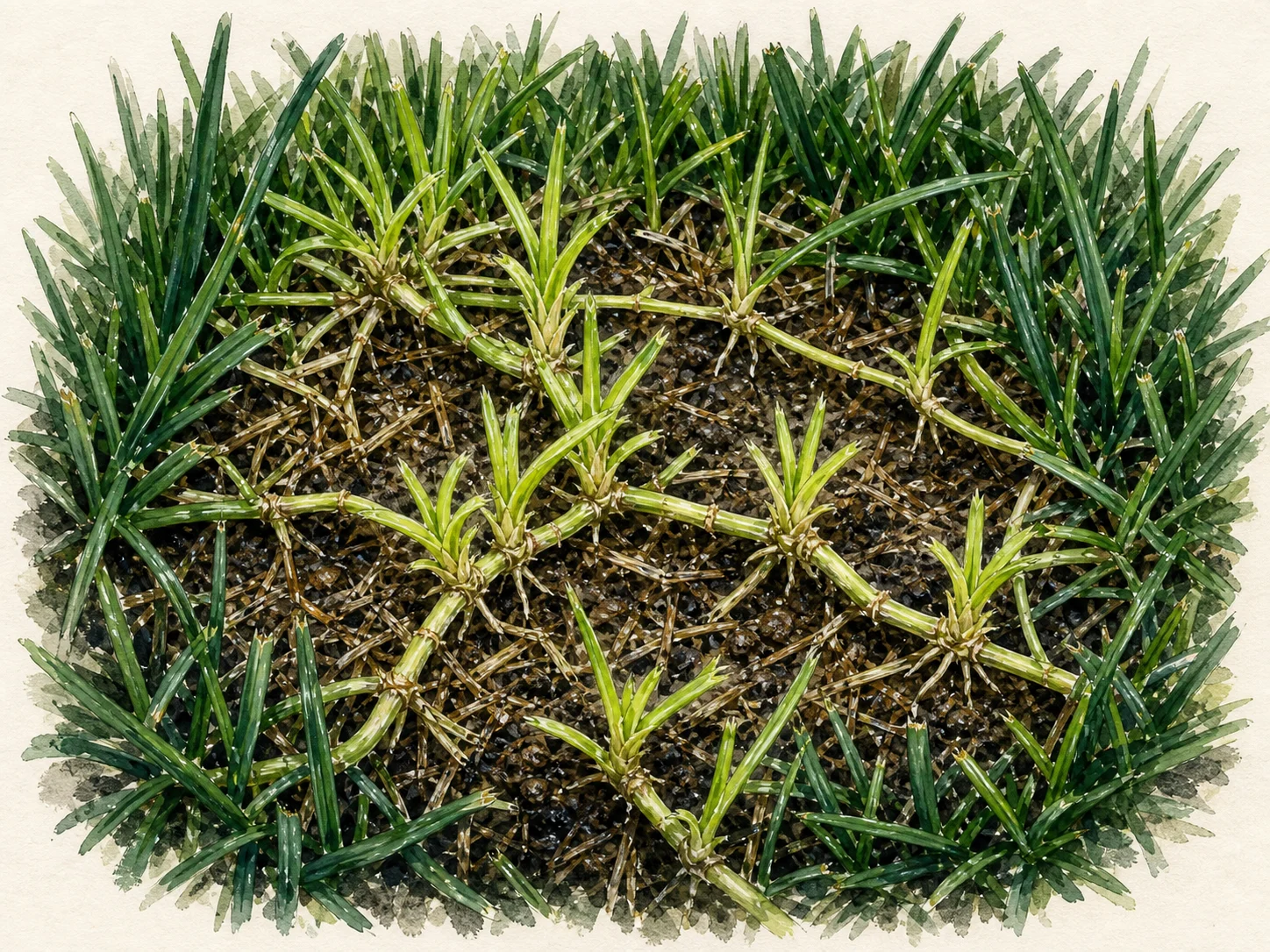 2
2Part the patch and look at the soil surface.
Stolons
Above-ground runners point toward Poa trivialis.
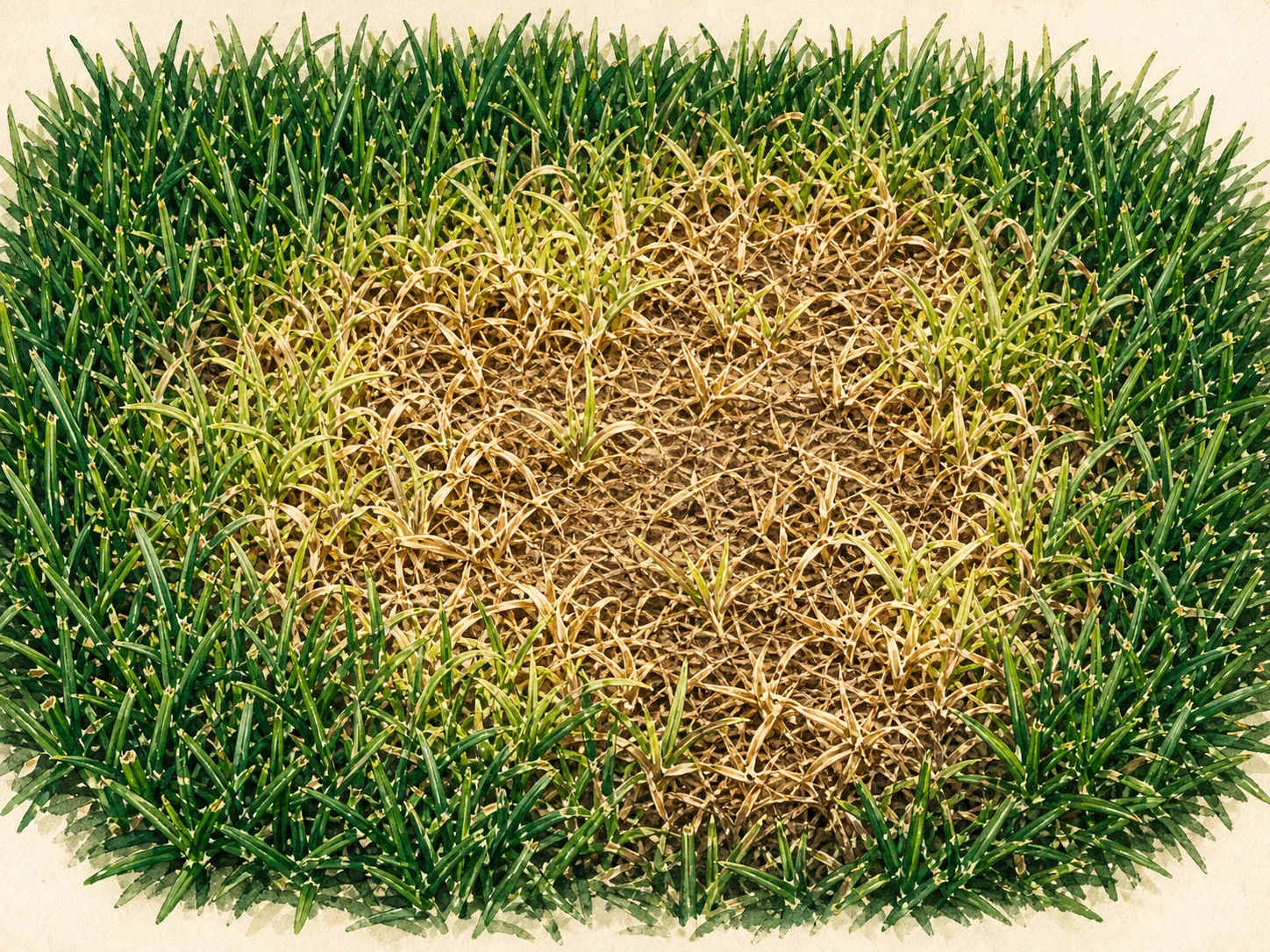 3
3Map the same patch again when heat stress arrives.
Summer
Heat decline helps confirm the pattern before fall work.
These illustrations are pattern cues, not stand-alone botanical ID. Confirm the pattern before treating, especially before herbicide or renovation work.
The Fast Answer
Do not panic from seedheads alone
If the whole lawn is making spring seedheads, it may be normal turf behavior.
Kentucky bluegrass can go to seed in spring. Poa annua usually gives you a different pattern: many low, greenish-white seedheads in lighter green clumps, often in cool, moist, compacted, or thin areas. Poa trivialis usually shows up more as lime-green, soft, matted patches with above-ground runners than as a seedhead haze in a regularly mowed lawn.
Likely normal
Seedheads are fairly uniform and the grass color mostly matches the rest of the lawn.
Poa annua clue
Seedheads are low, pale, dense, and sitting in lighter apple-green clumps.
Poa trivialis clue
You see lime-green, soft, shiny patches and can find stolons at the soil surface.
Quick Comparison Table
The point is not to name a grass from across the driveway. The point is to sort the evidence before you mow too low, spray the wrong thing, or overseed into the same conditions that created the problem.
Seedhead panic decoder
Kentucky Bluegrass vs Poa Annua vs Poa Trivialis
| Grass | Main clue | Seedheads | Growth habit | Field check | What to do |
|---|---|---|---|---|---|
| Kentucky bluegrass seedheads | The lawn mostly looks like itself, but seed stalks rise and mow ragged for a few weeks. | Spring panicles can be normal in cool-season turf. | Perennial, rhizomatous turf that forms a sod. | Look for underground rhizomes and a short, blunt membranous ligule. | Mow normally with a sharp blade. Do not scalp. |
| Poa annua | Lots of low, pale seedheads sitting in lighter green clumps or patches. | Prolific greenish-white spring seedheads, often at mowing height. | Usually bunch-type winter annual; can sometimes be stoloniferous or perennial. | Shallow, fibrous clumps plus folded leaves and boat-shaped tips. | Mow and bag during a heavy seedhead flush if practical. Avoid panic spraying. |
| Poa trivialis | Lime-green, soft, matted patches are more obvious than seedheads in mowed lawns. | Can seed, but mowed lawns often show patches and stolons before obvious seedheads. | Perennial rough bluegrass spreading by above-ground stolons. | Part the patch and look for white trailing tillers or stolons at the soil surface. | Mark the patch, inspect stolons, and reduce wet/shady stress where possible. |
Kentucky bluegrass seedheads
- Main clue
- The lawn mostly looks like itself, but seed stalks rise and mow ragged for a few weeks.
- Color
- Usually similar to the surrounding lawn, though cut stalks can leave a pale cast.
- Seedheads
- Spring panicles can be normal in cool-season turf.
- Growth habit
- Perennial, rhizomatous turf that forms a sod.
- Field check
- Look for underground rhizomes and a short, blunt membranous ligule.
- Typical location
- Broadly through a KBG lawn or cultivar patches, not only wet compacted spots.
- What to do now
- Mow normally with a sharp blade. Do not scalp.
- Long-term fix
- Ride out the seedhead flush and maintain density.
Poa annua
- Main clue
- Lots of low, pale seedheads sitting in lighter green clumps or patches.
- Color
- Light or apple green compared with surrounding turf.
- Seedheads
- Prolific greenish-white spring seedheads, often at mowing height.
- Growth habit
- Usually bunch-type winter annual; can sometimes be stoloniferous or perennial.
- Field check
- Shallow, fibrous clumps plus folded leaves and boat-shaped tips.
- Typical location
- Cool, moist, compacted, thin, shaded, irrigated, or edge areas.
- What to do now
- Mow and bag during a heavy seedhead flush if practical. Avoid panic spraying.
- Long-term fix
- Plan fall prevention or density repair; expect multi-season reduction.
Poa trivialis
- Main clue
- Lime-green, soft, matted patches are more obvious than seedheads in mowed lawns.
- Color
- Yellow-green to lime green; sometimes shiny on the underside.
- Seedheads
- Can seed, but mowed lawns often show patches and stolons before obvious seedheads.
- Growth habit
- Perennial rough bluegrass spreading by above-ground stolons.
- Field check
- Part the patch and look for white trailing tillers or stolons at the soil surface.
- Typical location
- Wet shade, drainage swales, overwatered turf, compacted moist soil.
- What to do now
- Mark the patch, inspect stolons, and reduce wet/shady stress where possible.
- Long-term fix
- Correct site conditions, then spot remove or renovate and reseed.
Why Cool-Season Lawns Make Seedheads in Spring
Spring seedheads are a normal seasonal event for several cool-season grasses. Purdue describes seedhead production in Kentucky bluegrass, tall fescue, and perennial ryegrass as a natural daylength-induced phenomenon. MSU Extension makes the same broad point: common lawn grasses make seedheads, and so do grassy weeds like annual bluegrass.
That is why the first answer is usually: keep mowing, keep the blade sharp, and do not lower the deck to chase seedheads. Seed stalks are tough and often cut ragged, which can leave the lawn looking pale after mowing even when the grass is desirable turf.
Normal does not mean pretty
What Poa Annua Seedheads Look Like
Poa annua, or annual bluegrass, is usually a winter annual in home lawns. Purdue describes it as germinating in late summer or early fall, overwintering, then flowering and producing seed in late spring and early summer. It is often lighter green than the surrounding lawn and can produce seedheads at mowing height.
The color clue
Light or apple-green clumps stand out from darker Kentucky bluegrass, tall fescue, or ryegrass.
The seedhead clue
Greenish-white seedheads sit low and keep showing up during the spring flush.
The site clue
Cool, wet, compacted, thin, shaded, or irrigated areas are common starting points.
The timing clue
Spring is when it is easiest to notice, but fall is usually the prevention window.
Purdue also notes a complication worth keeping in your head: not every Poa annua behaves like a clean one-year weed. Perennial biotypes can occur, especially in northern or irrigated turf. That is why the honest language is "usually" and "points toward," not guaranteed ID from one photo.
How Kentucky Bluegrass Seedheads Are Different
Kentucky bluegrass is also a Poa species, so the names get confusing fast. It can make spring seedheads, and Penn State lists its seedhead color as greenish-white too. The better clues are the whole-plant pattern: Kentucky bluegrass is a perennial sod-former with underground rhizomes, while Poa annua is usually a lighter, shallower, seed-heavy clump problem.
If the seedheads are scattered through a mostly uniform Kentucky bluegrass lawn, the grass color matches, and the issue fades after the spring flush, treat it as temporary ugliness. If the seedheads sit in low light-green clumps that come back in the same compact/wet/thin areas, Poa annua is more likely.
Close inspection matters
Where Poa Trivialis Fits In
Poa trivialis, or roughstalk bluegrass, is the one that causes a different kind of homeowner panic. It is not mainly a spring seedhead haze in a mowed lawn. It is a perennial patch grass that spreads by above-ground stolons, favors wet or shaded areas, and can look lime-green, soft, shiny, and matted.
University of Maryland notes that roughstalk bluegrass may go dormant during droughts or summer heat, leaving thin turf before returning in cooler fall weather. Heavy rain followed by hot sun can make it collapse into brown mats. CSU makes the same practical point: it can look dead in summer and revive when cooler weather returns.
That is why the stolon check matters. If you find runners, move to the Poa Recovery Calendar before you assume fall pre-emergent is the whole answer.
The 5-Minute Yard Test
Walk outside with your mower height in mind, but do not start by cutting lower. Start by proving the pattern.
Five-minute yard test
Start with what you can prove outside
A phone photo is useful, but a hand lens, a pull test, and a wet/shade map are better.
Seedheads everywhere?
Uniform taller seedheads that match the lawn usually mean normal turf seedheads. Low pale haze in lighter clumps points toward Poa annua.
No seedheads, but lime patches?
Soft, shiny, matted patches in wet shade should trigger the stolon check for Poa trivialis.
Runners at the soil surface?
Above-ground runners change the plan. Treat it as a perennial patch problem, not just a fall seedbank problem.
Summer collapse?
Mark the area. Summer decline is useful evidence, but confirm before treating because drought and disease can mimic Poa stress.
- 1. Check seedhead height. Low, repeated, pale seedheads in light clumps point toward Poa annua.
- 2. Check color. Apple-green or lime-green patches deserve closer inspection.
- 3. Pull a small clump. Shallow clumps lean Poa annua; runners at the surface lean Poa trivialis.
- 4. Map the site. Wet shade, compacted edges, drainage swales, and overwatered zones are not random.
- 5. Save a photo. Compare the same spot in summer and again next spring.
Should You Mow and Bag Seedheads?
Yes, but keep the promise small. Mowing and bagging can reduce the amount of visible seed and debris returned to the lawn during a heavy Poa annua flush. It does not remove seed already in the soil, and it does not fix compacted wet turf.
Do this
- Mow frequently enough that seedheads do not tower over the lawn.
- Use a sharp blade so stalks cut as cleanly as possible.
- Bag during a heavy suspected Poa annua seedhead flush.
- Return to normal clipping recycling once the seedhead flush passes.
Do not do this
- Do not scalp the lawn to remove seedheads.
- Do not assume fungicide fixes a Poa identification problem.
- Do not spray random herbicides without confirming the label and turf species.
- Do not overseed blindly into active Poa trivialis patches.
What to Do This Fall
Once you know whether you are dealing with normal seedheads, Poa annua, or Poa trivialis, use the Poa Recovery Calendar to decide what to do in spring, summer, and fall.
Fall timing conflict
Pre-emergent and overseeding can fight each other
Poa annua prevention often happens right when cool-season lawns want repair seed. Read the label before mixing those goals in the same soil.
Prevent
Use label-approved pre-emergent before Poa annua germinates. Do not seed that same area unless the label allows it.
Repair
Skip incompatible barriers where you need new turf to germinate, then focus on density and follow-up prevention.
Split zones
Pre-emerge chronic Poa zones and seed renovation zones separately instead of treating the whole lawn as one block.
Confirm
If stolons point toward Poa trivialis, pre-emergent is not the main fix for established patches.
If the problem is Poa annua, fall prevention may matter. If the problem is a bare or thin lawn, fall overseeding may matter. Many pre-emergents can prevent desirable grass seed from germinating too, so choose a zone-by-zone plan instead of trying to do everything everywhere.
Seed strategy after Poa pressure
Repair with the site, not just the species name
- Full sun, drought swings: choose turf-type tall fescue or a TTTF-heavy blend.
- Premium irrigated KBG lawn: use a Kentucky bluegrass blend only if you can wait for slow establishment.
- Mixed cool-season repair: a TTTF/KBG mix can balance speed, durability, and some self-repair.
- Shade: consider fine fescue or shade-tolerant mixes, but fix wet shade first.
- Questionable bag label: check weed seed, other crop, noxious weeds, cultivars, and test date before blaming the lawn.
For the label side of this decision, use the Seed Label Lab before buying repair seed.
FAQ
Is it bad if my lawn is going to seed?
Not always. Kentucky bluegrass, tall fescue, and perennial ryegrass can produce spring seedheads naturally. Heavy low pale seedheads in lighter green clumps are more suspicious for Poa annua.
Does Kentucky bluegrass go to seed in spring?
Yes. Kentucky bluegrass is one of the cool-season grasses that can produce spring seedheads. The key is whether the seedheads are fairly uniform in desirable turf or concentrated in light-green Poa-like patches.
What does Poa annua look like in spring?
Poa annua usually looks lighter or apple green, forms small clumps, and produces many low greenish-white seedheads in spring, often even under regular mowing.
Should I bag Poa annua seedheads?
Bagging while seedheads are heavy is reasonable damage control because it may reduce seed returned to the lawn. It is not a full cure and does not erase seed already in the soil.
Can mowing spread Poa annua?
Poa annua seed can move by mowing and other traffic, especially once seed is mature. Mow with a sharp blade, avoid scalping, and consider bagging during a heavy seedhead flush.
Is Poa annua the same as Poa trivialis?
No. Poa annua is usually a seed-producing winter annual problem. Poa trivialis is a perennial rough bluegrass that spreads by stolons and often shows up as soft lime-green patches in wet or shady areas.
Can Poa annua come from grass seed?
It can be introduced in contaminated seed, but that is not the only route. Existing seedbank, soil movement, equipment, neighboring lawns, and compact wet conditions can all contribute.
Can I overseed over Poa annua?
Sometimes, but do not ignore timing. Fall Poa annua prevention and cool-season overseeding can conflict because many pre-emergents prevent desirable seed from germinating too.
Research Sources
This guide synthesizes university extension turfgrass guidance on spring seedheads, annual bluegrass, roughstalk bluegrass, mowing, seed labels, and fall prevention timing.
- Purdue / Illinois AY-41-W - Annual bluegrass and rough bluegrass in lawns
- Purdue Turfgrass Science - Seedheads Make for Tough Mowing
- Michigan State University Extension - Seedheads in lawns
- University of Maryland Extension - Annual Bluegrass
- University of Maryland Extension - Roughstalk Bluegrass
- Penn State Plant ID - Annual Bluegrass
- Penn State Plant ID - Kentucky Bluegrass
- University of Maryland Extension - Grass Seed
Related Guides