
Seasonal recovery plan
The Poa Recovery Calendar
Poa control is mostly a timing problem. The right move in spring is usually not the right move in fall. Poa annua behaves like a seedbank and prevention problem. Poa trivialis behaves like an established perennial patch problem. This calendar keeps those two paths separate so you can recover the lawn without wrecking the seed window.
Signature field test
The S.S.S. Test
Do not diagnose from one blurry seedhead. Read the lawn in three passes: seedheads, stolons, then what happens when summer stress arrives.
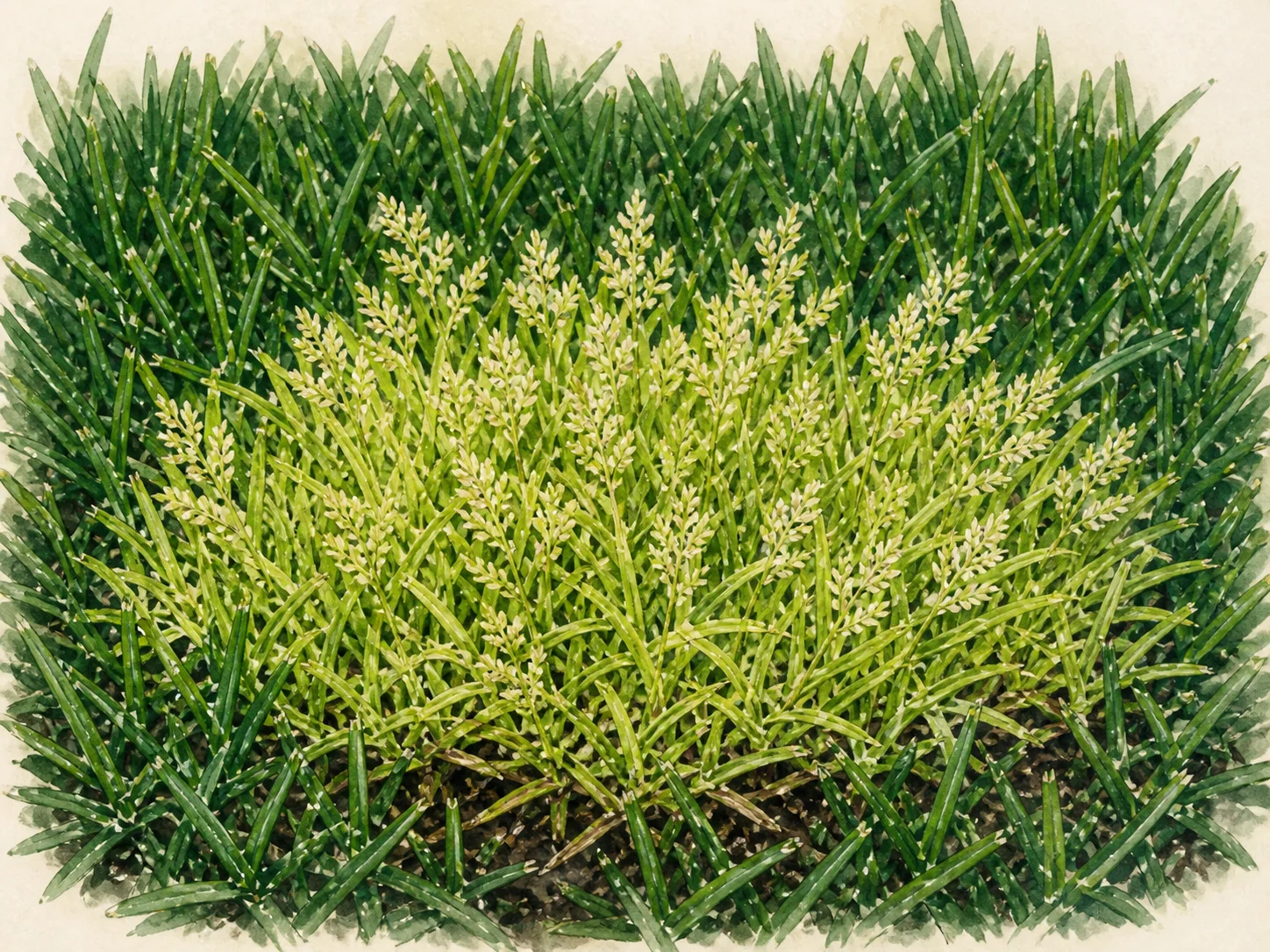 1
1Look for a pale haze sitting low in lighter clumps.
Seedheads
Low, pale, heavy seedheads point toward Poa annua.
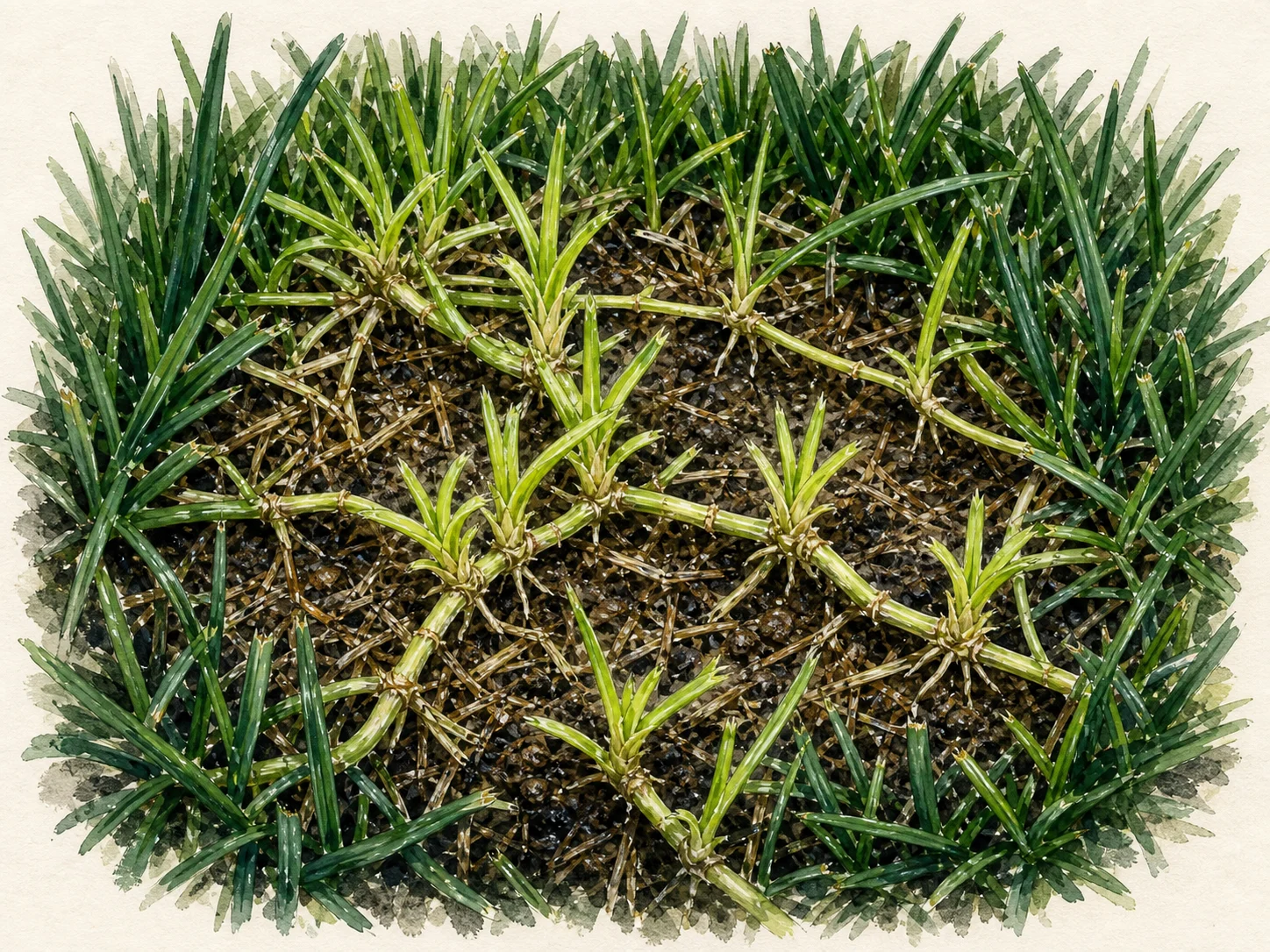 2
2Part the patch and look at the soil surface.
Stolons
Above-ground runners point toward Poa trivialis.
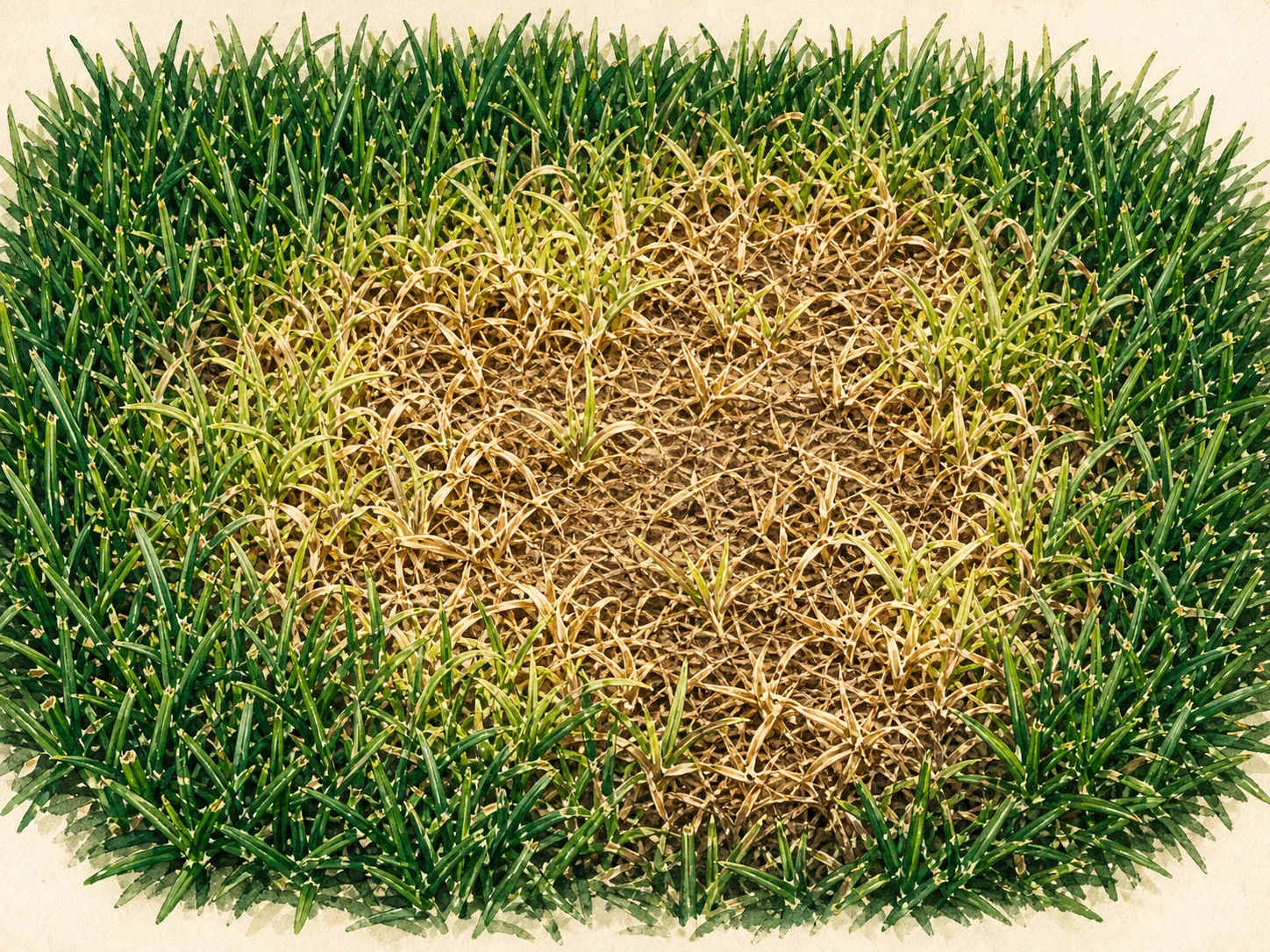 3
3Map the same patch again when heat stress arrives.
Summer
Heat decline helps confirm the pattern before fall work.
These illustrations are pattern cues, not stand-alone botanical ID. Confirm the pattern before treating, especially before herbicide or renovation work.
The Fast Answer
Season first, product second
Spring is mostly identify, mow, bag, mark, and stop making the site friendlier to Poa.
Summer helps reveal which patches decline, mat, or return. Late summer and fall are the main windows for Poa annua prevention, Poa trivialis renovation, and cool-season repair seeding. Winter is for reviewing notes. Next spring is the audit.
Poa annua
Think seedheads, seedbank, fall pre-emergent timing, and dense desirable turf.
Poa trivialis
Think stolons, wet shade, summer collapse, spot removal, and site correction.
Normal seedheads
Think sharp blade, normal mowing height, patience, and no panic treatment.
Quick Diagnosis Before the Calendar
Still not sure which grass you have? Start with our guide to lawn seedheads, Poa annua, and Kentucky bluegrass before choosing a control path.
Seedheads everywhere
Likely normal turf seedheads if color and pattern are uniform; likely Poa annua if low, pale, and concentrated in light clumps.
Lime-green soft patches
Points toward Poa trivialis when the patch is wet, shaded, matted, shiny underneath, or connected by stolons.
Summer thinning
Useful evidence for Poa pressure, but not proof by itself. Drought, disease, and irrigation misses can mimic it.
Bare area after removal
That is a repair site. Choose seed and timing only after you know whether pre-emergent is part of the plan.
The Seasonal Recovery Calendar
Treat the lawn as zones, not one big rectangle. Some areas may need fall pre-emergent. Some may need seed. Some Poa trivialis patches may need removal before any seed belongs there.
Seasonal recovery calendar
The right Poa move changes by season
Spring
Identify and reduce seed return
- Poa annua
- Confirm low pale seedheads, mow normally, bag during heavy seedhead flushes, and avoid scalp damage.
- Poa trivialis
- Look for lime-green soft patches, shiny undersides, and stolons in wet or shady zones.
- Seed / repair move
- Do not rush a full overseed into active Poa pressure. Mark areas and save photos.
Late spring / early summer
Watch the stress response
- Poa annua
- See whether shallow light-green clumps thin as heat and drought increase.
- Poa trivialis
- Watch for browning, matting, or collapse after wet weather followed by heat.
- Seed / repair move
- Audit irrigation, drainage, shade, and compaction before buying seed.
Summer
Choose tolerance, suppression, or renovation
- Poa annua
- Minor pressure can be tolerated while you plan fall prevention. Heavy pressure needs a multi-year plan.
- Poa trivialis
- Small patches can be marked for removal. Large patches need renovation math and site correction.
- Seed / repair move
- Decide whether each zone is a prevention zone, repair zone, or live-with-it zone.
Late summer / fall
Main prevention and repair window
- Poa annua
- Apply label-approved pre-emergent before germination where you are not seeding.
- Poa trivialis
- Spot remove or renovate patches, rake dead material, prep soil, and reseed corrected areas.
- Seed / repair move
- Use high-quality seed with a clean label. Do not put incompatible pre-emergent where seed must germinate.
Winter
Review and plan
- Poa annua
- Expect fall-germinated plants to overwinter where prevention missed.
- Poa trivialis
- Expect established perennial patches to persist quietly under winter conditions.
- Seed / repair move
- Review photos, seed labels, and zone notes so spring does not become guesswork again.
Next spring
Evaluate the loop
- Poa annua
- Compare seedhead pressure to last spring and repeat fall prevention if needed.
- Poa trivialis
- Check whether repaired patches stayed clean or wet/shade conditions recreated the problem.
- Seed / repair move
- Patch only after diagnosis. Dense desirable turf is the long-term defense.
Spring Plan: Identify, Mow, Bag, and Avoid Panic
Spring is when Poa annua gets loud. Purdue notes that annual bluegrass is especially visible in May and June because of prolific seedhead production. University of Maryland also notes that spring management options are limited because annual bluegrass forms seedheads early.
- Identify the pattern. Seedheads, stolons, and summer behavior are separate clues.
- Mow normally. Keep the mower high enough for the desirable turf and use a sharp blade.
- Bag strategically. Bag suspected Poa annua seedheads while they are heavy, then return to normal clipping management later.
- Avoid overwatering. Wet, compact, thin turf favors both Poa problems in different ways.
- Mark the zones. Flags and photos make fall decisions much easier.
Summer Plan: Decide Between Tolerance, Suppression, or Renovation
Summer is not just waiting. It is the stress test. Poa annua may thin or die in heat and drought, though perennial biotypes can persist. Poa trivialis often browns, mats, or goes dormant in heat, then returns when conditions cool.
Minor Poa annua
Tolerate for now, improve density, and prepare a fall prevention strategy for chronic areas.
Heavy Poa annua
Plan multi-year suppression. Decide whether fall is for prevention, seeding, or split-zone work.
Minor Poa trivialis
Correct water, shade, and compaction. Spot repair only if you can remove the patch cleanly.
Heavy Poa trivialis
Plan spot-kill, sod-cutting, or partial renovation. Reseed only after the site stops favoring trivialis.
Late Summer and Fall: The Main Recovery Window
Purdue AY-41 places annual bluegrass germination in late summer or early fall when soil temperatures drop below about 70 degrees F, which is why pre-emergent timing matters. That is also exactly when cool-season lawns often need seeding.
Poa annua fall plan
- Use label-approved pre-emergent before germination where you are not seeding.
- Build turf density with correct mowing, irrigation, and fall fertility.
- Seed thin areas only where the seed can actually germinate.
- Expect repeat work over multiple seasons.
Poa trivialis fall plan
- Spot remove or nonselectively treat patches only when you are ready to repair.
- Rake or cut out dead material and prep the seedbed lightly.
- Fix irrigation, drainage, and shade pressure before reseeding.
- Choose seed for the corrected site, not the wishful version of the site.
Pre-Emergent vs Overseeding Conflict
This is the tradeoff that causes the most expensive mistakes. University of Maryland is direct: pre-emergent timing for annual bluegrass can make sowing grass seed impossible in that treated window unless the product label specifically supports your seeding plan.
Fall timing conflict
Pre-emergent and overseeding can fight each other
Poa annua prevention often happens right when cool-season lawns want repair seed. Read the label before mixing those goals in the same soil.
Prevent
Use label-approved pre-emergent before Poa annua germinates. Do not seed that same area unless the label allows it.
Repair
Skip incompatible barriers where you need new turf to germinate, then focus on density and follow-up prevention.
Split zones
Pre-emerge chronic Poa zones and seed renovation zones separately instead of treating the whole lawn as one block.
Confirm
If stolons point toward Poa trivialis, pre-emergent is not the main fix for established patches.
A practical plan might pre-emerge the chronic Poa annua strip near the driveway, seed the spot-killed Poa trivialis patch under the maple, and leave healthy turf alone. Whole-lawn shortcuts are tempting, but Poa recovery is usually zone work.
Best Seed Choices After Poa Damage
Seed is the recovery step after the diagnosis. A clean, high-quality label reduces risk, but it does not make a wet, compact, shady Poa trivialis site behave like a sunny test plot. Match seed to the corrected site.
Seed strategy map
- Sunny, drought-prone cool-season lawn: TTTF-heavy blend.
- Premium irrigated lawn: KBG or KBG blend where slow establishment is acceptable.
- Fast cool-season repair: TTTF/KBG mix, or ryegrass only as a speed tool when the long-term look is acceptable.
- Shade: fine fescue or shade-tolerant mix after moisture and traffic problems are corrected.
- Wet shade: fix drainage first. Seed choice alone will not solve the reason Poa trivialis liked the spot.
Before buying, cross-check the Seed Label Lab for cultivar names, other crop seed, weed seed, noxious weeds, inert matter, and test date.
Sunny cool-season repair
Barenbrug Turf Saver RTF
Barenbrug
- Use when
- The Poa area is now corrected for water and compaction, and you want durable turf-type tall fescue recovery.
- Avoid when
- You are trying to match a pure Kentucky bluegrass lawn or seeding into wet shade that still favors Poa trivialis.
Mixed transition-zone recovery
Outsidepride Combat Extreme Transition Zone
Outsidepride
- Use when
- The lawn needs a TTTF/KBG-style repair path after spot removal or a thin fall renovation.
- Avoid when
- You need a single-species KBG look or the area is still chronically saturated.
Premium KBG rebuild
Outsidepride Midnight Kentucky Bluegrass
Outsidepride
- Use when
- You have full sun, irrigation discipline, and patience for slow Kentucky bluegrass establishment.
- Avoid when
- The fall window is short, the area is drought-prone, or you need quick cover before winter.
Shade-aware repair
Outsidepride Legacy Fine Fescue Mix
Outsidepride
- Use when
- The Poa pressure came from shade and you have improved moisture, traffic, and drainage conditions.
- Avoid when
- The site is wet shade with standing water or heavy traffic. Fix the site before leaning on fine fescue.
Small bare patch convenience
Scotts EZ Seed Patch & Repair Sun & Shade
Scotts
- Use when
- A few spot-killed or dug patches need fast, contained repair and convenience matters more than cultivar control.
- Avoid when
- The whole stand needs a species-matched renovation or you are trying to evaluate clean seed-label quality.
Common Mistakes That Reset the Poa Problem
Scalping seedheads
Lower mowing can weaken desirable turf and open the lawn to more weeds.
Overwatering the repair
Light frequent water helps new seed briefly, but chronic wet turf favors Poa pressure.
Ignoring compaction
Annual bluegrass and roughstalk bluegrass both exploit weak, thin, compacted areas.
Pre-emergent before seed
Many products block desirable seed unless the label says your seeding use is allowed.
Overseeding into trivialis
Seed thrown into active stolon patches usually feeds the cycle instead of fixing it.
Buying vague seed
Cheap seed with weak labels can introduce undesirable grasses or fail to establish cleanly.
FAQ
What month should I treat Poa annua?
For prevention, the key window is usually late summer to early fall before Poa annua germinates. Exact timing depends on your region, soil temperatures, turf species, and product label.
Is spring too late to stop Poa annua?
Spring is usually damage control in home lawns. You can identify, mow, bag seedheads, reduce stress conditions, and plan fall prevention, but spring selective control options are limited.
Should I mow and bag Poa annua?
Bagging during a heavy seedhead flush is reasonable damage control. Keep the mower at a normal height, use a sharp blade, and do not treat bagging as a full cure.
Can I overseed and prevent Poa annua at the same time?
Often those goals conflict because many pre-emergents can block desirable grass seed too. Use label-approved compatible products only, or split the lawn into prevention zones and seeding zones.
Does Poa trivialis die in summer?
It often browns, thins, collapses, or goes dormant in heat or drought stress, then returns when cooler, wetter weather returns. Do not assume brown Poa trivialis is permanently gone.
Should I kill Poa trivialis patches?
Small patches can be dug or spot-treated nonselectively if you are ready to repair the bare area. Large patches usually require site correction and renovation planning, not a quick spray promise.
What seed should I use after killing Poa?
Use seed that fits the corrected site: TTTF-heavy for sun and drought swings, KBG or KBG blends for managed premium lawns, fine fescue or shade mixes for shade, and drainage correction before any wet-shade reseeding.
Why does Poa come back after I kill it?
Poa annua can return from the seedbank, and Poa trivialis can return from stolons, viable buds, or repeated site conditions. Dense desirable turf and corrected water/compaction are part of the control plan.
Research Sources
This calendar synthesizes university extension guidance on annual bluegrass, roughstalk bluegrass, fall pre-emergent timing, seed labels, and cool-season repair strategy. Chemical labels change, so any treatment plan should start with the current label for your product, turf species, state, and use site.
- Purdue / Illinois AY-41-W - Annual bluegrass and rough bluegrass in lawns
- Purdue Turfgrass Science - Poa annua, Poa trivialis, and creeping bentgrass
- University of Maryland Extension - Annual Bluegrass
- University of Maryland Extension - Roughstalk Bluegrass
- Colorado State University PlantTalk - Roughstalk Bluegrass in household lawns
- UC IPM - Roughstalk Bluegrass
- University of Maryland Extension - Grass Seed
- MSU Extension - Purchasing Quality Turfgrass Seed
Related Guides