
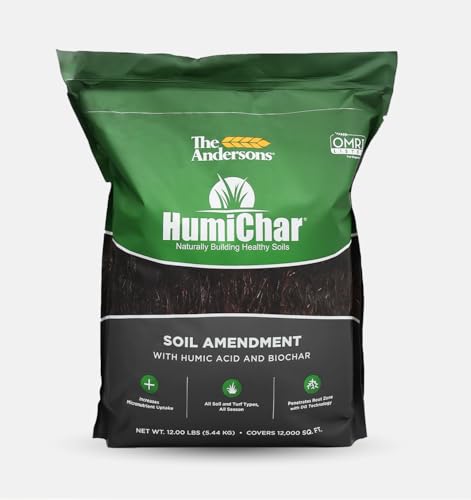
The Andersons HumiChar Organic Soil Amendment
Consider HumiChar when a carbon-based amendment has a defined place in your soil plan. Its spreadable format is convenient; permanent improvement, a fixed fertilizer saving and the advertised formula are not outcomes to assume for every lawn.
- A good fit for
- A homeowner evaluating a granular humic-acid and biochar amendment with realistic expectations and access to the actual package directions.
- The tradeoff
- The web page lists 30% humic acid and 43% biochar; its linked 12-pound label lists 46.58% humic acids and 23.26% pecan biochar. That unresolved difference matters before buying a particular formulation.
We may earn a commission from purchases through our links. How this works
Buy on AmazonResearch-based review · Updated
Know which HumiChar formulation you are buying
The linked retail item is the 12-pound HumiChar package. It is a soil amendment containing humic material and biochar, rather than a conventional nitrogen-phosphate-potash lawn fertilizer. Its job should therefore be considered separately from the lawn’s nutrient requirements. Adding this bag does not by itself supply a complete feeding plan.
The manufacturer’s current product page describes 30% humic acid and 43% granulated biochar. The 12-pound label linked from that page, marked E25 and copyright 2025, instead guarantees 46.58% humic acids derived from leonardite, 23.26% pecan biochar and 30.16% other ingredients. Neither source establishes which analysis will be on an individual delivered bag.
This is a material formulation difference, not rounding. Ask for the actual label if one of those ingredients or percentages is central to your purchase. The review retains both statements so the page does not silently turn one manufacturer version into a guaranteed retail composition.[1][3][4]
Granules make application practical; results still vary
- Expected benefit
- Biochar outcomes depend on the material and soil; general research is not a HumiChar lawn trial.[6]
Read how delivery and performance differ
The Andersons’ DG technology is a delivery format: the granules disperse with water, helping the material move from the turf surface toward the soil. That makes this product different to handle from loose chunks of biochar. It is a reason to consider the format, not independent proof that a given lawn will hold a particular amount of extra water.
Penn State’s June 2026 review explains why biochar results vary. Feedstock, production method, soil and application context change how a biochar behaves; studies have reported benefits, little change and sometimes reduced crop yields. Those findings concern biochar broadly, including agricultural settings, rather than a field trial of this retail HumiChar bag.
The useful purchasing question is what problem the amendment is meant to address and how improvement will be assessed. A manufacturer description of long-lived carbon does not establish that every lawn receives permanent improvement, or that its fertilizer budget can be reduced by a fixed percentage. Keep nutrient decisions and amendment expectations separate.[3][4][6]
Twelve thousand square feet is the lowest-rate coverage
- 1 lb per 1,000 sq ft
- A 12 lb bag calculates to 12,000 sq ft at the low panel rate.[4]
- 2 lb per 1,000 sq ft
- A 12 lb bag calculates to 6,000 sq ft at the middle panel rate.[4]
- 4 lb per 1,000 sq ft
- A 12 lb bag calculates to 3,000 sq ft at the high panel rate; the same label’s smaller turf directions say 1–2 lb. Confirm before use.[4]
Read the quantity and rate conflict
The 12-pound bag’s headline coverage is 12,000 square feet. That is the arithmetic for one pound per 1,000 square feet. At two pounds per 1,000, the same bag covers 6,000 square feet; at four pounds, 3,000. These are calculated quantities from the manufacturer’s rate panel, not three equally appropriate prescriptions for every lawn.
There is another direction conflict to resolve. The large spreader panel on the linked label shows one-, two- and four-pound rates, while its smaller turf directions specify one to two pounds per 1,000 square feet and an annual range of 40–200 pounds per acre. The web page uses one to four pounds per 1,000. Do not ignore the narrower turf text when selecting an application.
Measure the intended area and check the purchased label with the manufacturer or a local agronomist before using the higher panel rate. Spreader settings are starting guidance tied to walking speed and equipment; coverage should be checked against the actual weight applied over a measured area.[3][4]
Plan watering and cleanup with the actual label
The linked label calls for dry foliage, mowing before application and avoiding a heavy-rain forecast. After spreading, sweep material from driveways and sidewalks back onto the lawn. Its directions say to leave clippings in place for at least one mowing to reduce particle pickup, then keep unused material dry in a resealed bag.
Water is part of the delivery process, but the current sources differ here too: the linked label specifies at least 0.3 inches, while the web page says 0.2 inches. Follow the directions on the purchased package and clarify a mismatch rather than combining convenient parts of different versions.
The label also notes slower dispersion when water or weather is below 45°F. That describes particle behavior, not a promise that an extra application will overcome cold conditions. Plan the work around the ability to water appropriately and keep the material in the intended area.[3][4]
Use a soil plan instead of an automatic repeat schedule
The web page promotes repeat applications every three to four weeks; the linked label’s tips say four to six weeks. Those are manufacturer schedules, not independent evidence that every soil benefits from either interval. The label itself also advises following an Andersons representative or local agronomist where circumstances require a different approach.
A soil test is useful for understanding nutrient and lime requirements before building a broader lawn program. Penn State stresses matching the test and recommendations to the region and following the laboratory’s sampling directions. Such a test does not, by itself, prove that HumiChar will improve a particular property of that lawn.
Keep the distinction practical: decide which nutrient corrections are supported, identify why a carbon amendment is being considered, and avoid treating a recurring application calendar as the diagnosis. The product can be used alongside a fertilizer program, but its presence is not evidence that needed fertilizer can simply be omitted.[3][4][5][6]
Consider a soil test before an amendment purchase
If the lawn’s underlying problem is unclear, the MySoil kit is a relevant alternative purchase. Its manufacturer describes a mail-in laboratory service covering plant-available nutrients and pH, with online results and fertilizer recommendations. It is a diagnostic service rather than another bag of amendment.
That distinction can be more useful than comparing two broad soil-improvement claims. The test can inform a nutrient discussion; local extension or an agronomist can help decide whether the results support an amendment, a different fertilizer or another management change. Follow the chosen laboratory’s sample instructions so the result represents the area you are trying to improve.
HumiChar remains an option for a defined amendment plan, especially when the granular format is useful. Before ordering, confirm the 12-pound identity, obtain the actual analysis and directions, and budget quantity using the intended rate rather than the largest coverage number on the front.[2][5][3][4][1]
When to choose something else
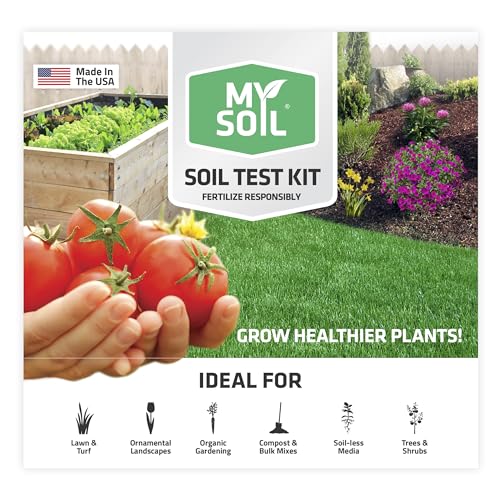
MySoil Soil Test Kit
For nutrient and pH information before choosing an amendment: MySoil is a mail-in laboratory kit with online recommendations, not a soil treatment.
Sources & research notes
This review draws on published product information and relevant care or operating guidance. We have not conducted a hands-on trial of this product. General guidance explains the intended task; it does not establish this product’s performance.
Amazon: current product identity and package photograph
Commerce identity only; not evidence of product performance.
Buy on AmazonRead 2026-09-23
- MySoil: mail-in laboratory soil test kit
Read 2026-09-23
- Manufacturer: current humichar product information
Read 2026-09-23
- The Andersons: matching package label
Read 2026-09-23
- Penn State Extension: turfgrass fertilization, soil testing and fertilizer grades
Read 2026-09-23
- Penn State Extension: Biochar opportunities and limitations, June 2026
Read 2026-09-23
Check the product before ordering
Check the package size, formulation and current label directions.