
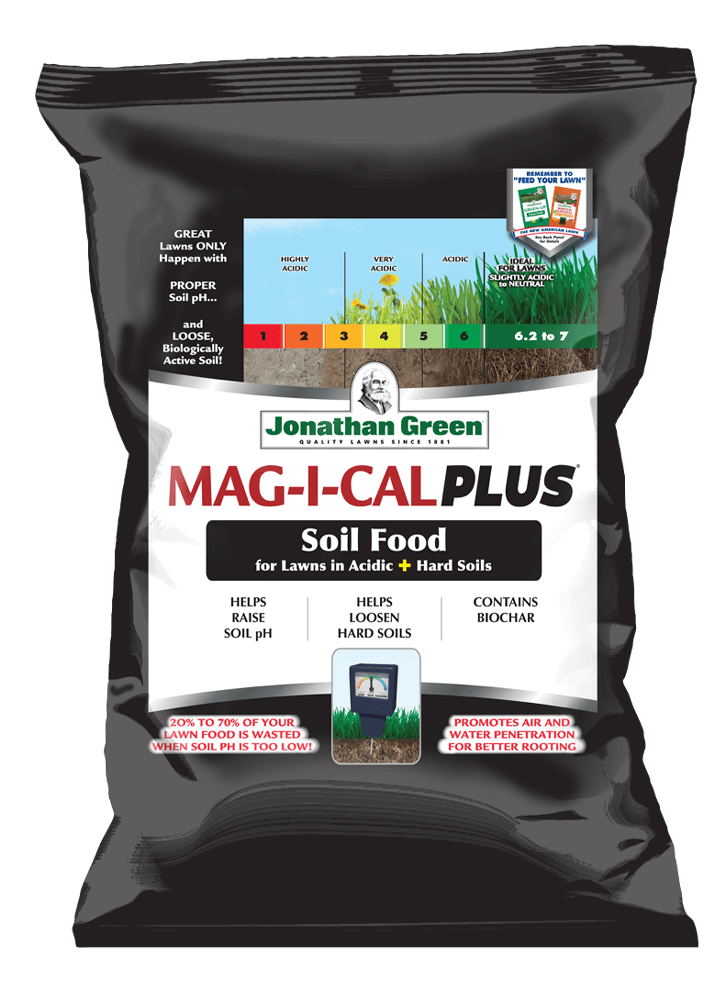
Jonathan Green Mag-I-Cal Plus for Acidic & Hard Soils
A documented combination amendment for a lawn that needs acidity correction. Its calcium, gypsum and biochar ingredients do not establish that every hard lawn needs it or that spreading it will eliminate compaction.
- A good fit for
- A homeowner with a confirmed lime requirement who wants this combined formula and will measure the treatment area, verify the 18-pound option and follow soil-specific guidance.
- The tradeoff
- The similarly named alkaline-soil product works in the opposite pH direction. Even within this acidic-soil formula, the 5,000-square-foot headline applies to the lower rate, not every lawn-renovation use.
We may earn a commission from purchases through our links. How this works
Buy on AmazonResearch-based review · Updated
Choose the acidic-soil Plus formula and the right size
Jonathan Green has several Mag-I-Cal products. This profile concerns Mag-I-Cal Plus for Lawns in Acidic & Hard Soil, the formula intended to raise pH. It is distinct from the Plus product for alkaline soil and from Mag-I-Cal without Plus. Matching only the brand name is not enough.
The manufacturer’s 2026 catalog identifies model 11354 as the 18-pound size, with nominal coverage of 5,000 square feet. Model 11355 is the 54-pound size. The linked retail record identifies model 11354, although one supplied retail photograph showed the larger bag. This page uses manufacturer artwork for the correct formula; confirm the selected net weight before checkout.
That identity check matters when estimating material. A larger family image does not change the amount in the selected listing. Review the product name, model and weight together, especially when the retailer combines several options on one product page.[1][6][4]
What the combination formula contains
The manufacturer label lists 28% calcium, 1.5% combined sulfur and 0.5% iron, derived from materials including calcium carbonate and gypsum. It also lists 1% humic acid, 1% polyhydroxycarboxylic acids and 2% wood biochar among the non-plant-food ingredients. These describe the formulation; they are not separate percentages of lawn improvement.
The pH-raising purpose is the important first decision. Penn State explains how lime should be chosen from a soil-test requirement, taking the liming material into account. A broad soil-food name does not establish that a lawn with satisfactory pH needs more acidity correction.
Jonathan Green also markets the product for hard soils and microbial activity. The sources reviewed here do not demonstrate that this exact retail bag will remove a measured amount of compaction or replace a physical lawn-renovation step. Treat those benefits as manufacturer claims, not a reason to skip diagnosis of a hard or poorly growing lawn.[5][6][3]
Calculate the 18-pound quantity at the intended rate
- Double-rate use
- At two passes totaling 7.2 lb per 1,000 sq ft, an 18 lb bag covers 2,500 sq ft.[5][6]
- Measure the actual turf
- Subtract the house, paths and other non-lawn areas before calculating the amount.[5]
Read the rate and soil-guidance caveat
The label’s established-lawn rate is 3.6 pounds per 1,000 square feet. At that rate, 18 pounds covers 5,000 square feet. For new lawns or soil pH below 5.9, its spreader chart calls for two passes over the area at the same setting, doubling the quantity to 7.2 pounds per 1,000 square feet.
The resulting coverage is 2,500 square feet per 18-pound bag for that double-rate use. A 5,000-square-foot area therefore takes one bag at the established rate or two at the double rate. Those are calculations from the label, not a finding that a particular lawn requires either amount.
The current manufacturer page makes the same established-versus-new-lawn coverage distinction. Before selecting a rate from a pH threshold alone, reconcile it with a soil-specific lime recommendation. Soil buffering and grass requirements can make a universal target or repeat schedule inappropriate.[5][4][6][3]
Make the soil test do more than name a pH number
Jonathan Green presents a general lawn pH range and a program for more acidic soils. Penn State’s independent explanation adds a necessary distinction: the lime-requirement test measures the correction needed, while pH describes current acidity. Different soils can need different quantities to reach a suitable range.
Use a recommendation appropriate to the grass and location rather than assuming every lawn must meet the same number printed in a general lawn program. The point is not to maximize pH. It is to correct a demonstrated mismatch without adding an unnecessary amendment.
A service such as MySoil can provide nutrient and pH results before the purchase. Seek appropriate interpretation for a lime correction, and do not assume that a routine nutrient report diagnoses drainage or compaction by itself. This combined product still needs a defined job, even when several advertised benefits sound relevant to a struggling lawn.[4][3][2]
Calibrate distribution and follow the watering guidance
The label suggests aerating or vigorous raking before application and provides approximate spreader settings. It also gives a small-area calibration check: 0.9 pound over 250 square feet corresponds to the established rate. Walking pace affects delivery, so the printed setting is a starting point rather than proof of the amount applied.
For turns, close the spreader to avoid depositing extra material. Avoid windy conditions and keep the granules on the intended lawn area. These details matter more than copying a setting from a different spreader model or assuming every pass covers the same width.
Jonathan Green says watering is not required for application, but recommends watering for fifteen minutes if possible. That is the manufacturer’s time-based guidance, not a measured irrigation depth for every sprinkler. The current page prefers temperatures of at least 45°F; do not interpret the older label’s broad timing language as a reason to disregard current local conditions or package directions.[5][4]
Protect hard surfaces and keep seeding needs separate
The label warns that ingredients can stain hard surfaces and directs users to sweep material off rather than wash it away. Keep it away from water, storm drains and drainage ditches, and avoid application when heavy rain is expected. After use, clean and dry the spreader as directed to limit corrosion.
For a new lawn, the maker allows same-day application with seed and its seeding fertilizer. That compatibility does not establish a universal need for either lime or starter fertilizer. Retain the seed’s own planting depth and irrigation requirements instead of treating this soil amendment as a complete establishment plan.
Store unused product cool and dry, beyond children’s and pets’ reach. When buying, the decisive checks remain the same: acidic-soil Plus formula, 18-pound model, appropriate soil recommendation and enough material for the chosen rate. The extra ingredients are not a substitute for those practical checks.[5][3]
When to choose something else
MySoil Soil Test Kit
For nutrient and pH information before selecting an amendment; obtain an appropriate lime-correction recommendation for the grass and soil.
Sources & research notes
This review draws on published product information and relevant care or operating guidance. We have not conducted a hands-on trial of this product. General guidance explains the intended task; it does not establish this product’s performance.
Amazon: linked product identity, verified through Creators API
Commerce identity only; not evidence of product performance.
Buy on AmazonRead 2026-09-23
- MySoil: mail-in laboratory soil test kit
Read 2026-09-23
- Penn State Extension: Liming Turfgrass Areas
Read 2026-09-23
- Manufacturer: magical product information
Read 2026-09-23
- Manufacturer: magical factsheet or package label
Read 2026-09-23
- Jonathan Green: 2026 retail catalog, Mag-I-Cal formulas
Read 2026-09-23
Check the product before ordering
Check the package size, formulation and current label directions.