
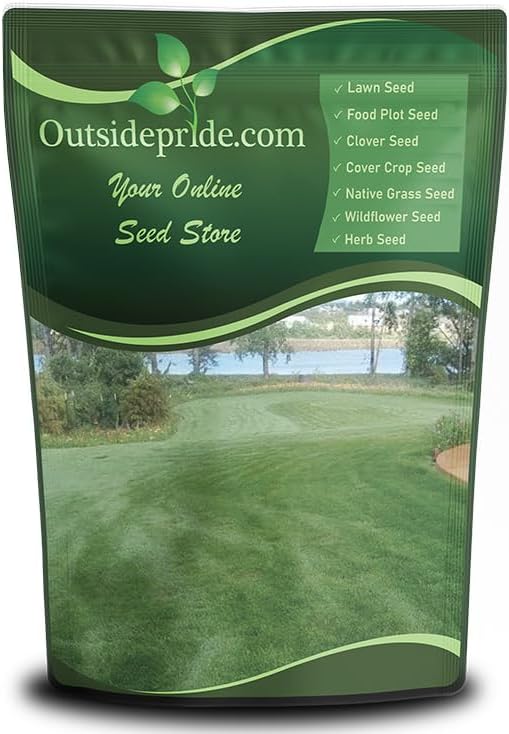
Outsidepride Combat Extreme Transition Zone
Consider it for a transition-region lawn where turf-type tall fescue fits the climate and you can support establishment and summer care.
- A good fit for
- New or thin tall-fescue lawns in sun or suitable partial shade, using the correct new-lawn or overseeding rate.
- The tradeoff
- Coating and tillering claims do not establish bluegrass-like spreading or eliminate reseeding after substantial damage.
We may earn a commission from purchases through our links. How this works
Buy on AmazonResearch-based review · Updated
The current blend is tall fescue, not a bluegrass mix
Outsidepride describes Combat Extreme Transition Zone as a three-way turf-type fescue blend. That is the product identity to use when deciding what kind of lawn it will create. The current manufacturer description does not identify a Kentucky bluegrass component, so we do not describe this version as a ninety-percent fescue, ten-percent bluegrass mixture.
The supplier lists several possible varieties, including Annihilator or Marauder, Chanell, Rhizing Moon or Bloodhound, Barbarian, Roman and Warhawk. A list of options is not a statement that every bag contains all of them, and it does not tell us the exact proportions in a delivered lot. Read the seed analysis for the actual cultivar names, percentages and test information before using cultivar-specific claims to choose the bag.
This distinction matters within the Combat Extreme family. The Northern Zone product is separately described with tall fescue and Kentucky bluegrass. A shared brand name does not make the formulas interchangeable. For an existing lawn, compare the actual grass types as well as the name on the package; the blend's appearance and repair behavior follow the grasses it contains.[1][2][5]
Treat coating and repair claims as separate questions
- OptiGrowth coating
- Manufacturer-described help with spreading, soil contact and moisture around the seed; preparation and watering still matter.[1][4]
Read the coating and repair evidence
The current Transition Zone product includes OptiGrowth coating. Outsidepride describes improved seed uniformity, easier spreading and soil contact, plus a moisture-retaining Aquatek component, nutrients, kelp and biological additions. Those are the manufacturer's explanation of the treatment. They do not establish an independently measured germination advantage for this bag under your soil and weather conditions.
The same page describes self-repair through tillering, or producing additional shoots. That is a different mechanism from assuming a bluegrass component spreads throughout damaged areas. Colorado State identifies tall fescue as a bunch-type grass and explains its limited capacity to fill damaged spots. Small-scale thickening should not become a promise that a bare path or a badly thinned lawn will close without more seed.
Buy the coating as part of the supplied planting format, while still budgeting effort for preparation, watering and later repairs. If rapid spreading recovery is central to the project, compare grass species appropriate to the location instead of relying on the phrase self-repairing. No coating establishes that a grass will tolerate unsuitable shade, climate or recurring damage.[1][3]
Match tall fescue to the actual site
The manufacturer's main description emphasizes full sun or partial shade in USDA zones six and seven, while its planting panel gives a broader zone range of three through eight. That inconsistency is a reason to use local turf guidance, not to select the broadest number as a guarantee. A winter-hardiness zone also does not fully describe a lawn's summer heat, humidity or shade.
Tall fescue can be a useful cool-season choice in transition climates, and turf-type varieties offer a different lawn texture from coarse utility fescues. Still, partial shade is not the same as deep shade beneath dense trees or against a building. Look at the growing conditions in the specific area you plan to seed and diagnose why any existing grass failed there.
NC State identifies brown patch as a concern during warm, humid weather and advises adapting maintenance to the site. That is species-level context rather than a test of this retail blend. The product's heat- and drought-tolerance language therefore belongs alongside a practical plan for summer care, rather than a promise of uninterrupted green color or freedom from disease.[1][3][6][4]
A five-pound bag covers different areas for each job
- 5 lb, new lawn
- Approximately 500–625 sq ft.[1]
- 5 lb, overseeding
- Approximately 1,000–1,250 sq ft.[1]
- 2,000 sq ft, new lawn
- 16–20 lb at the published rate.[1]
- 2,000 sq ft, overseeding
- 8–10 lb at the published rate.[1]
Read how to measure and compare quantities
The published application rate is eight to ten pounds per 1,000 square feet for a new lawn, or four to five pounds when overseeding. A five-pound bag therefore covers about 500 to 625 square feet of new lawn, or 1,000 to 1,250 square feet when adding seed to existing turf. The larger number belongs to the lighter overseeding application.
For a 2,000-square-foot project, plan on sixteen to twenty pounds for bare-ground establishment, or eight to ten pounds for overseeding. Measure the actual treatment area before choosing a size. If some areas are bare while others only need thickening, calculate those portions separately instead of spreading one bag thinly across the entire yard.
These calculations follow the current product directions for the supplied seed. They are not a pure-live-seed estimate and do not establish how much uncoated seed the bag contains. Inspect the lot's seed analysis, including any coating or inert material, if comparing formats. A lower price per pound alone cannot tell you which option provides the better planting value.[1][5]
Give the seed an establishment window
Outsidepride specifies soil temperatures of at least fifty-five degrees Fahrenheit and planting no later than six weeks before frost. Use that as product guidance, then narrow the timing with advice for your region. A broad spring-to-fall label is not a reason to seed just before the most difficult part of your local summer.
The planting panel gives seven to fourteen days for germination, a surface-to-one-eighth-inch depth, and a first-mowing estimate of twenty-one to thirty days. Those are planning ranges, not a guarantee that the whole lawn is ready for regular traffic on a particular date. Soil conditions, watering and the actual stand should drive the next step.
Prepare the surface so seed can contact soil instead of resting on debris or a dense layer of old vegetation. Keep the seedbed moist during germination and seedling development, then adjust watering as the stand develops. Follow any lawn-treatment label's restrictions around reseeding. OptiGrowth does not remove those requirements, and a calendar estimate should not be used to rush weed treatment or heavy use of the new grass.[1][4][6]
Plan maintenance and choose alternatives deliberately
Outsidepride lists a mowing height of two and a half to three inches. Regional guidance can change that through the year: NC State advises a three-and-a-half-inch height during summer. Treat the supplier's range as a starting point, then use local recommendations for heat, shade and season rather than keeping one low setting throughout the year.
Base feeding on soil information and local needs, and distinguish seedling watering from care of an established lawn. Watch recurring thin areas for causes such as traffic or unsuitable conditions before ordering more seed. A turf-type blend can improve the choice of grass, but it does not change the site's underlying constraints.
Combat Extreme Northern Zone is worth comparing when you specifically want the manufacturer's tall-fescue and Kentucky-bluegrass mixture and its regional fit makes sense. Its bluegrass is a real compositional difference, not proof of a universally better lawn. Compare the formula and planting directions, then the current bag analysis. We have not established a price or performance advantage over Scotts or Pennington from brand names or coating descriptions alone.[1][6][4][2][5]
When to choose something else

Outsidepride Combat Extreme Northern Zone
Compare Northern Zone when you want its stated tall-fescue and Kentucky-bluegrass mixture, after checking regional fit and the bag analysis. It is a different formula, not an interchangeable name.
Sources & research notes
This review draws on published product information and grass-selection guidance. We have not conducted a hands-on trial of this product. Species guidance helps explain the choice; it is not a trial of the bag you buy.
- Outsidepride: Combat Extreme Transition Zone product and planting guide
Read 2026-09-23
- Outsidepride: Combat Extreme Northern Zone product and planting guide
Read 2026-09-23
- Colorado State University Extension: turfgrass species selection
Read 2026-09-23
- University of Minnesota Extension: renovating a lawn
Read 2026-09-23
- UMass Extension: understanding the turfgrass seed label
Read 2026-09-23
- NC State Extension: Tall fescue lawn maintenance calendar
Read 2026-09-23
Ready to compare the bag?
Check the package size and seed tag before ordering.