
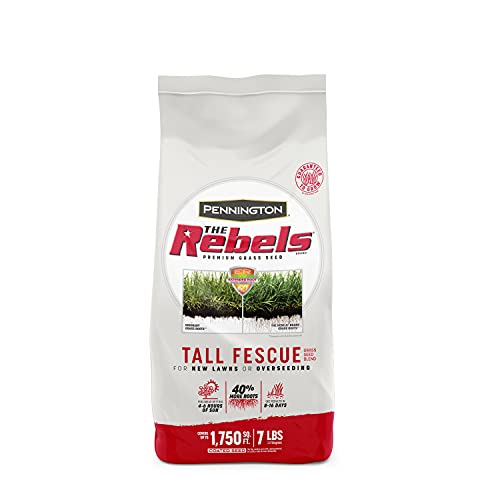
Pennington The Rebels Tall Fescue Mix
Consider The Rebels for a tall-fescue lawn where useful shade tolerance matters more than rapid spreading into bare patches.
- A good fit for
- A maintained cool-season lawn with the manufacturer’s stated 4–6 hours of daily sun.
- The tradeoff
- Tall fescue can thin under summer stress, and bare spots generally need reseeding.
We may earn a commission from purchases through our links. How this works
Buy on AmazonResearch-based review · Updated
The Rebels is a blend, not one fixed cultivar
- Species choice
- Multiple turf-type tall fescue varieties; no intentional bluegrass component is described.[1]
- Brand history
- Pennington traces The Rebels to the original Rebel cultivar released in 1979.[1]
Read the blend and cultivar distinction
The name has a history, but the current product is a blend of improved turf-type tall fescues. Pennington traces the brand to the original Rebel released by Rutgers in 1979. That history does not mean today's bag contains only that original cultivar. The current product page explicitly describes several turf-type tall fescue varieties blended together.
For a buyer, the useful distinction is the species and lawn type. This is a turf-type tall fescue blend rather than a deliberate tall-fescue-and-bluegrass mixture. Minnesota Extension explains that a blend contains varieties within a species, while a mixture combines species. If your goal is to overseed a tall-fescue lawn without intentionally introducing bluegrass, that is a direct reason to put The Rebels on the shortlist.
The delivered tag still matters. Neither the brand story nor an old bag photograph tells you the current cultivar names, purity, germination or weed-seed entries. The public 7-pound package artwork even leaves its seed-analysis area blank. Keep the lot information and inspect the actual label. A recognized product family is useful for finding a bag again; it is not a substitute for knowing what that bag contains.[1][3][6][2]
What the root claim means for a lawn
- Manufacturer claim
- The package promotes 40% more roots and labels its root photographs illustrative.[2]
- Site limitation
- Restricted soil depth can erase tall fescue’s expected watering advantage.[4]
Read the root claim and recovery limits
Pennington emphasizes thick, deep roots and markets The Rebels with a “40% more roots” claim. The package footnote says the root-development estimates are based on plant breeding and scientific research, with results varying by environment and management. Its root photographs are labelled illustrative. Treat the percentage as attributed marketing, not a measurement from our lawn or a forecast for yours.
The broader species case is easier to apply. Colorado State describes turf-type tall fescue as deep-rooted, drought-resistant and wear-tolerant. It also explains the important exception: shallow or poor soil can restrict roots enough that tall fescue needs as much water as Kentucky bluegrass, or more. Buying a grass selected for rooting cannot by itself remove compaction or create usable soil depth.
Roots also are not the same as spreading stems. Tall fescue primarily makes a bunch-type lawn, so a substantial worn gap may need reseeding. Do not read extended-root branding as a promise that a dog path will close like a spreading bluegrass lawn. For that buying question, compare the RTF product's specifically claimed rhizomatous feature and its limits, rather than assuming all root-focused products do the same job.[1][2][4][7]
Sunlight and summer conditions come first
Pennington specifies four to six hours of daily sun and describes use from partial shade to full sun. That makes The Rebels worth comparing for an open, partly shaded lawn. It is not a reason to keep seeding a strip that receives almost no direct light. The manufacturer itself notes that dense tree canopy remains a challenge, and CSU's species guidance treats shade as one factor among several.
Regional stresses can change the balance. NC State describes tall fescue's vulnerability to brown patch in warm, humid weather and notes that gray leaf spot can produce similar-looking dead areas. Those problems need diagnosis; a disease-tolerance rating on a package does not establish the cause of a declining patch. In colder locations, Minnesota Extension warns against tall fescue where winter ice accumulates.
Think about the season when your lawn struggles, not only the weeks when it looks best. A hot, humid transition-zone yard and a cold northern site face different limits. Use local guidance to decide whether tall fescue is appropriate, then compare the blend. If restricted light, poor drainage or compacted soil caused the last failure, improving that condition is part of the project.[1][4][8][3][5]
Use the package rate for the package you buy
- 7 lb for a new lawn
- About 583 sq ft at the package’s 12 lb per 1,000 sq ft rate.[2]
- 7 lb for overseeding
- Up to 1,750 sq ft at the package’s 4 lb per 1,000 sq ft rate.[2]
- 2,000 sq ft of new lawn
- 24 lb at the package rate; measure only the area being seeded.[2]
- 2,000 sq ft to overseed
- 8 lb at the package rate; do not use the new-lawn figure for the same job.[2]
Read the rate conflict and coating details
The 7-pound package artwork gives 12 pounds per 1,000 square feet for new lawns and 4 pounds per 1,000 square feet for overseeding. Its advertised coverage of up to 1,750 square feet therefore describes overseeding. At the new-lawn rate, seven pounds represents about 583 square feet. The current web page's 3-pound example uses the same basis: up to 750 square feet overseeding or 250 square feet new lawn.
The FAQ on that same webpage instead gives a general 8–10-pound new-lawn range and 4–6 pounds for overseeding. Those are not identical directions. We use the identified package artwork for the examples here and make the difference explicit. Confirm the directions on the bag you order, especially when comparing a different size or a listing with an older photograph.
The 7-pound artwork also says the coated product contains up to 53% coating material. That is an upper-limit statement on this artwork, not the measured coating percentage in every bag. Gross pounds are not automatically pounds of grass seed. UMass explains why purity and germination belong in a usable-seed comparison, and why a laboratory germination rate does not guarantee field establishment. Do not calculate a different application rate by subtracting an assumed coating amount.[2][1][6]
Plan the start, then keep caring for seedlings
Choose the local window
Use spring/fall package guidance together with regional renovation advice.[2][8][5]
Prepare the surface
Give seed contact with soil and avoid leaving it caught in debris or existing grass.[2][5]
Sustain moisture
The package calls for moist soil until seedlings reach about 3 inches; continue to manage the developing stand.[2]
Read the planting and establishment guidance
The package and main product page say to expect results in 8–16 days. The web FAQ gives a broader 7–21-day germination window. These are published expectations under suitable conditions, not a date on which the lawn becomes ready for normal traffic. Germination is one stage; the young stand still needs moisture and time to develop.
Pennington lists early spring or early fall on the package and emphasizes fall on its current webpage. Local timing is more useful than a universal start date. NC State separates late-August renovation in its western region from September into early October in the Piedmont and coastal plain. Minnesota has its own late-summer to early-fall window. Follow the guidance for your location and allow room for establishment before the difficult season.
Preparation depends on whether the ground is bare or already holds grass. Remove debris, loosen the surface and establish contact between seed and soil. For overseeding, manage existing growth so it does not prevent the new seed from reaching the surface. The package lists a quarter-inch planting depth and calls for moisture until grass sprouts and reaches about three inches. Its instructions also warn against applying preemergent weed control before establishment; always check the exact weed-control label for seed compatibility and timing.[2][1][8][5]
Plan for mowing, disease and future overseeding
The package lists a three-inch mowing height, advises removing no more than one-third of the blade in one mow and recommends raising the cut in hot weather. NC State's summer calendar calls for three and a half inches for tall fescue. Those directions describe a lawn that benefits from retained leaf area, not a grass to scalp for fewer mowing trips.
Watering should change as the stand develops. Establishing seed needs consistent surface moisture; an established lawn can be managed differently according to weather and soil. The manufacturer's deeper-root claim does not justify withholding establishment water. Likewise, a dense stand is a management goal, not a guarantee against weeds or summer thinning.
Use soil testing to guide additional nutrients and diagnose damaged areas before selecting a treatment. Where summer stress or traffic opens the stand, future overseeding may be part of keeping it even. That is a practical cost of choosing a primarily bunch-type grass. If you specifically want a rhizomatous tall-fescue feature, compare Turf Saver RTF; if you want to add bluegrass to the species mix, that is a different decision from simply buying another tall-fescue blend.[2][8][5][4][7]
When to choose something else
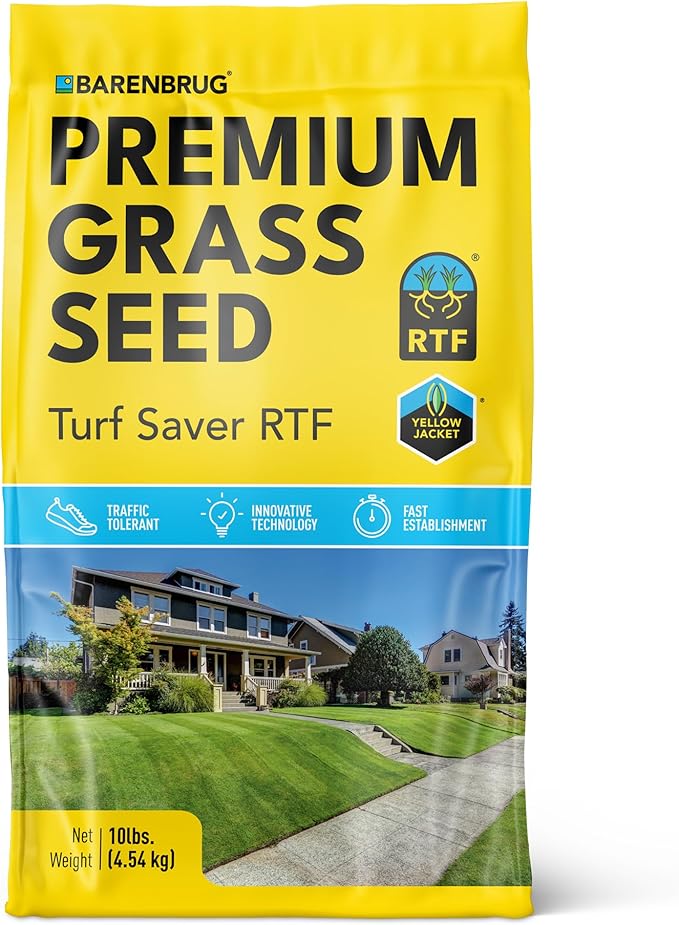
Barenbrug Turf Saver RTF
Compare Turf Saver RTF if a specifically rhizomatous tall-fescue component interests you. Its manufacturer describes a 60/40 traditional/rhizomatous formula; treat self-repair as a feature, not a guaranteed outcome.
Sources & research notes
This review draws on published product information and grass-selection guidance. We have not conducted a hands-on trial of this product. Species guidance helps explain the choice; it is not a trial of the bag you buy.
- Pennington: The Rebels Tall Fescue Grass Seed Blend
Read 2026-09-23
- Pennington: The Rebels 7 lb package artwork RB124_V2 (Lowe’s-hosted)
Read 2026-09-23
- University of Minnesota Extension: buying turfgrass seed
Read 2026-09-23
- Colorado State University Extension: turfgrass species selection
Read 2026-09-23
- University of Minnesota Extension: renovating a lawn
Read 2026-09-23
- UMass Extension: understanding the turfgrass seed label
Read 2026-09-23
- Barenbrug: Turf Saver RTF technical sheet B010726 (2026)
Read 2026-09-23
- NC State Extension: tall fescue maintenance calendar
Read 2026-09-23
Ready to compare the bag?
Check the package size and seed tag before ordering.