
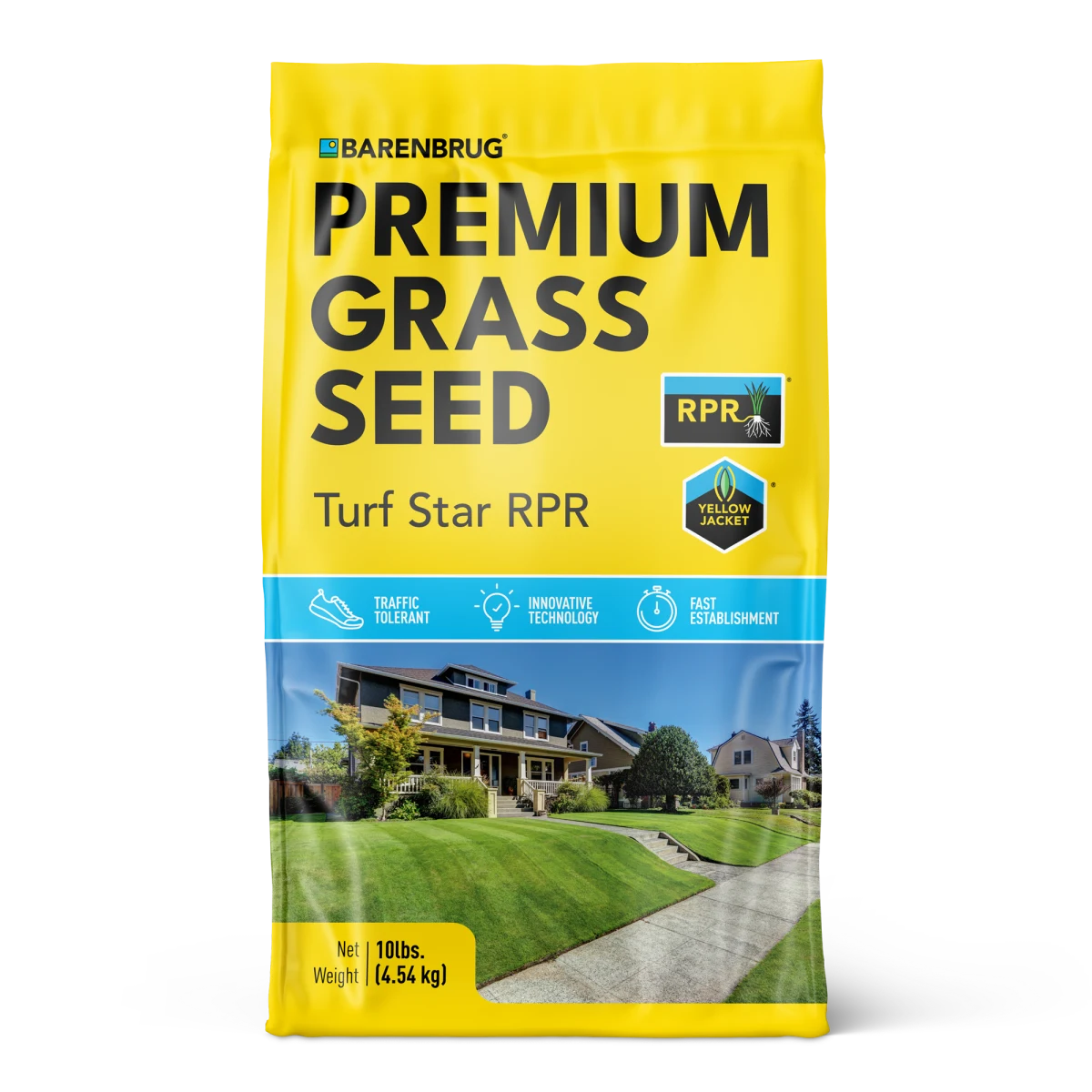
Barenbrug Turf Star RPR
A perennial-ryegrass blend worth considering for an actively used cool-season lawn. Its appeal is quick establishment plus Barenbrug’s RPR growth habit, designed to help worn turf recover.
- A good fit for
- Sunny cool-season renovation and overseeding where perennial ryegrass suits your location.
- The tradeoff
- Plan for watering and mowing. Local heat, disease and winter conditions can make another grass a better choice.
We may earn a commission from purchases through our links. How this works
Buy on AmazonResearch-based review · Updated
The difference is how it grows
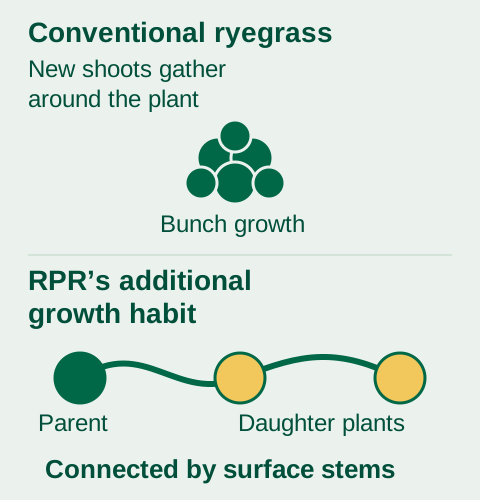
RPR adds a lateral growth habit to perennial ryegrass. Barenbrug describes surface stems that can root and form new daughter plants, helping the turf regain density after wear.[6]
Explore the mechanism and its limits
Ordinary perennial ryegrass is a bunch-forming grass: it thickens through new shoots around the plant. Barenbrug describes RPR as producing determinate stolons, horizontal stems at the soil surface that can root and form daughter plants. That gives its recovery story a specific biological mechanism, rather than simply another “tough lawn” slogan.
The underlying patent describes breeding and selection for these stems, including screening under simulated traffic. That is useful background for understanding what the technology is trying to do. It is not a side-by-side trial of the particular retail bag you order, nor a timetable for closing a dog track or a large bare patch.
For a homeowner, the sensible expectation is support for density and recovery in a managed ryegrass lawn. Our buying interpretation is that the feature is most relevant when wear is part of the problem and perennial ryegrass is already an appropriate choice. If your immediate job is filling bare ground, plan on seeding and establishment care; the RPR name alone is not a repair schedule.[6][8][7]
Match the seed to your lawn
- Sunlight
- Prioritize a sunny lawn. Maryland Extension rates ryegrass’s shade tolerance as poor to fair.[3]
- Foot traffic
- Worth comparing for an actively used lawn. Barenbrug positions RPR for wear tolerance and recovery.[6][7]
Read the regional guidance
The best starting point is an actively used lawn in a climate suited to perennial ryegrass. Barenbrug lists cool-season renovation and fall interseeding into bluegrass, fine fescue and traditional perennial ryegrass among its uses. That makes it a candidate for adding ryegrass to a suitable existing lawn; it does not mean every cool-season lawn needs it.
Regional advice can change the decision. University of Maryland Extension considers perennial ryegrass too disease-prone and insufficiently persistent to use alone in Maryland, highlighting gray leaf spot and brown patch. Minnesota Extension points to limited winter hardiness and advises keeping ryegrass a small part of typical Minnesota lawn mixtures. These are regional species recommendations, not product-specific trials, but they are good reasons to check local guidance before planting an all-ryegrass lawn.
Shade and dry summers deserve the same attention. Maryland’s species comparison gives ryegrass excellent full-sun tolerance, poor-to-fair shade tolerance and poor drought tolerance. We would therefore compare other grasses first for a deeply shaded yard or a lawn intended to stay attractive with little watering. Fast spring growth does not settle those longer-term questions.[6][3][11]
Three names. Three different choices.
- Turf Star RPR
- Perennial ryegrass blend. RPR adds surface-stem growth.[6]
- Turf Saver RTF
- Tall fescue. RTF uses underground rhizomes.[10]
- Turf Blue HGT RPR
- Kentucky bluegrass and perennial ryegrass mixture. Formerly HGT with RPR.[5]
See the blend and cultivar details
Turf Star RPR is a blend of perennial ryegrasses. That distinction matters: a blend combines varieties of one species, while a mixture combines different species. You are buying a ryegrass lawn component here, rather than a tall-fescue or Kentucky-bluegrass mixture with a little ryegrass added for an early green-up.
Barenbrug describes the product as RPR plus elite perennial ryegrasses. Its professional product page describes a 60% RPR and 40% premium perennial-ryegrass formula. Treat that as the manufacturer’s product description; the retail bag’s seed tag is still where you find its actual named varieties and percentages. We do not have a matching current retail lot tag to identify those cultivars.
The similar names can send you toward the wrong bag. Turf Blue HGT RPR, formerly HGT with RPR, combines Kentucky bluegrass and perennial ryegrass. Turf Saver RTF is tall fescue. If you want to retain a tall-fescue lawn, start by comparing tall-fescue products rather than choosing Turf Star solely because both bags advertise recovery.[12][6][11][2][5][10]
Buy for the area you’re planting
- New seeding
- 8–10 lb per 1,000 sq ft in the professional sheet.[7]
- Cool-season overseeding
- 4–15 lb per 1,000 sq ft. The wide professional range needs project-specific guidance.[7]
- Example: 2,000 sq ft
- 16–20 lb at the professional new-seeding rate. Confirm the rate on your retail package.[7]
Understand coating, coverage and value
Barenbrug offers Turf Star RPR with Yellow Jacket coating, and its direct store also lists an uncoated option. The coating is intended to hold moisture around the seed during establishment. Barenbrug explicitly says coated package weight includes the coating; a pound of bag contents is not automatically a pound of grass seed.
Start with the directions for the exact package and your project. The 2026 professional RPR sheet lists 8–10 pounds per 1,000 square feet for seeding, and a much wider 4–15 pounds for cool-season overseeding. That broad professional range is a reason to confirm the retail directions, rather than automatically choose its highest rate for your yard. As a planning example, 2,000 square feet at 8–10 pounds would require 16–20 pounds; this is arithmetic from the professional rate, not a replacement for your bag’s instructions.
For value, compare project coverage alongside purity and germination. UMass Extension explains that both determine the amount of pure live seed. A heavier coated bag and a lighter uncoated bag can represent different quantities of viable seed. Check the tag before comparing cost per pound, and follow the package’s watering instructions even when choosing a coated product.[12][7][2]
From thin lawn to new growth
Prepare the ground
Address why the lawn thinned. Create seed-to-soil contact rather than scattering seed onto a thick canopy.[9][7]
Sow and keep moist
Spread evenly and maintain a lightly moist seedbed. Avoid drying or saturation while seedlings emerge.[9][7]
Build an established lawn
Barenbrug describes 14–21 days for germination with ideal care. That is not a deadline for full traffic tolerance.[7][6]
Open the full planting and care guide
Before adding RPR to a thin lawn, work out why the existing grass is struggling. Minnesota Extension lists compaction, thatch, shade, disease and poor mowing among the possible causes. Fresh seed is only one part of a renovation when the site itself is causing the thinning.
Barenbrug’s technical sheet emphasizes seed-to-soil contact. It describes verticutting or lowering the existing sward to help seed reach the soil; for a home lawn, choose preparation that suits the grass you already have. Seed sitting on top of a thick canopy is not the prepared seedbed those directions describe. Use a soil test to guide amendments instead of guessing at lime or fertilizer needs.
For spreading, divide the intended amount into two passes in different directions to improve distribution. Then keep the seedbed lightly moist, avoiding both drying and saturation. Minnesota’s renovation guidance supports those steps. The practical commitment is access to water and time to monitor the seedbed during establishment. If you cannot provide that care, postpone the project until you can.
Barenbrug advertises emergence in as little as seven days on its professional product page. Its 2026 technical sheet describes a 14–21 day germination period with ideal irrigation and soil contact. Those statements describe the start of a lawn, not the date it is ready for unrestricted use.
Keep three milestones separate. Germination is the appearance of seedlings. Establishment is the development of a rooted stand. Wear recovery is how existing turf regrows after damage. The appeal of RPR involves all three, but an early green haze does not demonstrate mature traffic tolerance or show how quickly a worn patch will close.
The manufacturer favors fall planting as evenings cool and also describes late-winter or early-spring repair. Use that as seasonal context and then consult your local planting window. Its sheet calls for ample moisture during the first weeks and notes that interseeded turf may need supplemental water as late spring warms. Plan the project around care and growing conditions, rather than counting seven days backward from an event.
RPR’s professional sports-turf positioning is a clue to the management it is designed to receive. Barenbrug recommends frequent mowing and fertilization for optimal results, and Minnesota Extension characterizes perennial ryegrass as a grass with higher maintenance requirements. The recovery feature is a reason to investigate this seed for an actively cared-for lawn, not a reason to expect it to look after itself.
During renovation, Minnesota Extension recommends managing the existing canopy so light continues to reach new seedlings, then raising the cutting height as they develop. Its guidance for regularly managed sunny lawns also advises removing no more than one-third of the leaf tissue at a mowing. That is a more useful homeowner habit than copying a golf-course cutting height.
Longer term, choose watering and nutrition around local guidance, soil conditions and the lawn you maintain. If your priority is less mowing, less irrigation or a lawn you can largely leave alone, compare another grass type before paying for a ryegrass recovery feature. Those are different buying priorities, and the RPR label does not resolve the tradeoff.[7][9][6][11]
Our take: choose it for the recovery feature
Our strongest case for Turf Star RPR is a buyer who has already chosen perennial ryegrass for a suitable lawn, expects regular wear, and is prepared to manage establishment and ongoing care. For that buyer, Barenbrug’s described lateral growth gives a concrete reason to compare RPR with a conventional ryegrass blend.
The research we reviewed supports explaining the mechanism and the manufacturer’s intended uses. It does not establish a universal recovery advantage of a certain number of days, a savings percentage for your maintenance budget, or a head-to-head winner for every yard. A patent, a species guide and a retail product page each answer different questions. We would not combine them into a numerical product score.
Before choosing, settle three practical points: whether perennial ryegrass suits your location, whether the package’s coverage fits your project, and whether recovery from wear is more important to you than lower maintenance or a different species mix. If those line up, RPR belongs on your shortlist. If they do not, the alternatives below address more relevant needs.[6][8][7][11][2]
When to choose something else
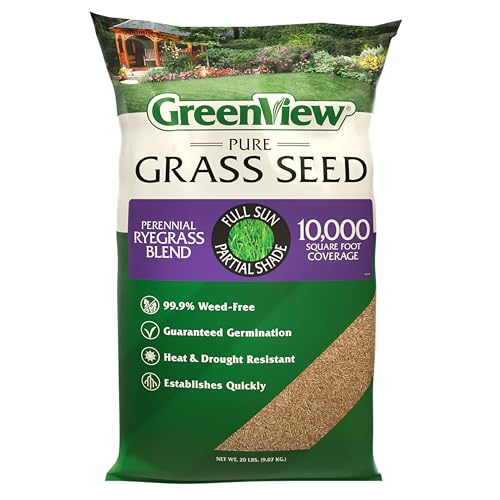
GreenView Pure Grass Seed Perennial Ryegrass
Choose this comparison when you want perennial ryegrass and your main priority is an uncoated blend. GreenView describes its Pure Grass Seed as having no coatings or fillers. Compare coverage and the seed tags against the exact Turf Star package; GreenView’s simpler proposition may matter more to you than the RPR feature.
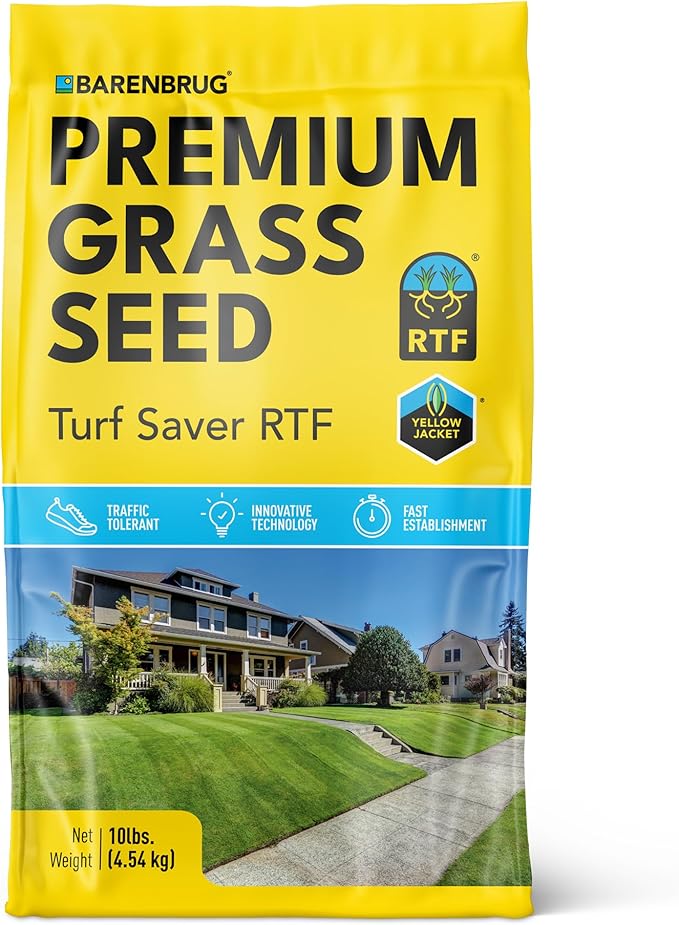
Barenbrug Turf Saver RTF
Compare Turf Saver RTF when you want tall fescue rather than perennial ryegrass. Barenbrug describes RTF as producing underground rhizomes, a different growth mechanism in a different grass species. This is the more relevant Barenbrug comparison for someone shopping specifically for tall fescue; it is not an interchangeable version of Turf Star RPR.
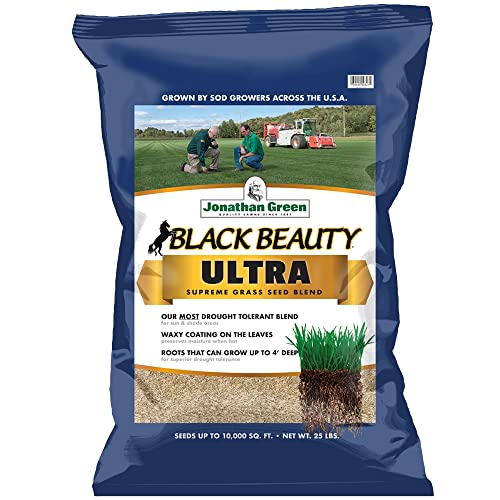
Jonathan Green Black Beauty Ultra
Compare Black Beauty Ultra when you want a mixture led by tall fescue, with bluegrass and ryegrass also included. Jonathan Green describes a mix of 80% tall fescue, 10% bluegrass and 10% ryegrass by weight. Its attraction here is the different species balance, rather than a claim that it has beaten RPR in a shared lawn trial.
Sources & research notes
This review draws on published product information and grass-selection guidance. We have not conducted a hands-on trial of this product. Species guidance helps explain the choice; it is not a trial of the bag you buy.
- Jonathan Green: the grasses in Black Beauty Ultra
Read 2026-09-22
- UMass Extension: understanding a seed label
Read 2026-09-22
- University of Maryland Extension: lawn grass comparisons
Read 2026-09-22
- GreenView: Pure Grass Seed Perennial Ryegrass Blend
Read 2026-09-22
- Barenbrug: Turf Blue HGT with RPR identity
Read 2026-09-22
- Barenbrug: Turf Star RPR product and recovery mechanism
Read 2026-09-22
- Barenbrug: Turf Star RPR technical sheet, B010726
Read 2026-09-22
- US8927804B2: perennial ryegrass with determinate stolons
Read 2026-09-22
- University of Minnesota Extension: renovating a lawn
Read 2026-09-22
- Barenbrug: Turf Saver RTF tall fescue
Read 2026-09-22
- University of Minnesota Extension: choosing lawn seed
Read 2026-09-22
- Barenbrug: Turf Star RPR retail blend
Read 2026-09-22
Ready to compare the bag?
Check the package size and seed tag before ordering.