
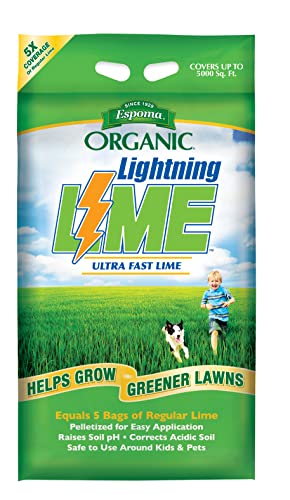
Espoma Organic Lightning Lime
A clearly documented lime option when soil guidance calls for raising pH without adding much magnesium. Its fine particles and pellet format are practical features, but the advertised speed is not a guaranteed correction date for your lawn.
- A good fit for
- A measured lawn with a confirmed lime requirement, particularly when the soil does not need the additional magnesium supplied by dolomitic limestone.
- The tradeoff
- At the maker’s raising-pH rate, the 30-pound bag covers 2,500 square feet rather than 5,000. The right quantity depends on the soil requirement, not simply the largest coverage number on the bag.
We may earn a commission from purchases through our links. How this works
Buy on AmazonResearch-based review · Updated
Read the lime composition before the speed claim
Lightning Lime is Espoma’s pelletized calcium-carbonate product. The linked size is 30 pounds. Its July 2026 factsheet lists 38% calcium, 0.4% magnesium and a calcium carbonate equivalent, or CCE, of 91%. Those figures describe a lime with little magnesium compared with a dolomitic product.
CCE measures neutralizing capacity relative to pure calcium carbonate; it is not a percentage of your lawn that will respond or a forecast of how quickly the soil will change. Particle fineness is another part of lime performance. Espoma publishes a fine-particle analysis and binds the material into a spreadable form.
The practical choice is whether this composition suits the soil recommendation. A homeowner correcting low pH and low magnesium may need a different material from someone correcting low pH alone. The words fast and organic do not settle that question, and this mineral amendment does not replace a separate, justified fertilizer program.[1][5][3]
The 30-pound bag has two useful coverage numbers
- Maintenance rate
- At 6 lb per 1,000 sq ft, the 30 lb bag covers 5,000 sq ft.[5]
- Raising-pH rate
- At 12 lb per 1,000 sq ft, the 30 lb bag covers 2,500 sq ft.[5]
- Before buying bags
- Use a soil-test lime requirement to establish whether lime is needed and how much correction is appropriate.[3]
Read the rate and soil-test distinction
Espoma lists six pounds per 1,000 square feet to maintain pH and twelve pounds per 1,000 square feet to raise it. At those rates, one 30-pound bag covers 5,000 or 2,500 square feet respectively. The higher rate also appears in its directions for seeding, overseeding and new sod.
For a 5,000-square-foot project, that is one bag at the maintenance rate or two at the raising-pH rate. This is a comparison of manufacturer quantities, not a recommendation that every new lawn needs lime. Establish the soil requirement before selecting either calculation.
The factsheet also has a simplified pH chart that increases the bag count for more acidic soil. Penn State explains why a laboratory lime-requirement test is more useful than pH alone: soils resist pH change differently. Bring the product’s CCE and label to the recommendation rather than treating a chart as a soil-specific diagnosis.[5][3]
Use the soil result to choose between lime types
Penn State recommends dolomitic limestone when a soil test shows both low pH and deficient magnesium. Agricultural lime rich in calcium carbonate serves a different composition choice. Lightning Lime’s published magnesium content is only 0.4%, so it should not be selected as though it were a substantial magnesium treatment.
For comparison, archived Pennington Fast Acting Lime artwork lists dolomitic limestone with 6% magnesium and 24% calcium. That is a reason to compare the formulations against a soil report, not a claim that one brand is better. Verify Pennington’s current delivered label because the available artwork is dated 2012.
If the lawn already has an appropriate pH, buying either lime simply because the grass looks pale skips the diagnosis. A mail-in service such as MySoil can provide nutrient and pH information. Ask for an appropriate lime recommendation when planning a correction; a pH number by itself is not the complete application plan.[3][5][7][2]
Separate pellet breakdown from the final pH response
Espoma advertises a pH adjustment in six to eight weeks and greater coverage than regular pelletized limestone. Treat those as manufacturer claims, not independent evidence that this bag will correct every lawn on that schedule. The comparison does not mean the product has five times the chemical neutralizing capacity of pure limestone.
Penn State describes pelletized lime as fine ground limestone gathered into larger particles with a water-soluble binder. Wetting can break that binder down quickly, while the actual soil reaction still depends on the material and soil. The convenience of a pellet should not be confused with a guaranteed whole-root-zone result.
For a renovation, this distinction prevents a misleading countdown: ordering a fast-lime product is not proof that the soil will be ready on a chosen seeding date. Use the soil recommendation and follow-up testing to judge progress rather than treating an advertising interval as the acceptance test.[5][3]
Spread on dry turf, then water
The factsheet directs application to a dry lawn with a drop or broadcast spreader, with slight overlap to avoid gaps. Water afterward to activate the product. Use settings appropriate to the actual spreader and intended rate; the maintenance and higher-rate settings are different.
Espoma allows use when the ground is not frozen and says actively growing turf is the preferred timing. Its same-day compatibility with seed or fertilizer is useful for project planning, but compatibility does not establish that all three products are needed. Keep each product’s quantity and purpose separate.
The label also says to keep material away from water, storm drains and drainage ditches, avoid application when heavy rain is expected, and sweep misplaced granules back onto the lawn. Those steps matter even when the package is marketed for organic gardening. The lawn area is the destination for the measured treatment; pavement is not extra coverage.[5]
Budget for the required treatment, not maximum coverage
A useful comparison starts with the treatment area and soil requirement, then checks the bag’s usable coverage at the appropriate rate. Lightning Lime’s 30-pound format can be convenient, but comparing every competing bag against its 5,000-square-foot headline ignores the higher-rate scenario. There is no fixed price or brand-value ranking in this review.
Handling is another practical consideration. Espoma’s safety sheet advises avoiding dust exposure, using appropriate eye and hand protection, washing after handling and keeping the container closed. Organic branding does not make those instructions unnecessary. Store remaining material according to the current package and safety sheet.
Choose Lightning Lime when its documented composition and amount fit the soil plan. Choose a magnesium-bearing alternative when the soil recommendation calls for that, or testing first when the need is unknown. That decision is more useful than selecting the fastest-sounding bag and hoping the lawn needed lime.[5][6][3]
When to choose something else
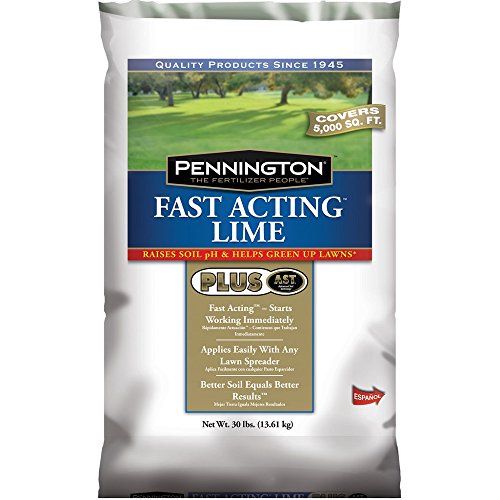
Pennington Fast Acting Lime
Compare when a soil test calls for magnesium as well as lime: archived Pennington artwork identifies dolomitic limestone. Verify its current bag label before choosing.
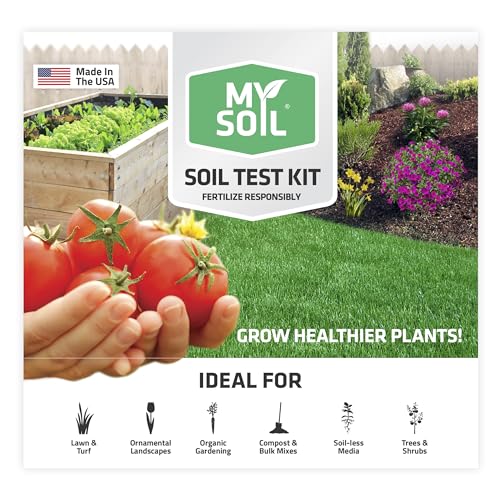
MySoil Soil Test Kit
For nutrient and pH information before choosing an amendment; obtain a suitable lime-requirement recommendation rather than calculating only from pH.
Sources & research notes
This review draws on published product information and relevant care or operating guidance. We have not conducted a hands-on trial of this product. General guidance explains the intended task; it does not establish this product’s performance.
Amazon: linked product identity, verified through Creators API
Commerce identity only; not evidence of product performance.
Buy on AmazonRead 2026-09-23
- MySoil: mail-in laboratory soil test kit
Read 2026-09-23
- Penn State Extension: Liming Turfgrass Areas
Read 2026-09-23
- Manufacturer: lightning product information
Read 2026-09-23
- Manufacturer: lightning factsheet or package label
Read 2026-09-23
- Espoma: lightning safety data sheet
Read 2026-09-23
- Alternative lime: manufacturer composition and rates
Read 2026-09-23
Check the product before ordering
Check the package size, formulation and current label directions.