
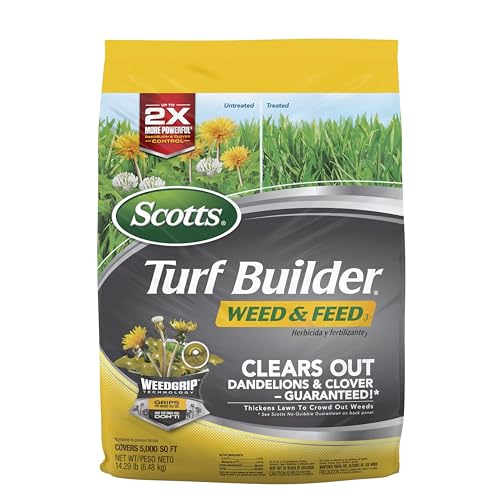
Scotts Turf Builder Weed & Feed3
An established-lawn product to evaluate only when both feeding and control of a listed weed are needed. It is not a routine companion to new grass seed, and the current 14.29-pound back-label directions remain unverified in this review.
- A good fit for
- A buyer who has identified the grass and target weed, needs both functions and can confirm the actual Weed & Feed3 label before application.
- The tradeoff
- The current retail identity is clear, but the detailed manufacturer label recovered here dates to 2015 and covers a smaller bag. Obtain the actual 14.29-pound package directions before relying on a rate or reseeding interval.
We may earn a commission from purchases through our links. How this works
Buy on AmazonProduct profile · Updated
Keep the version number and bag size together
The current retail identity is Scotts Turf Builder Weed & Feed3, model 25006A, in the 14.29-pound size. Its photographed front lists 5,000 square feet. This identifies the linked purchase option, not a current supply of complete application instructions.
The detailed manufacturer artwork recovered for this review is a 2015 Weed & Feed3 label hosted by a distributor. It is for the smaller 7.14-pound, 2,500-square-foot package. It documents that historical version of the product family, but should not be silently substituted for the exact current 14.29-pound back panel.
Before purchase, obtain the actual package label and compare the complete product name, net weight, active ingredients and registration number. Do not select instructions from a similarly named WinterGuard or Weed & Feed5 page. This details profile keeps that verification step visible instead of importing a newer formula’s directions.[1][4]
Decide whether both jobs need doing
- Only a nutrient need
- A weed-control combination is not automatically necessary for a lawn that only needs feeding.[4][3]
- A listed broadleaf weed and a feeding need
- Evaluate whether the actual product label permits the grass, timing and intended treatment.[4][3]
- A new seeding project
- Check the herbicide’s waiting intervals; do not treat weed-and-feed as a starter fertilizer.[4]
Read the combined-product decision
The archived Weed & Feed3 label combines a 28-0-3 fertilizer with 2,4-D and mecoprop-p for listed broadleaf weeds. Dandelion and clover appear among those targets. It is not simply a lawn fertilizer that happens to have a stronger name.
That combination is useful to evaluate when the lawn needs both an appropriate nutrient application and treatment of a weed listed on the actual label. If either need is missing, a combined product may not be the right purchase. Penn State’s nutrient guidance supports planning fertilizer around the turf’s needs rather than automatically feeding whenever weeds are noticed.
The zero middle number means the archived formula has no guaranteed phosphate contribution, but it does not make the product restriction-free. The herbicide component adds grass, weather, timing and exposure directions that must be checked alongside the nutrient rate. Identify the problem first, then assess whether one combined application fits it.[4][3]
Check the grass exclusions before the coverage figure
The archived label excludes St. Augustinegrass, including Floratam, as well as dichondra, lippia, carpetgrass and bentgrass. It also notes possible temporary discoloration on several warm-season grasses. These are meaningful limits to a broad established-lawn description.
They are also a reason to obtain the exact current label rather than relying on a retailer’s short description. The lawn’s grass identity comes before a favorable coverage number or a familiar brand. If the grass is uncertain, resolve that before selecting a herbicide product.
The older artwork does not establish current directions for every bag now sold under the linked listing. This page therefore does not publish a spreader setting or tell you to transfer the smaller bag’s quantity. Confirm the full current directions and applicable local requirements before treatment.[4][1]
Reseeding timing is a separate buying decision
The historical Weed & Feed3 label requires waiting until newly seeded, sodded or sprigged grass has been mowed four times before application. In the other direction, it specifies at least one month after use before seeding, sodding or planting sprigs. These are the archived label’s conditions, not a universal schedule for every weed-and-feed formula.
That distinction matters when a homeowner is trying to repair thin grass and remove weeds in the same project. A desired planting date can conflict with herbicide timing. Obtain the exact current package directions before placing both products in the plan.
Scotts Starter Food is a different product intended for planting grass, with its own nutrient analysis and directions. It can be a relevant comparison when the actual job is establishment and a starter nutrient mix is justified. It does not provide the same weed-control function, and this page does not recommend adding fertilizer regardless of soil need.[4][5][3]
Weather, water and exposure instructions need the full label
The archived artwork calls for moist grass so particles contact weed leaves, actively growing weeds and suitable temperatures. It also specifies a period without watering or expected rain after treatment. Those conditions illustrate why weed-and-feed instructions cannot be replaced with the simple spread-and-water routine of another fertilizer.
The same label addresses drift, water setbacks, hard-surface cleanup, clothing, eye irritation and keeping people and pets away during application and until dust settles. Its pesticide warning includes aquatic organisms. A broad pet-safe or harmless-to-waterways statement would erase important conditions.
Use the complete current label for the actual product, not this overview as an application manual. If a seller cannot supply it, resolve that gap before use. The useful buying decision is whether this exact combination fits the lawn, the weed and the project schedule; a familiar bag and a large coverage claim cannot answer those questions alone.[4][1]
When to choose something else
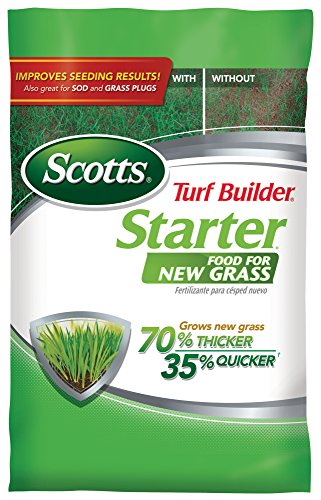
Scotts Turf Builder Starter Food for New Grass
For planting grass when a starter nutrient mix is appropriate. It serves establishment rather than the Weed & Feed3 broadleaf-control function; check soil need and its separate directions.
MySoil Soil Test Kit
For nutrient and pH information when it is unclear whether feeding should accompany any separate weed-control decision.
Sources & research notes
This profile draws on published product information and relevant care or operating guidance. We have not conducted a hands-on trial of this product. General guidance explains the intended task; it does not establish this product’s performance.
Amazon: current linked product identity and photograph
Commerce identity only; not evidence of product performance.
Buy on AmazonRead 2026-09-23
- MySoil: mail-in laboratory soil test kit
Read 2026-09-23
- Penn State Extension: turfgrass fertilization, soil testing and fertilizer grades
Read 2026-09-23
- Scotts: archived Weed & Feed3 label for 7.14-pound size (2015)
Read 2026-09-23
- Scotts: current Starter Food for new grass
Read 2026-09-23
Check the product before ordering
Check the package size, formulation and current label directions.