
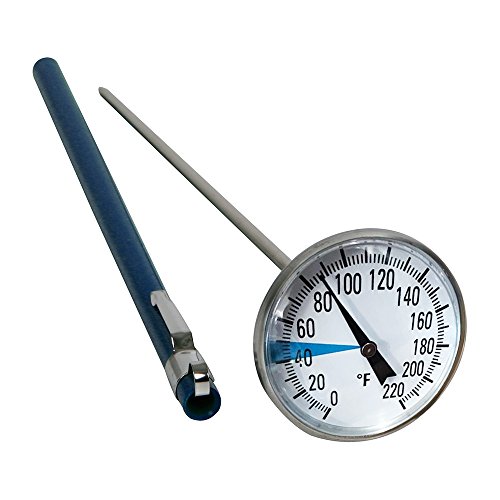
Smart Choice Stainless Steel Soil Thermometer
Consider it for basic in-person temperature observations when the listed stem and dial fit your task. Verify the supplied operating instructions before relying on a precise threshold.
- A good fit for
- A gardener who wants to read soil temperature on a physical dial and record a consistent series of observations.
- The tradeoff
- The listing gives a 0–220°F range, not a verified accuracy tolerance. We did not establish sensing depth, stabilization time or a calibration method for this exact model.
We may earn a commission from purchases through our links. How this works
Buy on AmazonProduct profile · Updated
The verified listing is a small analog instrument
The primary ASIN identifies Smart Choice model 43237-2, with a 127-millimeter, approximately five-inch stem and a 1.5-inch glass-covered dial. The photographed dial is marked in Fahrenheit from zero to 220 degrees. The listing describes stainless-steel components and use in soil and compost.
Those are advertised dimensions and intended uses, not independently measured performance. The statement that it is more accurate than digital thermometers is a seller comparison without supporting test results in the material reviewed here. We do not adopt it.
This page remains a product-details profile because the exact operating manual, accuracy tolerance and calibration procedure were not established. The physical range should not be confused with resolution or accuracy. Before a purchase that depends on a narrow temperature difference, obtain the specification or choose an instrument with suitable documented performance.[1]
Soil temperature differs from the weather report
Wisconsin Extension explains that soil changes temperature more slowly than air and that location and surface conditions influence the measurement. Its vegetable-planting guidance uses repeated observations rather than a single warm day as a signal. That gives a reason to measure the ground itself.
The same publication distinguishes measurement depths for seeds and transplants, but those are garden instructions for that context. They are not this thermometer's sensing-depth specification or a grass-seed burial recommendation. Do not infer that a five-inch stem must always be inserted fully.
For turf, a Maryland Extension response emphasizes consistently measuring at the same depth and notes how altered soil profiles change conditions. Use relevant guidance for the plant and decision involved. A thermometer supplies a reading; it does not select the grass species or establish a universal planting window.[6][7][1]
Separate dimensions from measurement performance
Check what the specification actually establishes.[1]
- Listed dimensions
- Approximately five-inch stem and 1.5-inch dial.[1]
- Listed range
- The Fahrenheit face spans 0–220°F; range is not an accuracy tolerance.[1]
- Still unverified
- Exact sensing depth, stabilization time and calibration procedure.[1]
Read the measurement limits
The stem length tells you the size of the listed product. It does not establish which portion of the stem senses temperature or the minimum insertion needed for a reliable reading. Likewise, the dial's wide temperature range does not establish how closely its needle agrees with a reference instrument.
The reviewed listing does not give a verified stabilization time, so this profile does not invent a two-minute wait or claim an immediate accurate result. Read the instructions supplied with the actual unit and check any required insertion and equilibration procedure.
For someone comparing tools, those missing details are meaningful. The design may suit simple observation, while work that requires repeatable numerical precision calls for documentation beyond a general accuracy claim. We also have no basis here to recommend an improvised calibration or to treat the product as a reference standard.[1]
Build a consistent record, then interpret it locally
Choose the context
Use guidance for the plant and task, including its measuring depth.[6][7]
Repeat consistently
Interpret the pattern
Consider location and conditions rather than using one reading as a universal planting command.[6][7]
Read the observation sequence
Choose a representative location and use the depth appropriate to the guidance you are following. Record the location, depth, time and reading so that a later observation has context. Wisconsin's garden guidance uses observations on three consecutive days at a consistent time; the Maryland turf response similarly stresses consistent depth.
Different exposures may justify separate observations. A shaded lawn and a sunny garden bed should not be assumed to share the same soil temperature merely because they sit on one property. The extension sources explain why local conditions matter more than treating one general weather value as a direct soil measurement.
Keep the scope modest: this is guidance for making observations useful, not a verified operating manual for Smart Choice. The exact instrument instructions still govern how to insert and read it. No temperature in this profile is presented as a universal grass-seeding trigger.[6][7][1]
Do not substitute temperature for soil analysis
A thermometer answers a physical-temperature question. It does not report pH or nutrient levels, and the listing does not establish a soil-moisture function. If the uncertainty is whether the lawn needs lime or fertilizer, a laboratory test addresses a different and more relevant question.
MySoil is one such option in this catalog, offering mail-in pH and nutrient analysis with recommendations. It is an alternative purchase for nutrient planning, not another style of thermometer. You may need different tools for separate decisions, rather than expecting one inexpensive dial to settle all of them.
The Smart Choice listing remains a candidate for basic observations if its documented dimensions fit. The unresolved operating and accuracy specifications are the reason to verify further before relying on a precise threshold, rather than accepting claims of superiority over digital instruments.[1][2]
When to choose something else
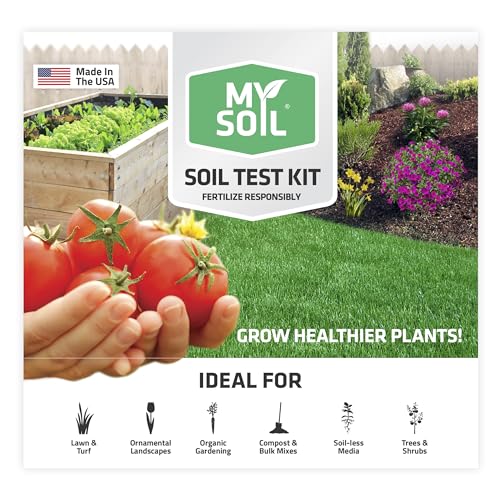
MySoil Soil Test Kit
Choose laboratory nutrient and pH analysis when the purchasing decision concerns fertilizer or amendments rather than temperature.
Sources & research notes
This profile draws on published product information and relevant care or operating guidance. We have not conducted a hands-on trial of this product. General guidance explains the intended task; it does not establish this product’s performance.
Amazon: linked product identity and features
Commerce identity only; not evidence of product performance.
Buy on AmazonRead 2026-09-23
- MySoil: current kit and analysis scope
Read 2026-09-23
- Soil Savvy: sampling, report access and test scope
Read 2026-09-23
- University of Maryland: choosing and using a soil-testing laboratory
Read 2026-09-23
- University of Minnesota: lawn and garden laboratory services
Read 2026-09-23
- Wisconsin Extension: measuring temperature for vegetable planting
Read 2026-09-23
- Ask Extension: Maryland turf depth and consistent readings, 2014
Read 2026-09-23
Check the product before ordering
Check the exact model, included parts and compatibility.