
Fall Is Prime Time
Fall is the #1 seeding window for cool-season grasses. Soil is warm, air is cool, and weed pressure drops. If you're planning to seed, now is the time.
Browse catalog starting points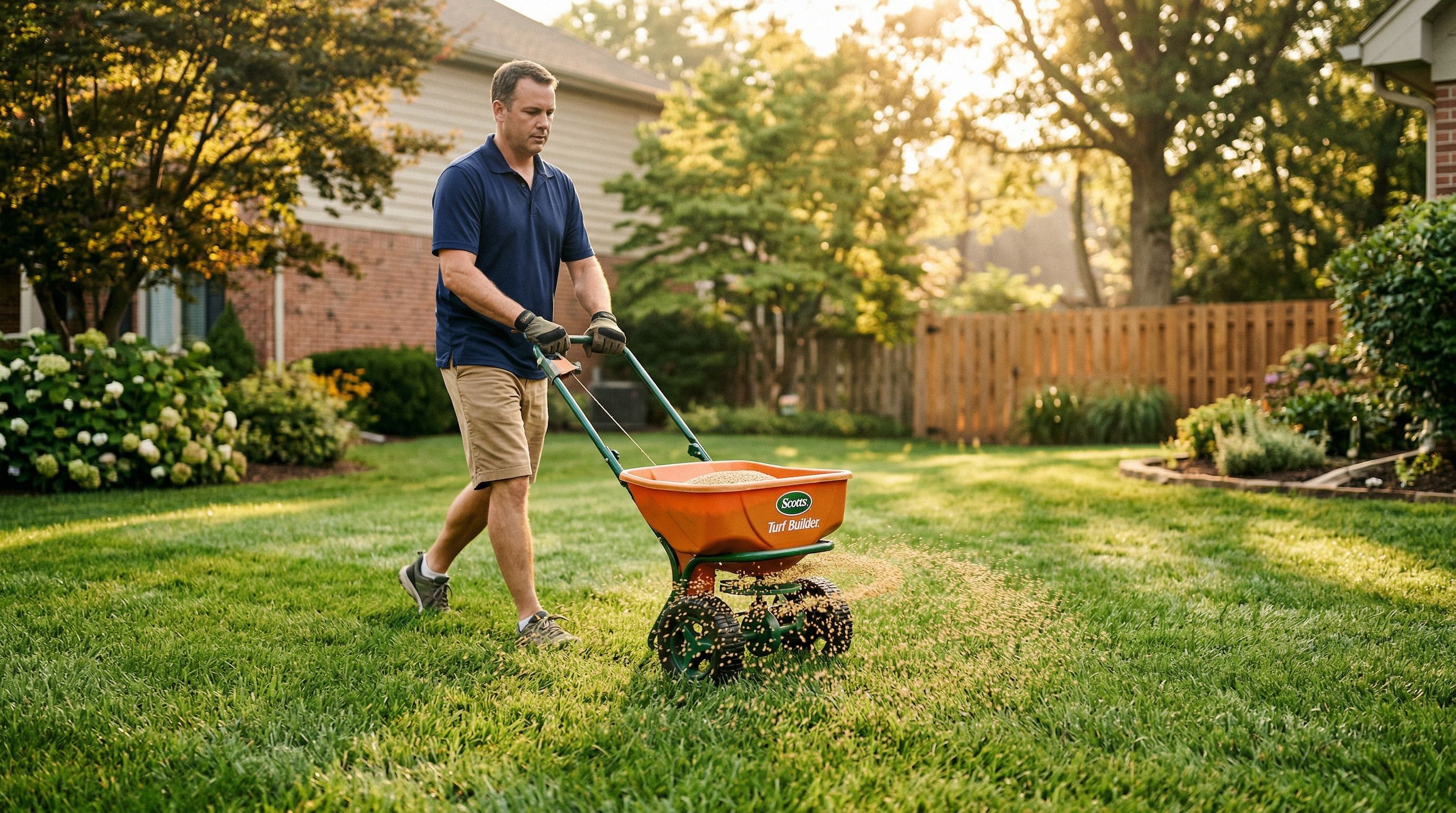
Best Overseeding Equipment: Spreaders, Dethatchers & More
Choose equipment around the work your lawn needs: diagnosis, surface preparation, spreading and watering. The product reviews below explain the operating burden, compatibility and limits of each tool so you can plan the project before buying.
The Overseeding Tool Sequence
Start by identifying why the lawn is thin and which grass belongs there. Soil testing, thatch removal, aeration and leveling solve different problems; they are not a compulsory shopping list for every overseeding.
- Diagnose: identify the grass, growing conditions and soil questions.
- Prepare where needed: choose thatch removal, core aeration or leveling for a specific problem.
- Plan treatments: check any weed-control waiting intervals and nutrient needs before seeding.
- Spread: use the seed’s directions and a calibrated, compatible spreader.
- Water and protect: plan how to maintain seedbed moisture and manage traffic while seedlings establish.
Pro Tip
Pair this equipment with the right feeding — see the lawn fertilizer hub to compare fertilizer purposes and label restrictions — and the timing in our overseeding guide.
Spreaders: Best for Overseeding
Compare the spreading pattern with the shape of the lawn. Broadcast machines cover a wider swath, drop spreaders release material in a defined band, and handheld models suit smaller jobs. Use the actual material and spreader instructions, then calibrate; advertised hopper coverage is not a guarantee of uniform application.
Scotts Turf Builder EdgeGuard DLX (Broadcast)
The linked label specifies five-foot pass spacing, while the current webpage suggests about 50% overlap. Match the instructions to the unit and material, then verify the applied rate.
Scotts Turf Builder EdgeGuard DLX Broadcast Spreader
Scotts
A push broadcast spreader for medium to large lawns, with a right-side shield for edges and a hopper advertised to hold up to 15,000 square feet of Scotts product. Calibration still matters.
For Larger Areas: Scotts Elite (Broadcast)
The linked label and instruction booklet specify six-foot pass spacing; the current webpage suggests roughly 50% overlap. Wider advertised coverage does not remove the need to calibrate.
Scotts Elite Spreader
Scotts
A dual-rotor push spreader with a nominal six-foot pattern, EdgeGuard and a larger hopper than the DLX. Its hardware suits larger jobs, but the published pass-spacing instructions need careful matching.
Drop Pattern: EarthWay 7312 Drop Spreader
The narrow path means more passes across a large lawn. Avoid both skipped strips and repeated full-rate overlap; a drop pattern does not make application mistakes impossible.
EarthWay 7312 Drop Spreader (75 lb)
EarthWay
A seventy-five-pound drop spreader that places material in a controlled twenty-two-inch path beneath the hopper. It suits boundaries and confined areas, with careful adjacent passes as the main tradeoff.
Handheld: Scotts Whirl Hand Spreader
The advertised 1,500-square-foot capacity is product-dependent, and the hand-crank workflow adds another speed variable. It is not a precision drop spreader for protected edges.
Scotts Whirl Hand-Powered Spreader
Scotts
A small hand-crank broadcast spreader for feeding, seeding and ice melt, with adjustable arm support. Its usefulness comes from portability, while output depends on both your walking and cranking rhythm.
Tow-Behind: Agri-Fab Pull-Behind Broadcast
The manual uses a three-mph application reference and a six-mph maximum. It warns against steep slopes, and the correct swath depends on the material.
Agri-Fab Pull-Behind Broadcast Spreader (130 lb)
Agri-Fab
A 130-pound-capacity tow spreader for larger open areas when you already have a suitable lawn tractor. Its spread width changes with material and speed, so a twelve-foot headline is not a universal seed pattern.
Dethatchers: Manual vs Electric
Inspect the layer between the green lawn and soil before deciding to remove thatch. A rake and a powered dethatcher remove surface material; they do not pull soil cores. Powered scarification adds a different cutting action. Match the intervention to the lawn, and plan recovery time, cleanup and suitable electrical supply.
Sun Joe AJ805E Electric Dethatcher & Scarifier
The scarifier and raking cylinder use different depth guidance. The bag also needs frequent emptying, and the machine does not remove soil cores to relieve compaction.
Sun Joe AJ805E 15-Inch Electric Dethatcher & Scarifier
Sun Joe
A corded fifteen-inch lawn tool with separate spring-tine and scarifying cylinders. Its adjustable depth and collection bag are useful only when excess thatch or surface preparation is actually the job your lawn needs.
Greenworks 14-Inch Corded Dethatcher
The listing says three depth positions, the maker page also says four, and its linked DHA103 manual illustrates five. Do not buy on an assumed setting count or an unverified bag configuration.
Greenworks 14-Inch Corded Dethatcher & Scarifier
Greenworks
A corded fourteen-inch dethatcher and scarifier with interchangeable cylinders. The linked model is DT13B00 / DHA103, but published depth-position and collection-bag information is inconsistent and needs checking against the actual package.
Manual: Walensee 15-Inch Thatch Rake
A long adjustable handle does not remove the physical effort. The rake works the surface; it does not extract soil cores or make aggressive annual dethatching necessary.
Walensee 15-Inch Thatch Rake
Walensee
A manual fifteen-inch thatch rake with nineteen curved tines, an adjustable head angle and a sectional handle. It suits a small, justified surface-cleanup job when hand effort is practical.
Core Aerators
Core aeration removes soil plugs and addresses a different problem from surface thatch. Choose equipment and timing for actual compaction and soil conditions. A tow aerator also requires a compatible tractor, turning space and an operating plan; adding ballast is subject to the model’s instructions.
For Larger Areas: Agri-Fab 48-Inch Tow-Behind Plug Aerator
The retail listing permits up to 175 pounds of ballast, while the linked 45-02993 manual says 140. Resolve the model-specific limit before loading; three-inch plugs are an upper capability, not a guaranteed result.
Agri-Fab 48-Inch Tow-Behind Plug Aerator
Agri-Fab
A forty-eight-inch tow-behind plug aerator for a compatible lawn tractor. It is designed to remove soil cores, but actual penetration depends on conditions and the published ballast limits disagree.
For a lawn without a suitable tractor, compare rental core-aeration equipment or a service with the work involved in towing and storing your own machine.
Leveling Rakes & Topdressing
Leveling rakes distribute suitable topdressing over shallow uneven areas. They do not diagnose drainage problems or turn every bump into a finished seedbed. Choose a material compatible with the existing soil and a manageable layer; wider heads also require more room and effort to move.
Landzie 36-Inch Lawn Leveling Rake
The broad head needs working room and manual effort. Material choice matters as much as the tool; golf-course sand practices do not transfer automatically to native home-lawn soils.
Landzie 36-Inch Lawn Leveling Rake
Landzie
A thirty-six-inch steel leveling rake for spreading suitable topdressing into shallow uneven areas. The broad head and sectional handle define its fit; it does not replace a thatch rake or repair a drainage problem.
Stainless Plate: Rocklin Stainless Steel Leveling Rake
Stainless steel is a construction specification, not proof of unlimited outdoor life. The rake also cannot substitute for diagnosing compaction, excess thatch or persistent drainage problems.
Rocklin Stainless Steel Lawn Leveling Rake
Rocklin
A thirty-inch stainless steel leveling rake with a long handle that can be shortened for tighter work. It distributes topdressing across shallow uneven areas; material selection and the cause of the unevenness still need attention.
Sprayers
Buy a sprayer only when the project calls for a permitted liquid treatment. Chemical compatibility, calibration and the product label determine its use; neither weed control nor liquid feeding is automatically required for new seed. Observe the actual chemical’s reseeding interval rather than a universal wait.
Small Tank: Chapin 20004 1-Gallon Pump Sprayer
One gallon is tank capacity, not a fixed treatment area. Pumping, calibration and thorough cleaning remain part of every job.
Chapin 20004 1-Gallon Pump Sprayer
Chapin
A one-gallon hand-pump sprayer for a defined liquid-treatment job, with an adjustable nozzle and a modest refill capacity.
Backpack Format: Field King 190328 Backpack Sprayer
The advertised 150 PSI is an upper pump capability, not a universal application setting. The internal pump does not remove inspection, maintenance or exposure precautions.
Field King 190328 Backpack Sprayer (4 Gallon)
Field King
A four-gallon manual backpack sprayer with an internal pump, several nozzle options and serviceable filters for a calibrated liquid-treatment job.
Soil Test Kits
A laboratory soil test can help distinguish nutrient or pH needs from problems that another fertilizer will not solve. Compare what each kit measures, its sampling procedure and the scope of its recommendations. A home screening kit, probe and laboratory analysis are different tools.
MySoil Soil Test Kit
One kit analyzes one submitted sample. Mixing unlike areas hides their differences, and the advertised nutrient panel is not a complete test of every soil problem.
MySoil Soil Test Kit
MySoil
A mail-in laboratory kit for planning fertilizer around a sampled area, with pH, thirteen nutrient measurements and recommendations in an online account. Its value depends on collecting a representative sample.
Turn the results into action with our soil amendments guide and soil preparation guide.
Frequently Asked Questions
What spreader type should I consider for overseeding?
Choose by the lawn layout, material compatibility and calibration requirements. Broadcast, drop and handheld designs have different operating patterns; read the linked reviews for their specific limits.
Do I need to dethatch before overseeding?
Inspect the thatch layer first. Dethatching is a response to a specific surface problem, not an automatic requirement. Plan the treatment and recovery around the grass and season.
Should I aerate or dethatch before overseeding?
They address different problems: core aeration removes soil plugs, while dethatching removes material near the surface. Choose based on actual compaction and thatch conditions.
What is a lawn leveling rake for?
A leveling rake distributes suitable topdressing over shallow uneven areas. It does not replace core aeration or correct the cause of a drainage problem.
When should I schedule the work?
Use the planting window for your grass and region, then allow time for preparation, any treatment waiting intervals and establishment watering. Cool-season and warm-season projects need different timing.
General lawn-care context: University of Maryland Extension on aeration and thatch. Product-specific manufacturer instructions and other sources are linked in each review.