
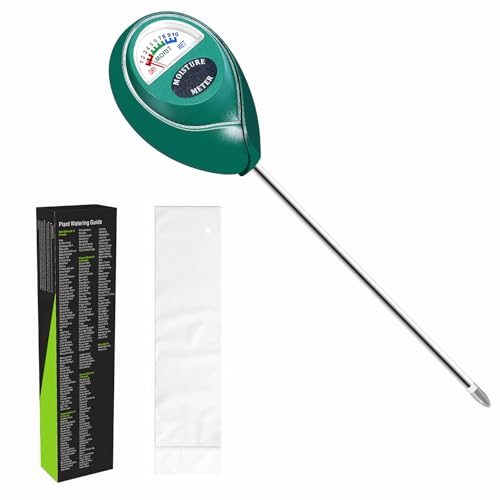
XLUX Plant Soil Moisture Meter
Consider it when a simple below-surface spot check is useful and you will remove and clean the probe after each reading.
- A good fit for
- A gardener comparing moisture at selected locations and depths, alongside observation of the surface and the plants.
- The tradeoff
- The listing says remove within five minutes; the T10 instruction sheet says not longer than one minute. Both describe temporary soil use, with no calibrated irrigation threshold supplied.
We may earn a commission from purchases through our links. How this works
Buy on AmazonResearch-based review · Updated
A simple dial answers a limited question
The linked XLUX T10 is a single-probe, battery-free moisture meter. Its analog dial has ten scale positions grouped into Dry, Moist and Wet. You insert the probe, observe the needle and remove it. No account, charging or sample shipment is part of that workflow.
The useful question is whether the soil at the probe's location appears relatively dry or moist. The numbered scale is not a percentage of water in the soil, and the reviewed material does not supply a calibrated volumetric-water measurement. Do not read a dial position as a laboratory result.
It also does not measure pH, fertilizer nutrients or temperature. If those are the questions driving a purchase, a moisture meter is the wrong instrument. The distinction matters in a lawn renovation, where a nutrient report and a watering observation serve different purposes even when both involve putting something into soil.[1][6][2]
Depth and location change the question
The manufacturer's instructions distinguish moisture at the surface from moisture deeper in a pot or garden. Inserting farther changes the depth being checked. A reading below the surface therefore cannot be assumed to describe the thin surface layer where seed has been placed.
A Maryland turf specialist's 2014 guidance emphasizes consistent measuring depth and warns that altered urban soil profiles vary in texture, compaction, exposure and water-holding capacity. That is useful context for choosing representative locations; it is not a universal calibration for this meter.
For practical comparison, decide which area and depth you are observing, then repeat consistently. A single reading from one corner is not evidence that an entire lawn has the same moisture condition. Keep the observation tied to the location and the stage of the project rather than turning one needle position into a whole-yard watering command.[6][7]
Read the instruction conflict before leaving it in place
- Listing care text
- Insert, read and remove within five minutes.[1]
- T10 instruction sheet
- Read after roughly two to five seconds; do not leave in soil longer than one minute.[6]
Read the care-source comparison
The current listing's care text says to insert, read and remove within five minutes. The reviewed manufacturer instruction sheet identifies model T10 and says the reading stabilizes after roughly two to five seconds, with the meter left in soil no longer than one minute. It links extended contact to corrosion of the probe tip.
Those are different upper limits, so this page does not conceal the disagreement. The common instruction is clear: this is a temporary spot-check instrument, not a sensor to leave planted. Take the reading promptly, remove the probe and follow the instructions supplied with the actual unit.
The instruction sheet also says not to immerse it in water. A glass of water is therefore not an appropriate substitute for the intended soil measurement or a meaningful calibration exercise. No continuous logging or unattended irrigation control is established by the reviewed product documentation.[1][6]
Probe care is part of the operating cost
Prepare the contact
Follow the instruction sheet’s tip-cleaning guidance before measurement.[6]
Measure temporarily
Insert into soil, let the reading settle and remove promptly.[6]
Clean and store
Wipe after use and use the supplied protective sleeve.[1]
Read the care sequence
The instruction sheet recommends wiping the probe tip with a coarse cloth or paper before use to remove surface oxides. The listing directs cleaning after use and storing the meter in its supplied protective sleeve. These are small tasks, but they are part of keeping a contact probe usable.
The current listing describes a slim 304 stainless-steel probe. That advertised material does not make the tip immune to the corrosion warning in the manual. It also does not independently prove the listing's comparative claims about root damage or long-term accuracy. We have not run those tests.
The model's pointed tip deserves ordinary care in handling and storage; the instruction sheet explicitly warns against being pricked. Buy the meter with the expectation that you will insert, read, remove and clean it, rather than leave it in the bed as a permanent marker.[1][6]
Keep a moisture observation separate from a nutrient plan
If a lawn looks poor, a moisture reading does not identify the fertilizer it needs. MySoil and Soil Savvy are mail-in laboratory services with nutrient and pH reports; XLUX is a field moisture instrument. They can answer different questions, but none should be described as a complete diagnosis of every lawn problem.
The T10's appeal is immediacy and a simple dial. Its limitation is interpretation: the reviewed sources do not provide a lawn-specific needle threshold that commands a certain number of sprinkler minutes. Soil profiles and measuring depth change what the observation represents.
Choose it as an additional spot-check aid if that fits your routine. If the actual uncertainty is which amendment to apply, prioritize a suitable soil analysis. If you need a logged or calibrated water-content measurement, this product's documented analog scale does not establish that capability.[2][3][1][6][7]
When to choose something else
MySoil Soil Test Kit
For the different question of soil nutrients and pH before choosing fertilizer; it does not replace a moisture spot check.
Sources & research notes
This review draws on published product information and relevant care or operating guidance. We have not conducted a hands-on trial of this product. General guidance explains the intended task; it does not establish this product’s performance.
Amazon: linked product identity and features
Commerce identity only; not evidence of product performance.
Buy on AmazonRead 2026-09-23
- MySoil: current kit and analysis scope
Read 2026-09-23
- Soil Savvy: sampling, report access and test scope
Read 2026-09-23
- University of Maryland: choosing and using a soil-testing laboratory
Read 2026-09-23
- University of Minnesota: lawn and garden laboratory services
Read 2026-09-23
- XLUX: model T10 instruction sheet
Read 2026-09-23
- Ask Extension: Maryland turf depth and soil-profile limitations, 2014
Read 2026-09-23
Check the product before ordering
Check the exact model, included parts and compatibility.