
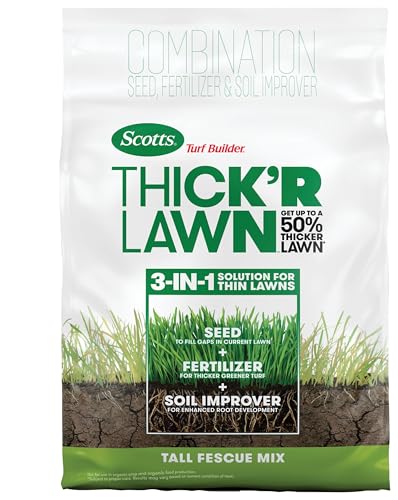
Scotts Turf Builder Thick'R Lawn Tall Fescue
A convenient combined treatment for a measured overseeding job. Diagnose why the grass thinned first, and make sure added fertilizer fits the lawn’s needs.
- A good fit for
- Thickening an existing tall-fescue lawn with a combined seed, fertilizer and soil-improver application.
- The tradeoff
- The 1,200-square-foot coverage applies to an existing lawn. It is not a bare-soil coverage figure, and the combined bag does not disclose your lot’s cultivar percentages.
We may earn a commission from purchases through our links. How this works
Buy on AmazonResearch-based review · Updated
Start with the lawn that is still there
- Existing thin fescue lawn
- The intended job: add seed and nutrients across existing grass.[5]
- Bare spots
- Scotts directs these repairs toward EZ Seed instead; Thick’R is not intended for this job.[5]
- New lawn
- Use a product with a stated new-lawn application rate; Scotts points to Rapid Grass.[5]
Read the fit guidance
Thick’R Lawn is intended to fill gaps within existing grass. The current Scotts directions explicitly say it is not intended for bare spots or establishing a new lawn. That distinction matters more than the size of the yard: a small area of bare soil is still a different job from thin grass across a large area.
For a lawn already based on tall fescue, the seed type can make sense. Penn State describes tall fescue as tolerant of moderate shade and capable of deep rooting, while also noting that it is primarily bunch-forming and has only fair recovery from damage. Those species traits explain why adding seed may help a suitable but thin stand; they do not prove how this particular combination performs.
Before applying, investigate persistent shade, compacted soil or another cause of decline. University of Minnesota renovation guidance emphasizes understanding the problem and choosing a suitable grass. A one-bag treatment is a practical format, but it cannot by itself change the conditions that made the lawn thin.[5][4][1]
Understand the three components
The product combines tall fescue seed, fertilizer and a soil improver. Scotts lists a 9-1-1 fertilizer analysis on its current product page. The 12-pound package weight includes the combined material, so it is not equivalent to 12 pounds of plain seed.
The format reduces the number of separate products involved in the application. It also means the seed and fertilizer arrive together. If you want to select a specific cultivar blend, choose a separate fertilizer rate or respond to a soil test with particular nutrients, a combined product gives you less independent control over those decisions.
The reviewed generic bag artwork is not the seed-analysis tag for the lot that will arrive. It does not establish current cultivar proportions, purity or tested germination. Read the actual tag when those details matter, and use a soil test and local guidance to decide whether additional nutrients are appropriate. Convenience is a defensible reason to consider this product; superior seed quality is not established by its format.[5][6][2][1]
Measure the thin lawn before filling the spreader
- 600 sq ft of thin lawn
- 6 lb, calculated from 12 lb covering 1,200 sq ft.[6]
Read the application calculation
The matching 12-pound package covers 1,200 square feet of existing thin lawn. That works out to ten pounds of combined product per 1,000 square feet. It is the rate for this product’s intended thickening application, not a general tall-fescue seeding rate.
For a 600-square-foot area, the same coverage implies six pounds. A 2,000-square-foot job needs 20 pounds, so one 12-pound bag is insufficient. These are simple calculations from the package coverage; they do not create a new bare-ground use for the product or justify applying more where grass is missing.
Check the current bag for the correct setting for your exact spreader. Scotts publishes different settings and pass counts for rotary, hand-held, drop and Wizz models. A setting number without the spreader type and number of passes is incomplete. Plan the route and quantity together, so an even application is the goal rather than using up whatever remains in the hopper.[5][6][7]
Prepare for seed contact and two weeks of moisture
Scotts recommends spring or late summer to early fall. Its preparation sequence starts with mowing to about two inches, then raking to loosen the soil and clear dead grass. The point is to give seed access to soil rather than leave it suspended in a layer of old plant material.
Apply evenly with the correct spreader instructions. Then water daily, or as needed, for the first two weeks to keep the soil moist. The manufacturer describes damp conditions rather than drenching. Arrange that watering before beginning the job; the soil improver and fertilizer are not substitutes for moisture while seed gets started.
The current page says to resume mowing once the new grass reaches the height of the surrounding lawn. Treat that as a growth milestone rather than a fixed date. Cool weather, moisture and the condition of the site can change how quickly the seeded areas catch up with the established grass.[5][6][1]
Read the thickness promise with its conditions
Scotts advertises up to a 50 percent thicker lawn from one application, subject to proper care and the lawn’s starting condition. That is a conditional manufacturer claim, not an independent measurement of what your lawn will gain. The current FAQ suggests visible results in two to three weeks; the package’s illustrative before-and-after image uses 35 days. Neither is a guarantee of a finished lawn by a deadline.
The maker also recommends spring and late-summer or early-fall applications. That promotion does not establish that every lawn needs the same fertilizer schedule. A soil test, local guidance and the fertilizer already applied should inform the broader program.
The package identifies fungicide-treated seed, including mefenoxam, and says it is not for food, feed or oil. Store it away from food and children. Follow the label’s runoff precautions and sweep granules from paved surfaces back onto the lawn. The combined format still carries ordinary application and handling responsibilities.[5][6][1]
Switch products when the job changes
For isolated bare spots, EZ Seed Sun and Shade is a more relevant comparison because its seed, mulch and fertilizer format is designed for patch repair. It uses a different cool-season grass mixture, so it is not automatically a texture match for a tall-fescue-only stand. Check the species as well as the convenience of the application.
For extensive bare ground or a new tall-fescue lawn, Rapid Grass Tall Fescue has a stated new-lawn rate as well as an overseeding rate. It combines tall fescue seed with fertilizer, but its coverage and application directions differ from Thick’R Lawn. Carrying over the ten-pound thickening rate would be the wrong comparison.
If the underlying problem is unsuitable growing conditions, neither alternative removes the need to address it. Choose the product after deciding whether you are thickening surviving grass, repairing discrete bare patches or establishing a new stand. That sequence makes the differences among these similar-looking Scotts bags useful.[5][8][9][1]
When to choose something else
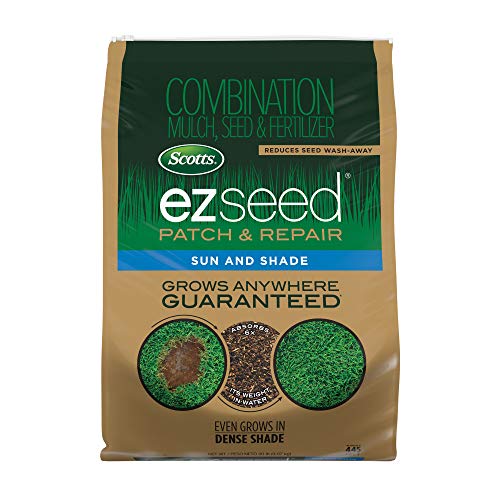
Scotts EZ Seed Patch & Repair Sun & Shade
For bare spots rather than a broadly thin lawn; its Sun and Shade grass mixture differs from tall-fescue-only seed.
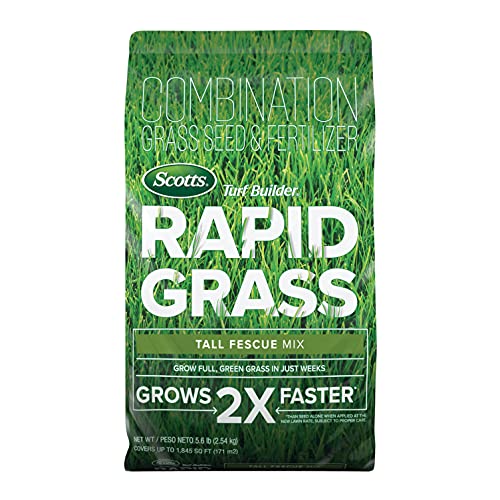
Scotts Turf Builder Rapid Grass Tall Fescue Mix
For a new tall-fescue lawn or extensive bare ground, with a separate new-lawn rate.
Sources & research notes
This review draws on published product information and grass-selection guidance. We have not conducted a hands-on trial of this product. Species guidance helps explain the choice; it is not a trial of the bag you buy.
- University of Minnesota Extension: renovating a lawn
Read 2026-09-23
- UMass Extension: understanding the turfgrass seed label
Read 2026-09-23
- Pennington: The Rebels Tall Fescue Grass Seed Blend
Read 2026-09-23
- Penn State Extension: turfgrass species for Pennsylvania, bluegrass and fescues
Read 2026-09-23
- Scotts: package-specific product description and directions
Read 2026-09-23
- Scotts: manufacturer package artwork
Read 2026-09-23
Amazon product identity: Scotts Turf Builder THICK'R Lawn Tall Fescue Mix, 12 lb.
Commerce identity only; not evidence of product performance.
Buy on AmazonRead 2026-09-23
- Scotts: package-specific product description and directions
Read 2026-09-23
- Scotts: package-specific product description and directions
Read 2026-09-23
Ready to compare the bag?
Check the package size and seed tag before ordering.