
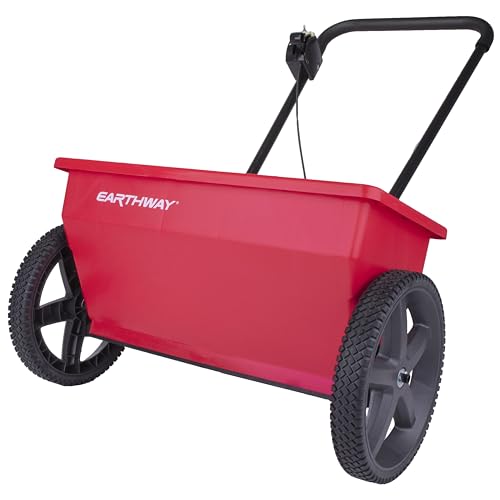
EarthWay 7312 Drop Spreader (75 lb)
Choose it when narrow placement matters more than covering open ground in wide broadcast passes.
- A good fit for
- A homeowner applying compatible seed or fertilizer near beds, sidewalks and property boundaries.
- The tradeoff
- The narrow path means more passes across a large lawn. Avoid both skipped strips and repeated full-rate overlap; a drop pattern does not make application mistakes impossible.
We may earn a commission from purchases through our links. How this works
Buy on AmazonResearch-based review · Updated
The placement method is the reason to choose it
EarthWay model 7312 carries material in a seventy-five-pound hopper and releases it through openings beneath that hopper. The manufacturer specifies a twenty-two-inch application path and twelve-inch semi-pneumatic tires. This is a drop spreader rather than a rotary machine throwing granules outward.
That narrower placement suits a site where beds, sidewalks or property lines make a broad broadcast pattern inconvenient. The hopper capacity can reduce refill stops, but the fixed narrow path still determines how closely the operator must place each pass.
The product is not a guarantee of zero drift, zero spills or safe application of any chemical beside a garden. Compatibility and handling remain governed by the material's label. The useful advantage is controlled placement beneath the hopper, not immunity to wind, operator error or an inappropriate product choice.[6][8][2]
Place adjacent swaths, not repeated full-rate bands
- Adjacent full-rate paths
- Meet the treated bands carefully while aligning the wheel paths appropriately.[2]
Read the pass-planning details
Penn State explains that material from a drop spreader falls between the wheels. Adjacent treated bands should meet without gaps or excessive overlap. Wheel paths may overlap to achieve that relationship, but overlapping wheel tracks is not the same as deliberately applying a second full dose across the treated strip.
This distinction is the main operating discipline of a drop spreader. Small skips or overlaps can create visible differences in the lawn. Its twenty-two-inch path requires more closely spaced trips across a large area than a wider rotary pattern.
The EarthWay manual illustrates both a full-rate path and perpendicular half-rate paths. Penn State similarly describes splitting the desired application into two directions to reduce the visibility of skips. If that method is chosen, calibrate each pass for half the total intended rate; do not halve a dial number and assume the flow follows linearly.[8][6][2]
Separate a flow setting from a measured application
The manual supplies a setting matrix based on pounds per thousand square feet, with a separate grass-seed reference. Its example converts a twenty-pound bag covering ten thousand square feet into two pounds per thousand. That is a rate calculation, not proof that every material will flow identically at the suggested setting.
Penn State recommends calibration for each product, operator and spreader because granule characteristics and walking speed vary. Use the applicable label and manual setting as a starting point, then measure the amount dispensed over a known area.
The hopper's seventy-five-pound rating tells you how much compatible material it may hold. It does not supply a universal coverage area. Calculate the amount needed for the measured lawn from the actual seed or fertilizer directions, then use that planned quantity to check the application rather than simply emptying the hopper.[8][6][2]
Assemble the handle and practice the shutoff
Set up
Attach the handle and verify the right-side control orientation using the manual.[8]
Start flow while moving
Push forward and open the lever to the selected stop.[8]
Close before stopping
Pull the lever back before ending a pass or stopping movement.[8]
Read the operating sequence
The August 2024 manual shows the control assembly already attached to the hopper and handle components. The remaining handle attachment uses the supplied carriage bolts and wing nuts, with the control assembly facing up on the right side. Confirm the parts and orientation before loading.
The operating directions set the stop bolt on the rate gauge, then move the control lever forward while pushing to open flow to that stop. To end a pass, pull the lever back and close the openings before stopping. Practicing that motion with an empty hopper helps you understand the control before material is involved.
Plan turns outside the active application pattern and keep the operator's pace consistent. Penn State warns against backward operation and against rocking a nearly empty hopper during application. Refill when needed rather than trying to shake the last granules onto the final strip.[8][2]
Maintain the cable and the metal parts
EarthWay provides a separate cable-calibration sheet for a control that no longer opens fully at setting thirty. It describes loosening the clamp, closing the shutoff bar with the handle lever at zero, tightening the clamp and checking movement between zero and thirty. Follow the diagrams for your actual version.
That is mechanical adjustment of the control travel. It is different from calibrating product output over a measured area. A correctly moving cable does not establish a correct fertilizer rate, and changing the dial cannot repair a cable that no longer closes the openings properly.
After use, the manual says to empty remaining material, wash the spreader and allow it to air dry. It also recommends light oil inside the chassis tubing and on metal parts to prevent corrosion. The manufacturer's rustproof marketing does not make those care steps optional.[9][8][2]
Use a rotary spreader when the open area dominates
The DLX is a relevant alternative when you want wider broadcast coverage and a right-side shield near boundaries. Its setting and spacing instructions differ from the EarthWay's drop method, so changing equipment requires a new application plan. Do not transfer a numerical dial setting between the two.
The Elite is another walk-behind rotary choice with dual rotors and a nominal six-foot pattern. It favors a different pace of coverage than a twenty-two-inch drop path, while still requiring material-specific calibration and careful boundary work. Neither rotary model is established here as an accuracy winner.
Choose the 7312 for its placement method when that is the site's main constraint. If most of the job is a large unobstructed lawn, the extra adjacent passes may outweigh the narrower placement advantage. Assess it by the working width and control method that fit your lawn, rather than assuming a larger hopper makes the job faster.[3][4][6][2]
When to choose something else
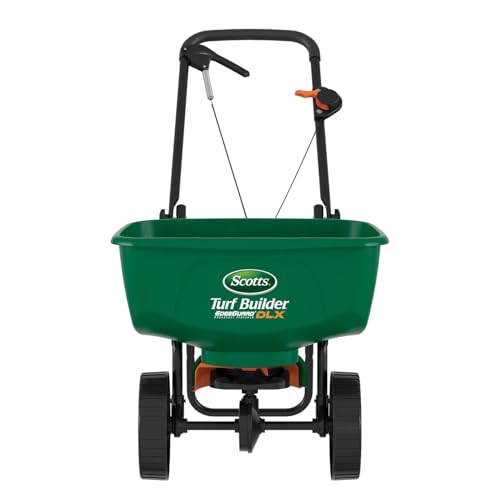
Scotts Turf Builder EdgeGuard DLX Broadcast Spreader
For a wider push-broadcast workflow with right-side EdgeGuard when broad lawn coverage matters more than a narrow drop path.
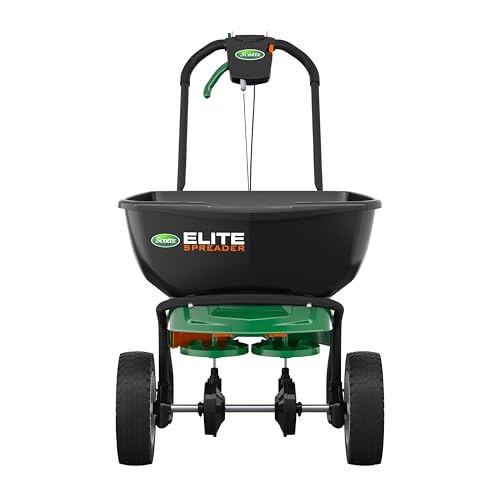
Scotts Elite Spreader
Compare the larger dual-rotor broadcast design for open areas, with its own settings and pass-spacing instructions.
Sources & research notes
This review draws on published product information and relevant care or operating guidance. We have not conducted a hands-on trial of this product. General guidance explains the intended task; it does not establish this product’s performance.
Amazon: current linked model and photographed product
Commerce identity only; not evidence of product performance.
Buy on AmazonRead 2026-09-23
- Penn State: calibrating fertilizer spreaders, April30,2025
Read 2026-09-23
- Scotts: current EdgeGuard DLX product page
Read 2026-09-23
- Scotts: current Elite product page
Read 2026-09-23
- Scotts: current Whirl product page
Read 2026-09-23
- EarthWay: current model7312 drop spreader
Read 2026-09-23
- Agri-Fab: model45-0463 specifications
Read 2026-09-23
- EarthWay: model7312 manual, August2024
Read 2026-09-23
- EarthWay:7312 cable calibration instructions
Read 2026-09-23
Check the product before ordering
Check the exact model, included parts and compatibility.