
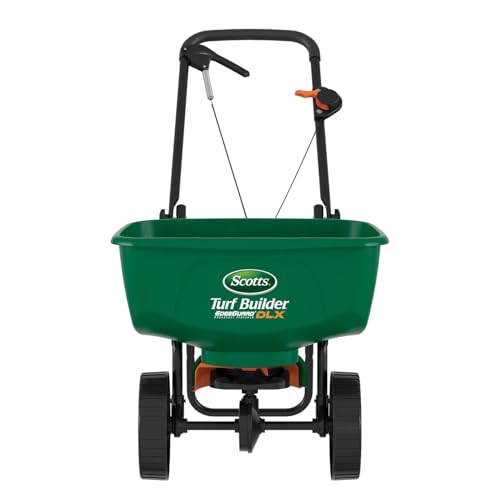
Scotts Turf Builder EdgeGuard DLX Broadcast Spreader
A practical choice when you want a wheeled broadcast spreader and right-side edge control, provided you check the actual product rate and pass spacing.
- A good fit for
- A homeowner treating a lawn large enough to favor a push spreader over a hand-crank model.
- The tradeoff
- The linked label specifies five-foot pass spacing, while the current webpage suggests about 50% overlap. Match the instructions to the unit and material, then verify the applied rate.
We may earn a commission from purchases through our links. How this works
Buy on AmazonResearch-based review · Updated
The DLX buys a wheeled workflow and an edge shield
The primary listing identifies model 76232. This is a rotary broadcast spreader: material drops from the hopper onto a rotating plate and is thrown outward as the operator pushes it. The EdgeGuard lever blocks the right side of that pattern near a driveway, sidewalk or bed.
That is useful control, but it does not make every boundary automatic. Plan the direction of the perimeter pass so the shield faces the area being protected. The current manufacturer page describes plastic, open-spoke wheels, and the matching photograph shows the green hopper and single-rotor arrangement.
Scotts describes the DLX as ready to use, with the handle raised and its fasteners tightened by hand. That limited setup burden is a reasonable reason to consider it. Claims that it guarantees uniform germination, eliminates all sweeping or is the correct choice for every lawn are not established by those features.[1][3][8][2]
Fifteen thousand square feet is a capacity description
The manufacturer says the hopper holds enough Scotts product for up to 15,000 square feet. This is not a fixed seed coverage rate. The amount of area treated by a hopper depends on the product, its density and the required application rate. New-lawn seeding and overseeding can require different quantities of the same bag.
The dial controls the hopper opening; its number is not pounds per thousand square feet. A setting printed for this model and product is a starting point, not a substitute for checking how much material actually leaves the spreader. Penn State recommends separate calibration for each spreader, operator and granular product.
Before filling, measure the treatment area and work out its required product quantity from the current product directions. That gives you a useful cross-check during application. A large hopper reduces refill interruptions; it does not decide how much fertilizer or seed belongs on the lawn.[3][2]
- Linked DLX label
- Five-foot spacing between passes, brisk four-feet-per-second walking speed and trigger release at turns.[8]
- Current webpage
- About fifty percent overlap or wheel-track-to-wheel-track guidance.[3]
Read the source difference
The manufacturer-linked 2022 DLX label says to walk briskly at four feet per second, release the trigger at turns and make each pass five feet from the previous one. It illustrates a five-foot broadcast pattern with EdgeGuard off and a three-foot controlled pattern with it on.
The current webpage instead advises roughly fifty percent overlap or wheel-track-to-wheel-track application. Those instructions should not be silently combined: changing pass spacing changes how much product lands on a given area. This is a material distinction, especially when applying a fertilizer or pesticide.
Use the instructions matching the actual unit and product, and ask Scotts to clarify a conflict that remains on the packaging you have. A measured calibration run provides an additional check on output. Do not solve the discrepancy by doubling the applied amount or assuming one generic overlap rule works for every broadcast model.[3][8][2]
Use a controlled start, stop and refill routine
Prepare
Measure the area, select the product-specific setting and fill where spills can be recovered.[8][2]
Apply while moving
Start walking before opening flow; close it for turns and stops.[8][2]
Check the total
If using two crosswise passes, calibrate each for half of the intended total product amount.[2]
Read the application sequence
Fill over a surface where a spill can be recovered, with the discharge closed. Scotts' label specifies a driveway and cleaning up spilled product. Begin walking before squeezing the trigger; release it at turns and before stopping so that material does not continue accumulating at one spot.
Keep a steady forward pace. Penn State advises against operating a spreader backward or rocking it to empty the last material from a nearly depleted hopper. Break up clumps or do not use the affected material, and avoid spreading lightweight material in windy conditions.
Two perpendicular passes can reduce the visibility of skips, but only when each pass is calibrated to deliver half the intended total rate. Half the application rate is not necessarily half the dial number. This technique is an application choice to calibrate, not a reason to apply a full dose twice.[8][2]
Clean it before the next treatment
A broadcast spreader carries fertilizer and sometimes pesticide particles through its hopper and moving parts. Penn State recommends thorough cleaning after application to prevent buildup and corrosion, with appropriate lubrication of moving parts before storage. The current product label governs handling of the material used.
EdgeGuard helps limit right-side scatter, but inspect hard surfaces afterward and recover stray granules. The DLX label explicitly calls for spill cleanup. Do not treat the webpage's claim of no more sweeping as permission to leave product where it can wash away.
The DLX is a consumer push spreader with useful convenience features. Its purchase should include willingness to measure the job, maintain a steady pace, check output and clean the equipment. We have not conducted a durability or distribution trial that would justify a performance rank over competing models.[8][3][2]
Choose a different spreader when placement or carrying changes
The Scotts Elite provides a dual-rotor design, a nominal six-foot pattern and greater advertised hopper capacity. Those are meaningful hardware differences, but its own instructions and settings still need checking. It is not evidence that the DLX necessarily leaves stripes or that the Elite guarantees better establishment.
EarthWay's 7312 takes a different approach: it drops material in a controlled twenty-two-inch path below the hopper. That narrower placement can suit confined areas and boundaries, at the cost of more closely spaced passes over open ground. Adjacent coverage still needs care.
For a small lawn where carrying the material is acceptable, the Whirl offers a hand-crank alternative. The DLX sits between that handheld routine and the larger or more specialized options. Choose it for the way you will work across the site, not because a capacity claim substitutes for a rate calculation.[4][6][5][2][3]
When to choose something else
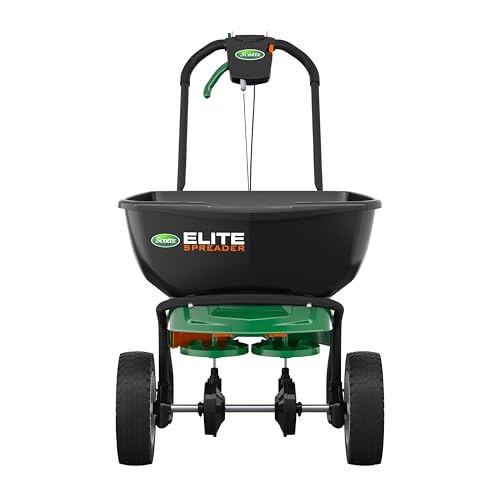
Scotts Elite Spreader
Compare the dual-rotor design, nominal six-foot pattern and larger advertised capacity; it has its own setting and spacing instructions.
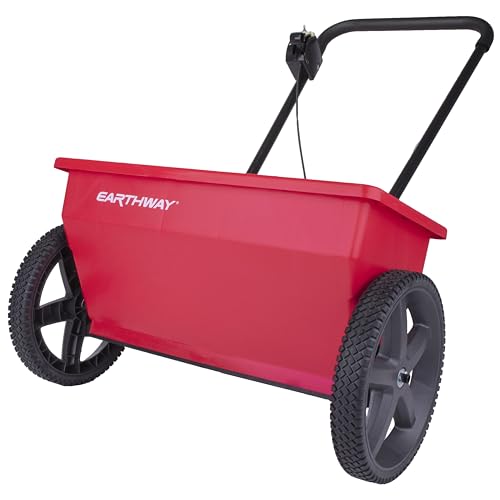
EarthWay 7312 Drop Spreader (75 lb)
For controlled placement in a narrower twenty-two-inch drop path near boundaries, accepting more passes across open areas.
Sources & research notes
This review draws on published product information and relevant care or operating guidance. We have not conducted a hands-on trial of this product. General guidance explains the intended task; it does not establish this product’s performance.
Amazon: current linked model and photographed product
Commerce identity only; not evidence of product performance.
Buy on AmazonRead 2026-09-23
- Penn State: calibrating fertilizer spreaders, April30,2025
Read 2026-09-23
- Scotts: current EdgeGuard DLX product page
Read 2026-09-23
- Scotts: current Elite product page
Read 2026-09-23
- Scotts: current Whirl product page
Read 2026-09-23
- EarthWay: current model7312 drop spreader
Read 2026-09-23
- Agri-Fab: model45-0463 specifications
Read 2026-09-23
- Scotts: manufacturer-linked dlx artwork
Read 2026-09-23
Check the product before ordering
Check the exact model, included parts and compatibility.