
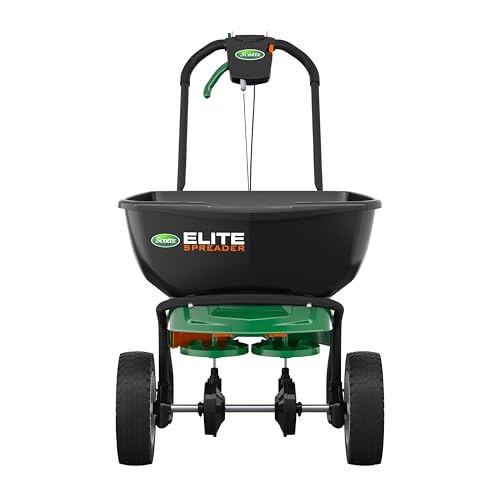
Scotts Elite Spreader
Consider it when the larger hopper and dual-rotor layout fit your lawn, with time to verify the material-specific setting and application pattern.
- A good fit for
- A homeowner who wants a larger walk-behind broadcast spreader with never-flat tires and right-side edge control.
- The tradeoff
- The linked label and instruction booklet specify six-foot pass spacing; the current webpage suggests roughly 50% overlap. Wider advertised coverage does not remove the need to calibrate.
We may earn a commission from purchases through our links. How this works
Buy on AmazonResearch-based review · Updated
Buy the hardware differences, not a striping promise
The linked model 75902 has two rotors, a black hopper, an ergonomic handle with a smartphone holder and ten-inch never-flat tires. Scotts advertises a six-foot spread pattern and capacity for up to 20,000 square feet of its lawn product. Those are the concrete differences to compare with the smaller DLX.
The manufacturer's twenty-percent-faster claim compares a six-foot pattern with a standard five-foot pattern. It is a stated comparison, not our timed trial across a real lawn with turns, refills and obstacles. Similarly, a dual-rotor design does not establish that every application will be stripe-free.
Choose the Elite when its capacity and wheeled configuration fit the work you intend to do. It still relies on the operator to choose the correct material setting, move consistently and shut off flow appropriately. The product name and promotional accuracy language do not replace those tasks.[1][4][9][2]
Capacity does not determine the fertilizer dose
The up-to-20,000-square-foot statement describes how much Scotts product the hopper may hold for an application. It is not a universal area that any seed, fertilizer or ice melt will cover. Product density, granule characteristics and the required rate determine the useful amount for your job.
Penn State recommends calibrating separately for each product and operator because spreaders and walking speeds vary. The Elite setting must be matched to the actual product. Do not borrow a DLX number simply because both spreaders carry the Scotts name.
Work from the product label to calculate how much belongs on the measured lawn area, then check output over a known test area. A higher-capacity hopper can reduce refills, but applying too much more quickly is not a benefit. The quantity planned for the treatment remains the useful reference.[4][2][8]
Read six-foot spacing and overlap in context
- Linked label and booklet
- Parallel internal passes six feet apart; the label specifies a brisk four-feet-per-second pace.[8][9]
- Current product webpage
- About fifty percent overlap or wheel-track-to-wheel-track guidance.[4]
- Why it matters
- Spacing changes treated area per pass, so verify output and the intended instructions together.[2]
Read the spacing comparison
The manufacturer-linked Elite label and the 2018 instruction booklet specify parallel internal passes six feet apart. The label also calls for brisk walking at four feet per second. EdgeGuard changes the illustrated pattern from a six-foot broadcast to a three-foot controlled spread.
The current product webpage instead suggests roughly fifty-percent overlap or wheel-track-to-wheel-track application. Those are materially different directions if applied to the same pattern. Pass spacing affects the amount deposited per square foot, so the conflict should be resolved before a full fertilizer or pesticide application.
Match the instructions to the unit and current lawn product, and ask the manufacturer for clarification where they disagree. Penn State's measured-output approach is a useful check on the actual application. Do not combine the webpage's overlap instruction with a rate calibrated for the booklet's spacing and assume the dose stays unchanged.[4][8][9][2]
Check assembly and start with the perimeter
Set up the actual unit
Check the package’s assembly instructions and hardware before loading.[9][1]
Control the boundary
Use the right-side EdgeGuard for the perimeter and close flow at turns.[9]
Apply the planned total
Verify the product-specific output; divide the total correctly if making two perpendicular passes.[2]
Read the setup and application sequence
The reviewed instruction booklet shows wheel installation with washers, cotter pins and hubcaps, followed by raising the handle and tightening its fasteners. The current retail listing says minor assembly is required, while the current webpage also contains fully-assembled language. Verify what is supplied with the actual package rather than promising no assembly.
The booklet describes a perimeter pass with EdgeGuard engaged, followed by the internal passes. The shield blocks the right side of the pattern. Orient the path accordingly and release the trigger at turns or when stopping. Start moving before opening the flow.
For a two-direction application, Penn State's method divides the intended total rate between the passes. It does not mean setting the dial to half its number or repeating the full product dose. Check the output for the actual treatment plan, particularly after changing material or operator.[4][1][9][2]
Plan for cleaning and product-specific care
The instruction booklet says not to leave unused material in the spreader. Return leftovers to their package, sweep granules off hard surfaces and wash the equipment thoroughly, including the underside. Allow it to dry before storage and lubricate rotating parts as directed. Keep product and rinse water out of storm drains.
The current listing also says to remove agitator pins when spreading coarse rock salt. That is a material-specific instruction, not a reason to remove parts during ordinary fertilizer use without consulting the applicable directions. The current webpage describes ice melt and screened rock salt among intended uses.
Never-flat tires avoid an air-inflation task, but they do not eliminate hopper, flow-control or moving-part maintenance. We have not verified the broad marketing claim that they handle any terrain. Choose a route and load you can control, and keep the material's own handling requirements part of the job.[9][4][1]
Compare the Elite with a simpler or narrower route
The DLX offers a single-rotor push-spreader workflow, right-side EdgeGuard and up-to-15,000-square-foot capacity. It may fit a job that does not require the Elite's larger hopper. This review does not establish a purchase-price saving or a measured accuracy difference between the two.
EarthWay's 7312 is a more substantial change of method: its twenty-two-inch drop path favors controlled placement directly beneath the hopper. It requires careful adjacent passes and more travel over a broad open lawn. That can be preferable when a wide broadcast pattern is the wrong fit for the boundaries.
The Elite is worth considering for its larger capacity, dual rotors and tire design. Make the buying decision around those documented features and your willingness to calibrate, rather than a promise that the machine alone delivers uniform seed-to-soil contact or eliminates operator error.[3][6][2][4]
When to choose something else
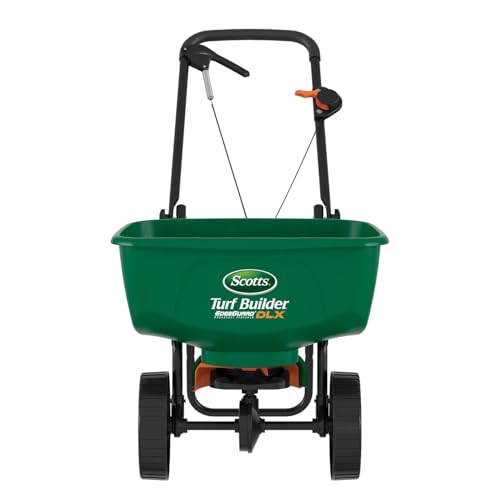
Scotts Turf Builder EdgeGuard DLX Broadcast Spreader
A smaller-capacity push broadcast option with right-side EdgeGuard; use its own settings and instructions.
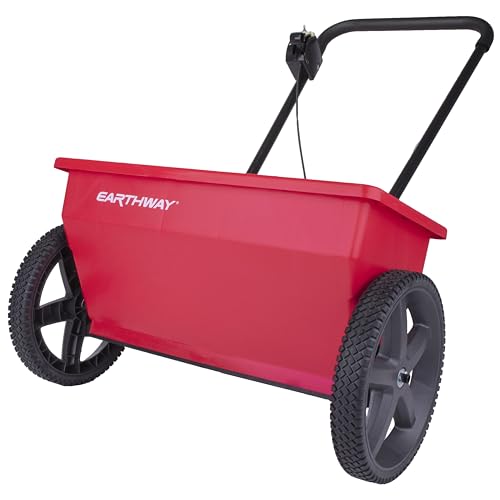
EarthWay 7312 Drop Spreader (75 lb)
For narrower drop placement near boundaries when a broad rotary pattern is less suitable.
Sources & research notes
This review draws on published product information and relevant care or operating guidance. We have not conducted a hands-on trial of this product. General guidance explains the intended task; it does not establish this product’s performance.
Amazon: current linked model and photographed product
Commerce identity only; not evidence of product performance.
Buy on AmazonRead 2026-09-23
- Penn State: calibrating fertilizer spreaders, April30,2025
Read 2026-09-23
- Scotts: current EdgeGuard DLX product page
Read 2026-09-23
- Scotts: current Elite product page
Read 2026-09-23
- Scotts: current Whirl product page
Read 2026-09-23
- EarthWay: current model7312 drop spreader
Read 2026-09-23
- Agri-Fab: model45-0463 specifications
Read 2026-09-23
- Scotts: manufacturer-linked elite artwork
Read 2026-09-23
- Scotts: 2018 Elite instruction booklet, retailer hosted
Read 2026-09-23
Check the product before ordering
Check the exact model, included parts and compatibility.