
Failure diagnosis lab
The 21-Day Germination Autopsy
When grass seed fails, the bag usually gets blamed first. Sometimes that is fair. More often, the autopsy points to one of five field conditions: moisture broke, seed was too deep or too exposed, soil temperature was wrong, water moved the seed, or the seedlings emerged into stress they could not survive. This guide shows what each failure looks like by day, how to prove it, and how to rescue the stand without starting over blindly.
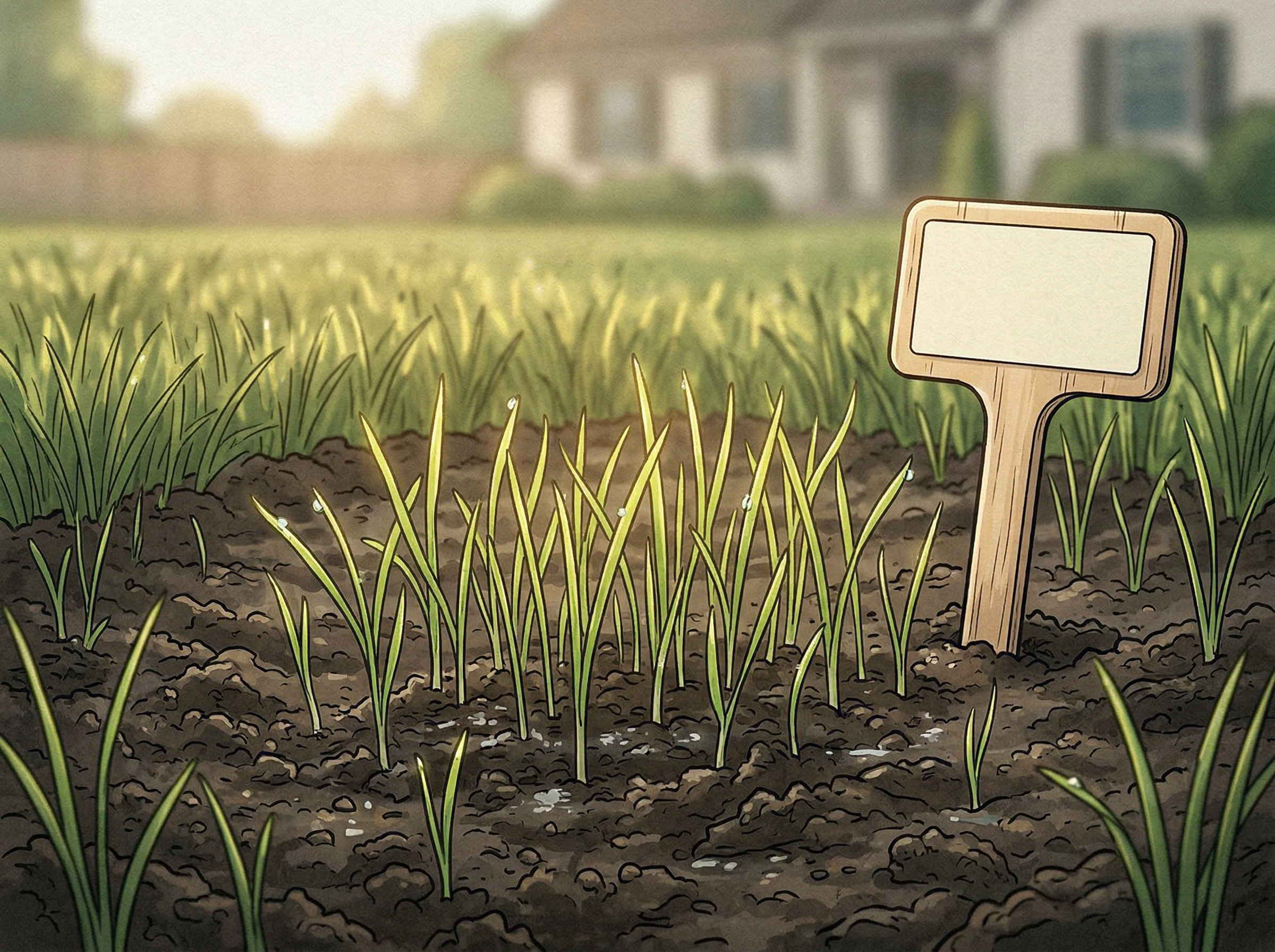
The diagnostic rule
Do not ask, "Did it germinate?" Ask which stage failed.
A failed seeding is easier to fix when you separate the biology from the field condition. Track the stage first, then test moisture, depth, contact, temperature, runoff, and seed quality.
Read the field in order
Stage one
Water uptake
Stage two
Radicle emergence
Stage three
Seedling survival
Species clock
7 / 14 / 21 days
Judge ryegrass, tall fescue, and Kentucky bluegrass on different calendars before calling a stand dead.
Soil temperature
59-86 degrees F
Purdue ranges put cool-season germination in a temperature window, not on a single fixed date.
Seed depth
Shallow cover
Grass seed needs oxygen, contact, and light cover. Too deep can fail as cleanly as too dry.
Bag proof
20-seed towel test
A simple side-by-side test separates a weak seed lot from a failed seedbed.
The Fast Answer
Timing is the strongest clue
The strongest diagnosis comes from timing.
No ryegrass by Day 7, no tall fescue by Day 14, and no Kentucky bluegrass by Day 21 usually means the seedbed failed, not that grass seed is impossible in your yard. Before buying another bag, check moisture, depth, contact, temperature, runoff, seed label age, and early weed pressure.
Most common cause
The surface dried after the seed absorbed water
Once seed imbibes water and starts internal germination, the top layer cannot repeatedly dry to dust. This is why short, light irrigation cycles matter in the first window.
Most overlooked cause
Seed was placed in the wrong physical layer
Grass seed needs contact with soil, oxygen, and shallow cover. It struggles when buried under compost, floating in straw, sitting on thatch, or packed into sealed clay.
The 21-Day Timeline
Purdue turfgrass guidance lists optimum germination temperature ranges around 59-86 degrees F for Kentucky bluegrass, 68-86 degrees F for tall fescue, and 68-86 degrees F for perennial ryegrass. That does not mean every seedling appears at the same speed. It means you should read the calendar by species.
Day 0
Seed-to-soil contact
What to see: Nothing visible. The only job is firm contact, shallow cover, and moisture.
Autopsy clue: If seed is sitting on thatch, buried more than about 1/2 inch, or floating in mulch, the failure started before watering.
Days 1-3
Imbibition
What to see: Seed absorbs water and swells. You usually will not see green growth yet.
Autopsy clue: If seed gets wet and then dries hard, it can lose viability before you ever see a sprout.
Days 4-7
Fast species show first
What to see: Perennial ryegrass and some fine fescues may show hairlike shoots in ideal weather.
Autopsy clue: No ryegrass by Day 7 usually means dry topsoil, cold soil, old seed, or seed washed out of the target area.
Days 8-14
Tall fescue window
What to see: Turf-type tall fescue should start appearing. Fine fescue should be visible in most good seedbeds.
Autopsy clue: Patchy tall fescue at this point usually traces to irrigation coverage, seed depth, compaction, or uneven spreading.
Days 15-21
Kentucky bluegrass patience zone
What to see: Kentucky bluegrass may finally begin to show, especially in cool weather or mixed seed.
Autopsy clue: If nothing has emerged after 21 days of proper moisture and temperature, assume a seedbed, seed-quality, or weather failure and repair deliberately.
Pro tip
If There Are No Sprouts at All
A completely blank seedbed is a narrow set of problems. Grass seed needs moisture, favorable temperature, and oxygen. If none of the seed shows up, one of those requirements probably failed across the whole area.
Moisture
The top layer dried between watering cycles or crusted after heavy irrigation.
Temperature
Soil was too cold, too hot, or swinging outside the practical range for the species.
Oxygen
Seed was buried too deep, sealed under wet compost, or sitting in saturated soil.
The cleanest proof is a side-by-side germination test. Put 20 seeds from the same bag on a damp paper towel, seal it in a bag, keep it warm, and count how many sprout. If the towel test works but the lawn did not, the bag is not the main suspect. If the towel test fails too, the label date, storage history, or seed lot deserves scrutiny.
If Germination Is Patchy
Patchy germination is usually a map. The pattern tells you whether the seed moved, dried, missed contact, or ran into a microclimate problem.
Symptom to fix
Read the pattern before adding more seed
| Signal | Likely diagnosis | Field proof | Next move |
|---|---|---|---|
| The top 1/4 inch dried out | Moisture break after germination began | Scratch the surface. If it is powder-dry by lunch, your watering schedule is losing the seedbed. | Resume light, frequent watering. Re-seed bare areas if the dry spell lasted more than a day or two after swelling. |
| Seed is gone from high spots | Washout or sprinkler runoff | Look for seed piled along sidewalk edges, low seams, mulch ridges, or the bottom of a slope. | Regrade small channels, topdress lightly, split seed passes in two directions, and water with a gentler pattern. |
| Green islands surrounded by bare soil | Uneven seed-to-soil contact | The islands usually line up with rake grooves, aeration holes, compost streaks, or spreader overlap. | Rake the bare zones until 10-15% of seed remains visible, then roll or firm the surface before watering. |
| Seedlings collapse like wet threads | Damping-off pressure or saturated seedbed | Look for pinched stems, greasy-looking soil, algae, or areas watered late in the evening. | Reduce saturation, water earlier, improve airflow, and re-seed once the surface can breathe. |
| Weeds germinate before grass | Disturbed soil plus slow turf emergence | Spring seedings and tilled soil are the classic setup, especially when the seed mix leans heavily on Kentucky bluegrass. | Mow weeds once turf reaches mowing height. Avoid most herbicides until the new lawn has matured enough for the product label. |
| Every area is weak, even where watering was perfect | Old seed, poor label, or bad storage | Check germination test date, germination percentage, weed seed, inert matter, and whether the bag sat hot in a garage. | Run a paper-towel germination test and replace suspect seed with a fresh, transparent label. |
The top 1/4 inch dried out
- Likely diagnosis
- Moisture break after germination began
- Field proof
- Scratch the surface. If it is powder-dry by lunch, your watering schedule is losing the seedbed.
- Next move
- Resume light, frequent watering. Re-seed bare areas if the dry spell lasted more than a day or two after swelling.
Seed is gone from high spots
- Likely diagnosis
- Washout or sprinkler runoff
- Field proof
- Look for seed piled along sidewalk edges, low seams, mulch ridges, or the bottom of a slope.
- Next move
- Regrade small channels, topdress lightly, split seed passes in two directions, and water with a gentler pattern.
Green islands surrounded by bare soil
- Likely diagnosis
- Uneven seed-to-soil contact
- Field proof
- The islands usually line up with rake grooves, aeration holes, compost streaks, or spreader overlap.
- Next move
- Rake the bare zones until 10-15% of seed remains visible, then roll or firm the surface before watering.
Seedlings collapse like wet threads
- Likely diagnosis
- Damping-off pressure or saturated seedbed
- Field proof
- Look for pinched stems, greasy-looking soil, algae, or areas watered late in the evening.
- Next move
- Reduce saturation, water earlier, improve airflow, and re-seed once the surface can breathe.
Weeds germinate before grass
- Likely diagnosis
- Disturbed soil plus slow turf emergence
- Field proof
- Spring seedings and tilled soil are the classic setup, especially when the seed mix leans heavily on Kentucky bluegrass.
- Next move
- Mow weeds once turf reaches mowing height. Avoid most herbicides until the new lawn has matured enough for the product label.
Every area is weak, even where watering was perfect
- Likely diagnosis
- Old seed, poor label, or bad storage
- Field proof
- Check germination test date, germination percentage, weed seed, inert matter, and whether the bag sat hot in a garage.
- Next move
- Run a paper-towel germination test and replace suspect seed with a fresh, transparent label.
If It Sprouted, Then Died
Sprout-and-collapse is different from no germination. It proves the seed was alive and the first stage worked. Now look for stress after emergence: drying, heat, disease pressure, traffic, overwatering, or fertilizer burn.
The seedling survival checklist
- Pinched stems: suspect damping-off or saturated, low-airflow soil.
- Crisp brown tips: suspect drying, afternoon heat, or shallow moisture.
- Flattened lanes: suspect pets, foot traffic, hoses, mower turns, or runoff.
- Yellow weak growth: suspect poor soil contact, low fertility, pH issues, or constant wetness.
Warning
If Weeds Beat the Grass
A weed flush after seeding does not automatically mean bad seed. Tilling, raking, and topdressing expose dormant weed seed to light and moisture. Spring seedings are especially vulnerable because weed pressure rises while cool-season turf is still young.
The lawn-friendly response is usually patience plus mowing. Let the turf reach a mowable height, mow with a sharp blade, and avoid broad herbicide applications until the new grass has matured enough for the product label. University of Maryland guidance is blunt here: young seedlings are sensitive, and traffic and herbicide timing matter.
The Rescue Plan
Do not repeat the original seeding exactly. Change the condition that failed, then patch only what needs patching.
Stop guessing and mark the pattern
Use flags, chalk, or photos to mark dry corners, washout lanes, shaded strips, dog traffic, and areas where seed visibly moved.
Audit water coverage
Place cups across the area for one watering cycle. Uneven cup levels explain more failed seedings than almost any product choice.
Scratch and firm the failed zones
Expose mineral soil, remove loose thatch, lightly topdress depressions, seed in two directions, then press the seedbed so seed cannot roll away.
Match seed speed to the calendar
Use perennial ryegrass for emergency cover, turf-type tall fescue for durable cool-season repair, and Kentucky bluegrass only when you have the time and moisture discipline.
Protect the next 14 days
Keep the surface moist but not waterlogged, avoid foot traffic, mow only when seedlings are ready, and delay weed-control shortcuts until the new turf can tolerate them.
Repair Products That Actually Fit the Diagnosis
Match the product to the failure. A patch mix is great for small dead areas. Pure perennial ryegrass is for speed. Tall fescue is the durable cool-season repair base. A starter fertilizer helps when the soil test or establishment plan calls for it.
Bare-patch repair
Scotts PatchMaster Lawn Repair Mix Sun + Shade
Scotts
- Use when
- The failed area is small, mostly bare, and needs seed plus cover material in one pass.
- Avoid when
- The whole seedbed failed because water, depth, or grade was wrong. Fix the field condition first.
Convenience patch
Scotts EZ Seed Patch & Repair Sun & Shade
Scotts
- Use when
- A homeowner needs a fast, contained repair for dog spots, small misses, or visible dead patches.
- Avoid when
- Cost per square foot matters more than convenience, or the area needs a specific cultivar match.
Fast confirmation
GreenView Pure Grass Seed Perennial Ryegrass
GreenView
- Use when
- You need quick green cover or a live test that proves the repaired seedbed can support germination.
- Avoid when
- You are trying to match a Kentucky bluegrass lawn long term without a temporary ryegrass look.
Durable cool-season repair
GreenView Pure Grass Seed Turf Type Tall Fescue
GreenView
- Use when
- The failure traces to heat, traffic, drought swings, or a cool-season lawn that needs tougher turf.
- Avoid when
- The existing stand is fine-textured bluegrass and visual matching matters more than durability.
Establishment nutrition
Scotts Turf Builder Starter Food for New Grass
Scotts
- Use when
- Soil prep is corrected and the seedbed needs starter nutrients for root development.
- Avoid when
- Seedlings are already stressed by heat, saturation, disease pressure, or herbicide timing.
Proof before reseeding
MySoil Soil Test Kit
MySoil
- Use when
- Failures repeat across seasons or the symptoms suggest pH, nutrient, salt, or soil-zone problems.
- Avoid when
- The cause is visibly mechanical, such as washout, thatch, buried seed, or broken irrigation coverage.
FAQ
Should I reseed immediately after a failed attempt?
Only after you identify the failure. If the sprinkler pattern was bad, fix it. If the seed washed down the slope, change the surface and watering pattern. Repeating the same setup usually repeats the same failure.
Is 21 days always enough time?
It is enough time to make a practical decision for most home lawns. Kentucky bluegrass can be slow, especially in cool weather, but a well-watered seedbed should show evidence by then. If conditions were cold or inconsistent, inspect before declaring it dead.
Can I put more seed over the failed seed?
Yes, but do not simply bury the old surface. Scratch the bare areas, restore contact, correct the grade or water issue, then seed lightly. Too much seed can create weak, crowded seedlings.
Research Sources
This guide synthesizes university extension guidance on seed establishment, germination biology, watering, soil temperature, seedbed preparation, and new-lawn failure causes.
- University of Minnesota Extension - Seeding and sodding home lawns
- University of Maryland Extension - Starting a New Lawn
- Purdue Turfgrass Science - Optimum temperatures for seed germination
- Penn State Extension - Cool-season turfgrass seed germination
- Penn State Extension - Lawn establishment
- University of Minnesota Extension - Fine fescue establishment timing
Related Guides