
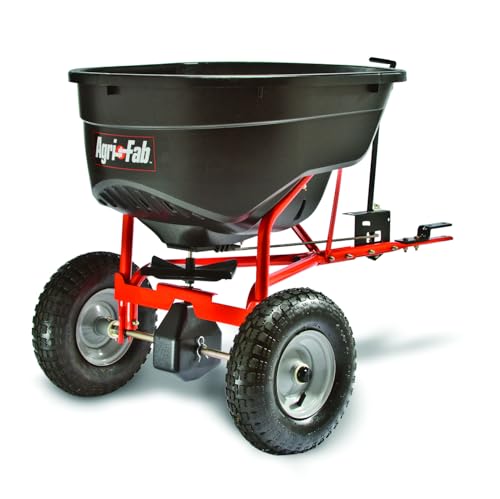
Agri-Fab Pull-Behind Broadcast Spreader (130 lb)
Consider it for a larger open job with a compatible tow vehicle, room to turn and willingness to assemble, calibrate and maintain the attachment.
- A good fit for
- A lawn-tractor owner treating broad areas where a larger hopper and tow-behind workflow are useful.
- The tradeoff
- The manual uses a three-mph application reference and a six-mph maximum. It warns against steep slopes, and the correct swath depends on the material.
We may earn a commission from purchases through our links. How this works
Buy on AmazonResearch-based review · Updated
Start with the tractor and the site
The linked model is Agri-Fab 45-0463, a tow-behind broadcast spreader with a 130-pound hopper, enclosed gearbox and pneumatic tires. The current product page lists a 37-pound empty weight and assembled dimensions of approximately forty-six by twenty-seven by thirty-two inches. It is an attachment to store and maneuver, not simply a larger push spreader.
The listing describes a universal hitch for most riding mowers and lawn tractors. That does not establish compatibility with every vehicle. Check the hitch arrangement and towing instructions for the vehicle you have before buying, along with the route and turning space available on the site.
Penn State describes pull-behind spreaders as useful for large open areas. That is the relevant buying fit here. A narrow lawn filled with beds and obstacles may create more difficult turns and boundary control than the large hopper solves.[1][7][8][2]
A hopper rating is not a seed coverage guarantee
- Capacity
- The hopper is advertised for up to 130 pounds of material.[1]
- Grass-seed reference
- The reviewed manual lists six-to-seven-foot fine-seed and eight-to-nine-foot coarse-seed widths.[8]
- Material matters
- Fertilizer and ice-melter widths differ; do not borrow the widest number for every product.[8]
Read the capacity and width distinction
The 130-pound figure is the hopper's advertised load capacity. The retail listing also gives up-to-half-acre or 25,000-square-foot coverage language, but actual treated area depends on the material and its prescribed rate. Those two approximate area descriptions should not be used as an exact conversion.
The owner manual directs measuring the intended area and estimating the material needed before loading. Its chart changes spread width by material: fine grass seed is shown around six to seven feet, coarse seed eight to nine, and granular fertilizer eight to ten. Pelleted fertilizer and ice melter have wider listed ranges.
Consequently, the twelve-foot headline does not establish a twelve-foot effective path for every seed. Use the material's directions and verify its actual pattern and output. Wider distribution, a larger load and correct dose are different properties of the job.[1][8][2]
Speed changes output and handling
The reviewed 2010 owner manual bases its application chart on three miles per hour, approximately one hundred feet in twenty-three seconds. It says changing speed requires a flow adjustment and that faster travel increases broadcast width. It also sets a maximum towing speed of six miles per hour.
That upper limit is not the recommended application speed. Begin with the vehicle in low gear and build speed only as conditions allow. Open the flow after the tractor is moving and close it before turning or stopping. Otherwise, a stationary or slowing machine can concentrate material where you do not intend it.
The manual warns against steep slopes and directs readers to the vehicle's own grade-safety instructions. Pneumatic tires and an enclosed gearbox do not establish that this attachment handles rough or sloped ground better than every walk-behind. Choose a controllable route rather than treating the capacity rating as permission to tow anywhere.[8]
Calibrate before committing the full load
Plan the amount
Measure the treatment area and calculate the product required from its label.[8][2]
Verify the pattern
Check output and effective swath for the actual material at the intended speed.[8][2]
Control flow
Begin moving before opening the gate; close it before turns and stops.[8]
Read the application sequence
Choose the setting using the current material instructions and the model's applicable chart, then verify it over a measured area. Penn State recommends weighing output and checking the effective swath for the actual product. A universal dial setting cannot account for different granule sizes, density, moisture and operators.
The Agri-Fab manual says to break up lumpy fertilizer and warns that powdered lawn chemicals do not produce a satisfactory consistent broadcast pattern. It also notes that humidity and material moisture can change application. Those are reasons to inspect the material before loading, not after a patchy pass.
The manual calls for a slight overlap of adjacent broadcast patterns. Keep this instruction tied to the tested swath and intended total rate. If using a two-direction application, each pass must deliver only its planned share of the total. Two full-rate runs are not a calibration method.[8][2]
Assembly and maintenance are part of ownership
The owner's manual provides a parts-based assembly procedure and routine checks for loose fasteners, worn parts and tire inflation. The current product specifications establish the finished attachment's size, but they do not establish an assembly time. Allow for assembly and adjustment before the application day.
Before use, inspect the tires and do not exceed the pressure printed on their sidewalls. After use, rinse the hopper and exterior and let the equipment dry before storage. The manual specifies gear lubrication, light oil at designated points and periodic oiling of the idler wheel and axle bushings.
The flow-control adjustment is another ownership task if the gate no longer corresponds to the dial positions. Use the model's service instructions rather than compensating indefinitely with a guessed setting. The enclosed gearbox helps contain the mechanism; it does not make the attachment maintenance-free.[7][8]
Choose a push or drop spreader for a different site
A Scotts Elite offers a larger walk-behind broadcast option when you do not want to tow an attachment. Its nominal six-foot pattern and advertised 20,000-square-foot product capacity are different specifications, not proof that it applies the same material at the same rate. It still needs model-specific setup and calibration.
EarthWay's 7312 favors controlled placement beneath the hopper in a twenty-two-inch path. That can fit tighter boundaries, while its narrow path creates more work over an open field. The comparison is application method and site layout rather than a universal performance ranking.
Choose the Agri-Fab when the compatible tractor, open area and operating routine are already part of the plan. Its capacity can reduce refills, but it cannot replace appropriate product rates, a safe route or the attention needed at turns and boundaries.[4][6][2][8]
When to choose something else
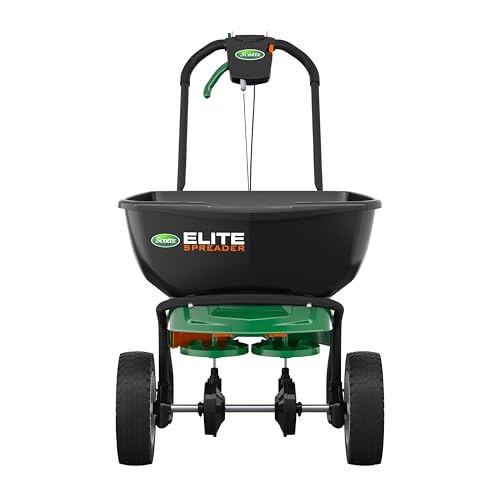
Scotts Elite Spreader
A walk-behind broadcast alternative when you want a larger hopper without towing an attachment.
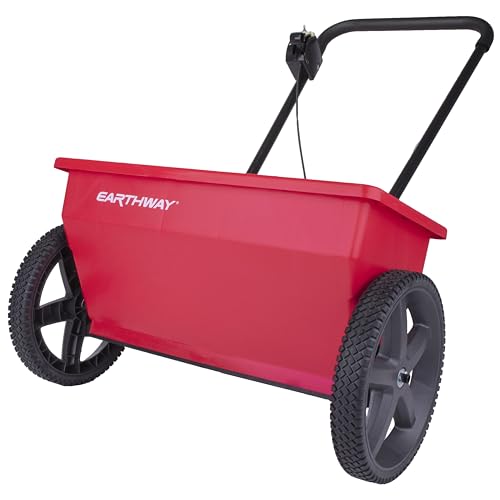
EarthWay 7312 Drop Spreader (75 lb)
For narrower controlled placement in confined areas, accepting more passes than a wide broadcast pattern.
Sources & research notes
This review draws on published product information and relevant care or operating guidance. We have not conducted a hands-on trial of this product. General guidance explains the intended task; it does not establish this product’s performance.
Amazon: current linked model and photographed product
Commerce identity only; not evidence of product performance.
Buy on AmazonRead 2026-09-23
- Penn State: calibrating fertilizer spreaders, April30,2025
Read 2026-09-23
- Scotts: current EdgeGuard DLX product page
Read 2026-09-23
- Scotts: current Elite product page
Read 2026-09-23
- Scotts: current Whirl product page
Read 2026-09-23
- EarthWay: current model7312 drop spreader
Read 2026-09-23
- Agri-Fab: model45-0463 specifications
Read 2026-09-23
- Agri-Fab: model45-0463 owner manual, 2010
Read 2026-09-23
Check the product before ordering
Check the exact model, included parts and compatibility.