
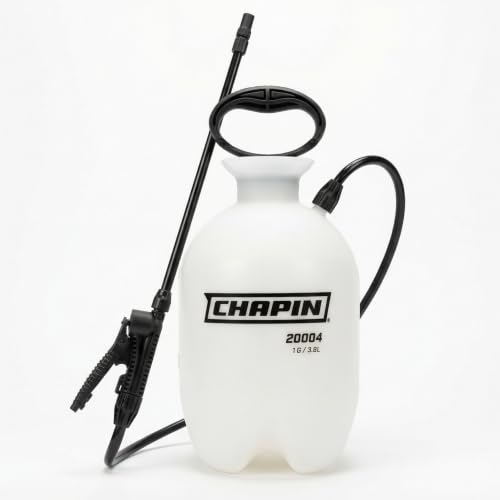
Chapin 20004 1-Gallon Pump Sprayer
Consider it for occasional spot work when the intended product is compatible with the sprayer and its label allows the treatment.
- A good fit for
- A homeowner treating a limited area who prefers carrying a small tank to wearing a larger backpack.
- The tradeoff
- One gallon is tank capacity, not a fixed treatment area. Pumping, calibration and thorough cleaning remain part of every job.
We may earn a commission from purchases through our links. How this works
Buy on AmazonResearch-based review · Updated
Buy it for the treatment you actually need
The linked product is Chapin model 20004: a one-gallon translucent tank with a funnel opening, hand pump, adjustable cone nozzle and thirty-four-inch hose. The current photograph visibly identifies 20004. Chapin also names that model in its own lawn-and-garden spraying guidance. These details establish what you are comparing; they do not demonstrate leak-free service, lower fatigue or a better treatment result than another sprayer.
A small tank is a practical format for carrying liquid to a limited treatment area. It does not make a pesticide, fertilizer or other additive necessary before every seeding project. Choose the job and check the product directions first. If your lawn needs no compatible liquid application, purchasing a sprayer does not by itself improve establishment.[1][6][5]
Separate three different quantities
- Tank capacity
- The Chapin tank holds one gallon of prepared solution.[1]
Read the capacity and rate distinction
The one-gallon figure describes how much prepared solution the tank can hold. It does not say how many square feet that solution should treat, or how much concentrate belongs in the tank. Those questions depend on the treatment label and on your measured spray output. A gallon used quickly over a small patch is a different application from the same gallon spread evenly over a larger area.
Penn State's calibration guidance keeps operating pressure, walking speed and technique consistent while testing with water. That is a more useful starting point than copying another owner's claimed lawn coverage. Recheck the output if you change the nozzle pattern or the way you move across the lawn.[1][3]
Check compatibility before filling
The current retail description mentions several lawn and cleaning uses. Do not interpret that broad wording as approval for every chemical or homemade mixture. The reviewed generic SureSpray instructions prohibit flammable, caustic, acidic, chlorine, bleach and other corrosive or gas-producing solutions. They also require following the chemical manufacturer's directions.
That generic sheet is useful safety guidance, but it is not proof that every SureSpray package includes identical hardware. Confirm the instructions supplied with your 20004, particularly its pressure-release method and replacement parts. For a pesticide, the treatment's own label also decides whether it can be used on the target grass and around seeding. There is no universal waiting period or seedling-safe mixture established by the sprayer's name.[1][5]
Inspect and test
Check the tank, hose and connections, then test with water for leaks or clogs.[5]
Measure output
Use water and consistent pressure and technique to determine output over a known area.[3]
Follow the treatment
Mix and apply only as permitted by the product label and equipment instructions.[5][3]
Read the setup and calibration sequence
Inspect the tank inside and out, check the hose and connections, and assemble the wand according to the supplied instructions. Chapin's generic sheet calls for a water-only test for leaks and clogs before filling with treatment. Use that opportunity to see the actual nozzle pattern and learn how pumping changes output.
For an area-based treatment, measure the intended area and calibrate under similar walking conditions. Penn State demonstrates timing a measured plot and collecting output for the same time while holding pressure and technique steady. That principle applies to planning the treatment; it is not permission to improvise the chemical dose. Wear the protection required by both equipment instructions and the treatment label, and stop if the tank or hose is damaged.[5][3]
Budget for pumping and cleanup
This is a manual pressure sprayer. The instructions call for pumping until resistance is felt, then pumping again as needed during spraying. The adjustable nozzle is useful, but it does not automatically hold an application rate constant while pressure and pace change. A one-gallon tank may also require repeated fills for a larger job; the number cannot be predicted from lawn size alone without calibration.
After use, release pressure as directed before opening or servicing the unit. Rinse the tank, wand, nozzle and pump, and dry and store the equipment according to its instructions. Cleaning is substantive work, especially when changing treatments. It should not be reduced to an unsupported claim that a quick rinse makes any previous chemical irrelevant.[5][3]
Plan disposal before mixing
Mix only the quantity needed for the job. EPA advises following the pesticide label's disposal instructions and using local waste guidance when leftover product cannot be used properly. Never pour pesticides into a sink, toilet, sewer or street drain. A sprayer review cannot give a blanket disposal route for every formulation.
The Chapin suits a limited, compatible job when you can manage carrying, pumping, measurement and cleanup. The larger Field King offers a different carrying format and more tank capacity, but it adds the burden of a filled backpack. Neither format establishes that a liquid program is necessary, that one fill will finish your lawn, or that a treatment is suitable for new seedlings. We have not performed comparative spraying or long-term seal tests.[4][1][2][5][3]
When to choose something else
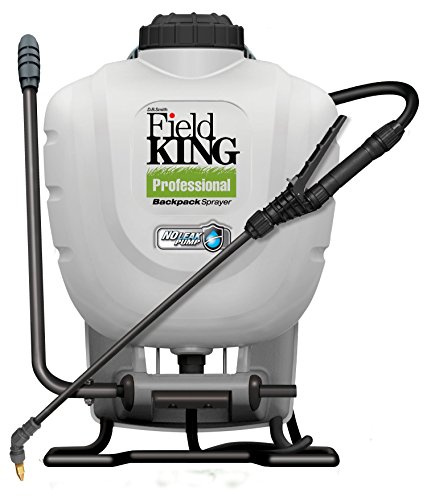
Field King 190328 Backpack Sprayer (4 Gallon)
For a larger compatible job when a four-gallon backpack and its carrying and cleaning burden suit you better.
Sources & research notes
This review draws on published product information and relevant care or operating guidance. We have not conducted a hands-on trial of this product. General guidance explains the intended task; it does not establish this product’s performance.
Amazon: current Chapin 20004 1-Gallon Pump Sprayer identity
Commerce identity only; not evidence of product performance.
Buy on AmazonRead 2026-09-23
Amazon: current Field King 190328 Backpack Sprayer (4 Gallon) identity
Commerce identity only; not evidence of product performance.
Buy on AmazonRead 2026-09-23
- Penn State: backpack sprayer calibration
Read 2026-09-23
- EPA: safe pesticide disposal, June2026
Read 2026-09-23
- Chapin: generic SureSpray instructions 020470R0925
Read 2026-09-23
- Chapin: model20004 identification and adjustable nozzle
Read 2026-09-23
- Field King: current-linked manual181702 RevG, safety and operation
Read 2026-09-23
Check the product before ordering
Check the exact model, included parts and compatibility.