
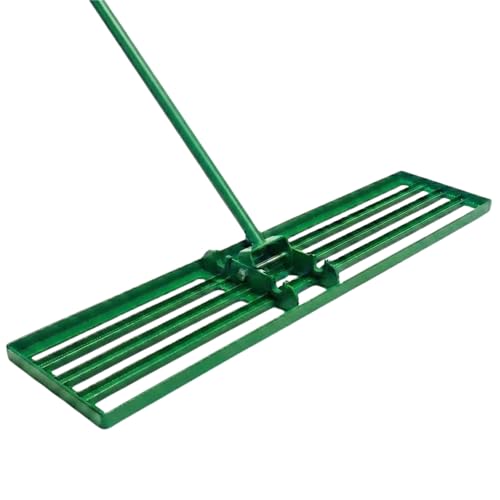
Landzie 36-Inch Lawn Leveling Rake
Consider it when you have a real surface-leveling job, suitable fill material and enough room to work a three-foot head.
- A good fit for
- A homeowner smoothing shallow low spots or distributing topdressing across an open lawn.
- The tradeoff
- The broad head needs working room and manual effort. Material choice matters as much as the tool; golf-course sand practices do not transfer automatically to native home-lawn soils.
We may earn a commission from purchases through our links. How this works
Buy on AmazonResearch-based review · Updated
A leveling rake distributes material
The linked product is Landzie's thirty-six-inch lawn leveling rake, with a seventy-two-inch handle and powder-coated steel construction. Its flat, open head is intended to move topdressing across the surface and work fine material into shallow low areas. Confirm the thirty-six-inch model when comparing listings that also offer other head sizes.
Choose it because a broad leveling head fits the work you need to do. The three-foot width creates a different working shape from a narrow hand rake, but it is not a measured guarantee of how quickly you will finish. A wide tool still needs room to travel around beds and other obstacles.
We have not measured its rigidity, weld strength or resistance to bending. The documented steel construction is a useful specification, not proof that competing tools flex or that this model produces a professional finish for every user.[1][4]
Decide whether the lawn needs this job
- Excess thatch
- A thatch rake or appropriate powered tool removes the organic layer.[2]
- Compacted soil
- Core aeration removes soil plugs; a leveling rake performs a different task.[2]
Read the job distinctions
Topdressing and leveling are related tasks with different objectives. Clemson describes topsoil or suitable sand as materials for filling low or bare areas, while compost can be used to improve soil quality. Decide which problem you are addressing before buying the rake or the material.
A lawn that needs only seed may not need substantial surface reshaping. Similarly, a thatch layer is not a low spot, and compacted soil is not simply an uneven surface. Maryland's guidance distinguishes removing excess thatch from pulling soil cores to relieve compaction.
Use that distinction to avoid an automatic sequence of buying every renovation tool. The Landzie moves material you have supplied; it does not remove plugs or comb out a thatch mat. It belongs in the plan when distributing topdressing or smoothing shallow unevenness is an actual requirement.[3][2][4]
Choose the material before the technique
Landzie discusses sand and soil mixes in its product guidance. Clemson adds an important condition: its South Carolina home-lawn guidance limits sand topdressing to sandy native soils and recommends compatible topsoil when the native soil is not sandy. Golf greens often have specially constructed sand-based root zones.
That difference matters more than whether a rake can physically push sand. A tool being sold as a sand leveler does not establish that sand is the appropriate amendment for your lawn. Use soil information and local guidance to select the material.
For established grass, Clemson recommends light, even raking so material settles between the blades, with incremental applications over time. Do not interpret a broad head as permission to bury the turf beneath a thick layer. The aim is a suitable surface treatment that the existing lawn can accommodate.[4][3]
Assess
Identify shallow uneven areas and choose compatible material.[4][3]
Distribute
Move the leveling head across the placed material in controlled back-and-forth passes.[4]
Reassess
Favor incremental treatment and check the remaining surface problem.[4][3]
Read the leveling workflow
The manufacturer describes placing material over the area and moving the head back and forth to distribute it. It identifies shallow depressions as the intended kind of leveling work and cautions that a lawn may require multiple treatments rather than becoming perfectly level in one session.
Assess the area, bring in the chosen material and work it through the grass gradually. A wheelbarrow or other means of moving material is a separate part of the job; the rake does not deliver the bulk material to the lawn. Recheck the surface as you work instead of judging success by whether the pile has disappeared.
Persistent saturation or a larger grading problem deserves a separate diagnosis. Maryland notes that even aeration alone cannot solve saturation. Treating every wet depression as a routine topdressing project can leave the underlying problem unresolved.[4][3][2]
Allow for assembly and storage
Landzie describes attaching the lower pole to the rake head, then screwing in the upper pole. For storage, the poles separate and fit into slots on the back of the head. The seventy-two-inch handle length describes the assembled tool, so the ability to break it down is useful when storage space is limited.
Those are documented design features, not a timed assembly test. Check the actual supplied hardware and instructions before working, particularly if the package differs from the current product photographs.
The powder coating is a finish on a steel tool; this review does not treat it as evidence of permanent corrosion immunity. We have no long-term exposure test or verified service-life measurement for this model. Buy on the dimensions, application method and storage arrangement you can confirm, rather than an unsupported durability ranking.[4][1]
Compare width and purpose
Rocklin's linked thirty-inch model has a narrower ground plate and a stainless steel construction claim. Its handle is advertised at seventy-eight inches and can be shortened to fifty. Those differences are concrete things to compare with the Landzie's thirty-six-inch head and sectional storage design.
The narrower head may fit a tighter working area, while the Landzie spans a broader strip. Neither dimension proves that one will finish your job faster; obstacles, material and operator effort still affect the work.
If the actual task is removing surface thatch, the Walensee rake is a different alternative altogether. Choose it for that operation rather than expecting a leveling plate to comb the lawn. The Landzie makes the strongest sense when a broad topdressing and smoothing tool is the missing part of an already thought-through project.[5][4][6][2]
When to choose something else
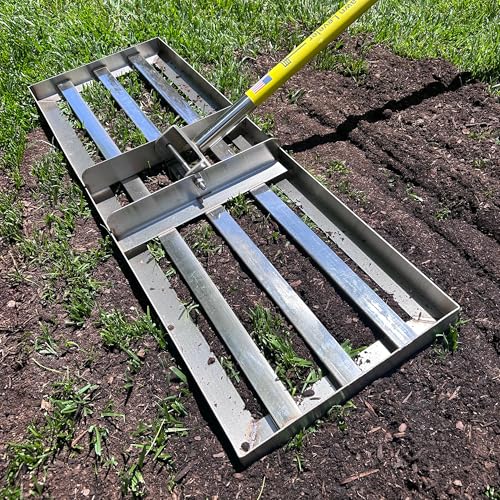
Rocklin Stainless Steel Lawn Leveling Rake
Compare a narrower thirty-inch stainless steel head and a handle that can shorten to fifty inches.
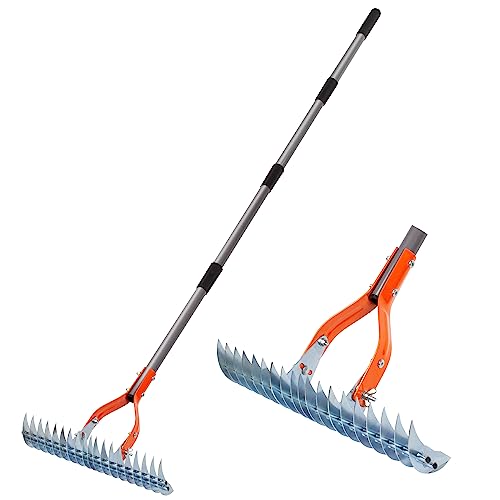
Walensee 15-Inch Thatch Rake
For small-area thatch removal instead of distributing leveling material.
Sources & research notes
This review draws on published product information and relevant care or operating guidance. We have not conducted a hands-on trial of this product. General guidance explains the intended task; it does not establish this product’s performance.
Amazon: current linked product identity and photograph
Commerce identity only; not evidence of product performance.
Buy on AmazonRead 2026-09-23
- University of Maryland: established-lawn aeration and thatch guidance
Read 2026-09-23
- Clemson: topdressing a home lawn, September2020
Read 2026-09-23
- Landzie: model36-inch lawn leveling rake
Read 2026-09-23
- Rocklin:30-inch leveling rake and handle specifications
Read 2026-09-23
- Walensee:15-inch rake and visually reviewed product artwork
Read 2026-09-23
- Greenworks Canada: DT13B00 page and conflicting specifications
Read 2026-09-23
- Agri-Fab: current45-0299 aerator page
Read 2026-09-23
Check the product before ordering
Check the exact model, included parts and compatibility.