
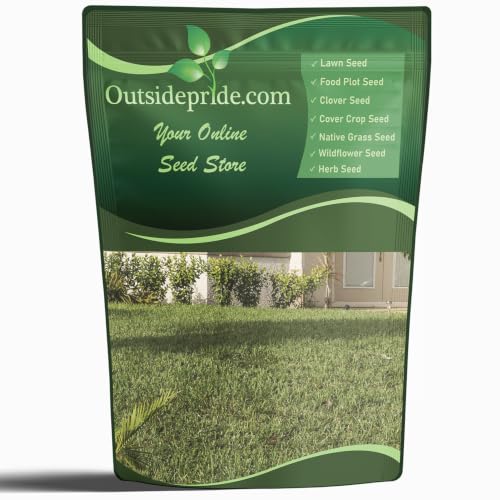
Outsidepride Pensacola Bahia Grass Seed (Coated, 5 lb)
Consider Pensacola for a sunny, region-appropriate utility lawn when resilience and modest inputs matter more than a dense, uniform finish.
- A good fit for
- A sunny southern lawn with suitable soil where the owner accepts seed heads, seasonal dormancy and a less uniform appearance.
- The tradeoff
- Pensacola produces more seed heads and a less uniform stand than Argentine, while drought survival may mean brown, dormant grass.
We may earn a commission from purchases through our links. How this works
Buy on AmazonResearch-based review · Updated
Choose the type of lawn before choosing the seed
Bahiagrass is a warm-season option associated with lower-input southern lawns. UF/IFAS describes its usefulness on sandy, less fertile soils, but also explains the tradeoffs in appearance and management. The right buyer accepts those tradeoffs rather than expecting a finely groomed carpet from a grass chosen mainly for practical resilience.
Pensacola is distinct from Argentine. UF/IFAS describes differences in leaf appearance, seed-head production and uniformity. Pensacola's greater seed-head production can be a nuisance in a lawn even though seed production is useful in other settings. A preference for less frequent visible stalks may change which type you choose.
Assess the site as well as the grass. Outsidepride calls for full sun, with eight or more hours for best results. Do not use low-maintenance wording to overlook inadequate light or a poor local fit. This is published species and variety guidance, not a field test of the five-pound Outsidepride bag.[1][7]
Keep drought survival separate from green appearance
- Established grass survives drought
- Survival can include brown dormancy; it does not promise continuous green color.[1][7]
- An irrigation decision
- Observe the lawn and rainfall rather than treating marketing language as a fixed schedule.[2]
Read the water-use distinction
A drought-tolerant grass can survive by becoming dormant rather than remaining green. UF/IFAS and Outsidepride both describe that distinction for bahiagrass. If a green lawn throughout dry weather is essential, the plant's ability to survive drought does not eliminate watering decisions.
The manufacturer's page is not entirely consistent in how it presents water needs. It promotes very low supplemental inputs but also gives a weekly water preference. Treat neither as a universal irrigation schedule. UF/IFAS recommends observing the lawn and considering rainfall and soil conditions when deciding whether irrigation is needed.
That distinction also applies to establishment. Seed and young plants need moisture while developing; the tolerance of mature turf is not an instruction to leave a newly seeded area dry. Make sure the project has reliable watering access before treating bahiagrass as a way to reduce later lawn inputs.[1][2][4][7]
Use the lawn rate and verify the coated package
- 5 lb, published lawn range
- About 625–1,250 sq ft at 4–8 lb per 1,000 sq ft; verify the actual coated bag.[7][8]
- 1,000 sq ft new lawn
- 4–8 lb at the published lawn rate; one 5 lb bag is not enough at the high end.[7][8]
- Pasture or overseeding
- Do not transfer a pasture rate into a lawn project; no separate lawn-overseeding rate is verified here.[7]
Read the quantity and application limits
The selected listing is five pounds and explicitly says coated Pensacola seed. Outsidepride's current product page gives a new-lawn rate of four to eight pounds per 1,000 square feet. Applying that published range to five pounds gives approximately 625 to 1,250 square feet.
The same page also lists pasture rates per acre. Those are for a different use and should not replace the lawn directions when planning residential turf. For 1,000 square feet of new lawn, the lawn range means four to eight pounds: a single five-pound bag covers the lower rate but not the upper one.
Check the actual coated bag's directions before application. The public product page does not establish the delivered lot's coating percentage or purity, and it does not give a separately verified lawn-overseeding rate. UF/IFAS offers general bahiagrass seeding guidance, but that is not a substitute for the treatment-specific instructions on this package. Measure the project and confirm the intended rate before ordering.[7][8][1]
Give warm-season establishment a realistic window
Outsidepride recommends spring or summer planting with consistently warm nights and roughly three months before frost. Its planting guide lists a quarter-inch depth, twenty-one to thirty days to germination and four to eight weeks to first mowing. Those are manufacturer estimates for stages of growth, not a promise of complete, durable turf in a month.
UF/IFAS explains that establishing a lawn from seed requires suitable preparation and continuing moisture management. Begin with a prepared surface and good seed-to-soil contact. Watch for areas where seed washes away, dries faster or fails to contact the soil; spreading extra seed over an unchanged problem is not the same as correcting it.
Use local timing advice rather than taking the product's broad geographic description literally. Protect the young stand from repeated traffic while it develops. The first mowing and the first visible shoots are useful milestones, but neither alone proves that the lawn is ready for its normal level of use.[7][4][1]
Plan for seed heads and moderate mowing height
Seed-head management is part of the Pensacola decision. UF/IFAS recommends mowing actively growing bahiagrass about every seven to fourteen days at three to four inches. Outsidepride's page gives two to three inches in one passage and three to five in its planting panel. We make that disagreement visible rather than selecting the shortest number without context.
For a Florida lawn, the UF/IFAS guidance is a useful local reference; elsewhere, check the advice for your conditions and actual stand. Avoid treating low maintenance as no maintenance. A tough grass can still require routine mowing, especially when the seed stalks are the feature you notice first.
Fertility decisions also deserve local context. UF/IFAS recommends soil testing and region-appropriate nutrient management. Do not assume that adding more fertilizer will turn a naturally less uniform bahiagrass lawn into a different grass type. Compare your desired finish with the plant's normal characteristics before increasing inputs to chase an unsuitable expectation.[2][3][7][1]
Compare a different grass when appearance changes the decision
TifBlair centipedegrass is a useful alternative to investigate when you want a different low-input warm-season lawn, rather than another bahiagrass package. It has its own soil requirements, climate limits and establishment timeline. Clemson's centipedegrass guidance makes clear that this is not simply an interchangeable seed choice for every southern site.
If the real issue is Pensacola's seed heads or uneven appearance, Argentine is also a variety-level comparison worth understanding through UF/IFAS guidance. That does not establish that either type is the better current retail bag, and it does not remove the need to check the actual offered seed.
Our preference would depend on the site and the finish the owner accepts. Pensacola is a practical choice when its characteristics match the job. It is a less persuasive purchase when the plan depends on no mowing, no establishment watering or year-round green color regardless of weather.[5][6][1][7][2]
When to choose something else
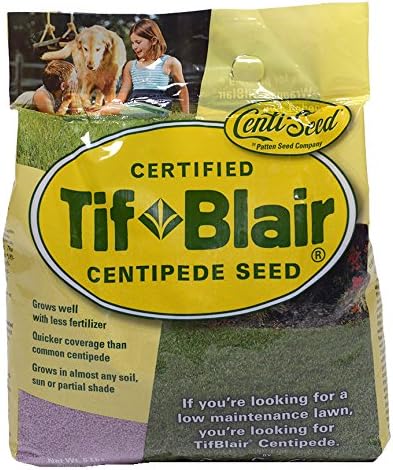
TifBlair Centipede Grass Seed
Compare TifBlair centipedegrass for a different low-input warm-season lawn, after checking its soil and climate requirements. Its establishment and maintenance needs differ from Pensacola’s.
Sources & research notes
This review draws on published product information and grass-selection guidance. We have not conducted a hands-on trial of this product. Species guidance helps explain the choice; it is not a trial of the bag you buy.
- UF/IFAS: Bahiagrass for Florida Lawns
Read 2026-09-23
- UF/IFAS: Bahiagrass nutrition, mowing, watering and pest management
Read 2026-09-23
- UF/IFAS: Bahiagrass soil and nutrient guidance
Read 2026-09-23
- UF/IFAS: Establishing Your Florida Lawn
Read 2026-09-23
- Super-Sod: TifBlair Centipede Grass Seed
Read 2026-09-23
- Clemson Extension: centipedegrass maintenance calendar
Read 2026-09-23
- Outsidepride: Pensacola Bahia product and planting guide
Read 2026-09-23
Amazon product identity: Outsidepride five-pound coated Pensacola Bahia seed
Commerce identity only; not evidence of product performance.
Buy on AmazonRead 2026-09-23
Ready to compare the bag?
Check the package size and seed tag before ordering.