
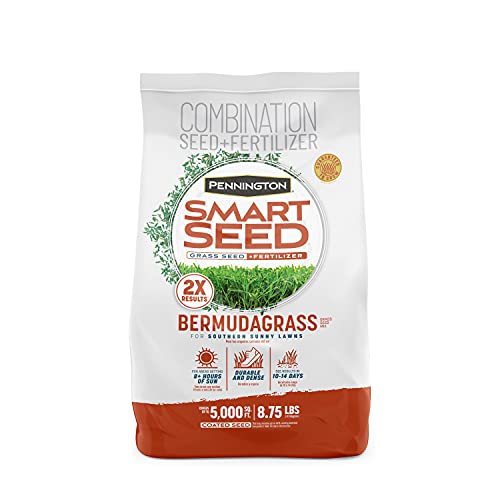
Pennington Smart Seed Bermudagrass
Consider it for a sunny southern lawn when you want a seed-and-fertilizer mix with temporary early cover while bermudagrass develops.
- A good fit for
- Southern bermudagrass sites receiving at least 8 hours of sun, planted in spring or early summer.
- The tradeoff
- Early color is not all permanent bermudagrass; shade, winter dormancy and regular mowing still shape the result.
We may earn a commission from purchases through our links. How this works
Buy on AmazonResearch-based review · Updated
The companion grass is the distinctive feature
Early growth
A cool-season companion supplies early color and soil stability.[1]
Warmer weather
The companion is intended to fade as heat arrives.[1]
Long-term lawn
The goal is an established bermudagrass lawn suited to the site.[1][4]
Read what the companion does and what remains unknown
Smart Seed Bermuda is more than a bag of bermudagrass seed. Pennington describes a seed-and-fertilizer combination with a temporary cool-season companion grass. Its stated job is to provide early color and help stabilize the soil, then fade as warm weather arrives. That sequence explains the product better than treating the first green shoots as the finished bermudagrass lawn.
The manufacturer promotes twice the results and coverage compared with bermudagrass alone. We treat that as its product claim, not an independent trial result or a promise that every lawn becomes usable twice as quickly. The concrete feature is the companion strategy: something grows early while the long-term warm-season grass develops.
The current product page does not name the companion species or list the delivered lot's cultivar percentages. We do not assume ryegrass from that description or invent a bermudagrass cultivar. The package artwork leaves space for the seed tag; that is where the actual mixture and germination analysis belong. If you want a particular permanent cultivar rather than a ready-mixed establishment product, make that distinction before choosing a bag.[1][6]
Make full sun the first decision
Pennington specifies at least eight hours of sun and rates shade tolerance inadequate. That is a clear boundary: this is a southern, sunny-lawn product rather than a compromise for a yard split between open sky and dense tree cover. Count the light reaching the grass during the growing season, including shade from buildings and mature trees.
The underlying species offers meaningful advantages where it fits. Texas A&M describes bermudagrass as heat- and drought-tolerant, with stolons and rhizomes that help it spread and recover from wear. Those are reasons to consider a bermudagrass lawn for suitable sunny areas. They are species traits, however, not proof that this unspecified retail mixture outperforms a named sports-turf cultivar.
Seasonal expectations matter as well. Clemson's bermudagrass guidance discusses winter dormancy and the need to adjust care to local weather. The companion's early color does not turn the final lawn into a year-round cool-season lawn. If winter color or substantial shade is the deciding requirement, reconsider the grass type instead of relying on the mix to cancel those tradeoffs.[1][4][5]
The 8.75 lb bag has two coverage jobs
- 2,000 sq ft, new lawn
- 7 lb of the combination product.[1]
- 2,000 sq ft, overseeding
- 3.5 lb of the combination product.[1]
Read the bag-size and quantity calculation
The official 8.75-pound artwork advertises up to 5,000 square feet. Pennington's planting specifications give 3.5 pounds per 1,000 square feet for new lawns and 1.75 pounds for overseeding. Together, those directions explain the headline: 5,000 square feet is the overseeding figure; a new lawn gets about 2,500 square feet from the same bag.
For a measured 2,000-square-foot project, the published rates require seven pounds on bare ground or three and a half pounds when overseeding. These examples use the actual combination-product weight. They are not raw-bermudagrass or pure-live-seed rates, and they should not be replaced by a lighter generic bermudagrass recommendation from another source.
Before ordering, separate new soil from an existing lawn that only needs additional seed. Measure the area that will actually be treated, leaving out beds and paths. The current webpage also discusses a smaller 1.75-pound bag in its prose, so check the size on the selected purchase listing and the delivered bag. Size matching matters more than the largest coverage number on the page.[1][2][6]
Prepare for seedlings, not just a spreading pass
Pennington recommends spring or early summer planting. That aligns the project with a warm-season lawn's growing period; it does not mean seeding during any mild spell will produce the same result. Local weather and the time available for growth before dormancy still deserve attention.
For bare ground, the manufacturer says to remove debris, loosen and smooth the surface. For thin existing areas, it adds mowing and debris removal before raking to create soil contact. Spread the measured product evenly, then rake gently to work it into the surface. Its planting specification gives a quarter-inch depth. The preparation is part of the product's use, not an optional step replaced by seed coating or included fertilizer.
Water to keep the soil moist as needed until grass sprouts and reaches about two inches. The listed germination window is ten to fourteen days, but the early stand includes a temporary companion, and emergence is different from a mature lawn that tolerates regular use. Keep assessing the developing grass rather than using the calendar or the first green color as the only signal that establishment care can end.[1]
Check compatibility before repairing an existing lawn
Overseeding coverage does not mean that this bag matches every lawn called Bermuda. Texas A&M separates seeded bermudagrasses from interspecific hybrid cultivars that are normally established vegetatively with sod or sprigs. If the existing lawn is a named hybrid and a uniform appearance matters, identify it before introducing a seed mixture.
Also diagnose why an area became thin. Shade, compaction and watering problems can undermine the next planting as well as the old grass. Clemson's maintenance guidance treats mowing, irrigation, soil testing and seasonal conditions as connected parts of lawn health. A bag can add seed, but it cannot remove the underlying site constraint.
Because this product already contains fertilizer, read its package directions alongside any other lawn treatment you plan to use. Check the exact weed-control label for reseeding restrictions and seedling compatibility. A routine intended for established turf can be poorly timed for new seed, so plan those operations before the product is in the spreader.[4][5][1]
Choose convenience with its continuing maintenance
Pennington lists a mowing height of one to one and a half inches. Texas A&M's general home-lawn guidance is one to two inches with a rotary mower and notes that bermudagrass needs frequent mowing and moderate to high fertility. The convenience of combined seed and fertilizer is an establishment feature, not a promise of a low-mowing mature lawn.
After establishment, use local guidance and soil testing to plan feeding, and adapt watering to soil and weather. Clemson emphasizes observing conditions as the lawn greens up or enters dormancy. Bermudagrass's drought tolerance does not justify withholding establishment water or assuming that every yard will retain the same summer color on rainfall alone.
Yukon is a useful alternative when identifying the permanent seeded cultivar is more important than buying a companion-and-fertilizer format. Oklahoma State lists Yukon by cultivar identity and provides winter-hardiness context for Oklahoma athletic fields. That does not make it universally better, but it changes the buying decision: a named seeded cultivar with its own coated-seed directions versus Pennington's temporary-cover strategy for a sunny southern lawn.[1][4][5][3][7]
When to choose something else
Outsidepride Yukon Bermudagrass
Compare Yukon if you want a named seeded bermudagrass cultivar. It has its own coated-seed rates and independent, region-specific cultivar context.
Sources & research notes
This review draws on published product information and grass-selection guidance. We have not conducted a hands-on trial of this product. Species guidance helps explain the choice; it is not a trial of the bag you buy.
- Pennington: Smart Seed Bermudagrass seed and fertilizer mix
Read 2026-09-23
- Pennington: 8.75 lb Smart Seed Bermuda package coverage artwork
Read 2026-09-23
- Outsidepride: Yukon Bermuda product and planting guide
Read 2026-09-23
- Texas A&M AggieTurf: Bermudagrass
Read 2026-09-23
- Clemson Extension: Bermudagrass Yearly Maintenance Program
Read 2026-09-23
- UMass Extension: understanding the turfgrass seed label
Read 2026-09-23
- Oklahoma State Extension: bermudagrass cultivar comparison for Oklahoma athletic fields
Read 2026-09-23
Ready to compare the bag?
Check the package size and seed tag before ordering.