
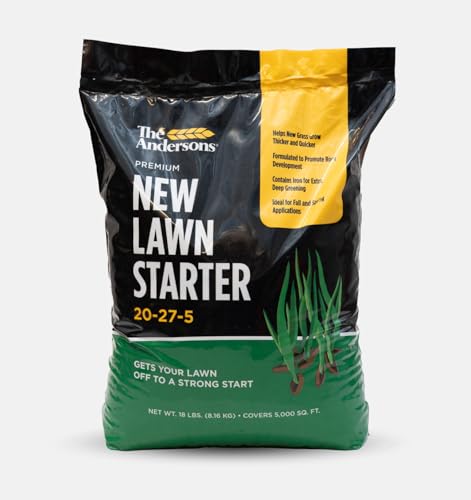
The Andersons New Lawn Starter 20-27-5
Consider it when a soil-informed establishment plan calls for a phosphorus-rich starter. Confirm the exact 20-27-5 bag and a locally appropriate rate before ordering; the headline coverage is not an unrestricted application instruction.
- A good fit for
- A new-seed, sod or renovation project where the current label permits use and the nutrient plan supports this starter formula.
- The tradeoff
- At 3.6 lb product per 1,000 sq ft, this 20% nitrogen formula supplies 0.72 lb nitrogen. The same label includes a 0.7 lb nitrogen limit for specified states, so the nominal rate cannot be treated as universal.
We may earn a commission from purchases through our links. How this works
Buy on AmazonResearch-based review · Updated
Match the 20-27-5 bag, not an older starter description
The current primary retail link identifies The Andersons New Lawn Starter 20-27-5 in an 18-pound package. The manufacturer’s matching label also prints that retail ASIN. This is the product evaluated here; a description of a 40-pound 18-24-12 starter refers to a different formulation and should not guide the purchase.
The guaranteed analysis is 20% nitrogen, 27% available phosphate expressed as P2O5 and 5% soluble potash expressed as K2O. It also lists 1% iron and smaller amounts of copper, manganese and zinc. The nitrogen includes quick-response sources and 8.71 percentage points of slowly available urea nitrogen from polymer-coated sulfur-coated urea.
Those figures do not support describing half the total nitrogen as slow-release, or adding an unlisted humic-acid guarantee. Read the actual guaranteed analysis rather than borrowing features from another Andersons product. The useful distinction is a relatively phosphorus-rich starter formula with mixed nitrogen delivery, in a verified 18-pound package.[1][3][4][5]
Establishment is the intended job; phosphorus need still matters
- New seed or sod
- The manufacturer’s starter directions cover establishing seed and sod, subject to the label’s use notices.[3][4]
- Overseeding
- The maker allows surface application followed by watering; soil incorporation is not required for every overseeding job.[3]
- Routine maintenance
- The linked label explicitly excludes routine turf maintenance.[4]
Read the use and soil-test limits
The manufacturer positions this formula for new lawns and allows use with seed or sod. Its FAQ also says it can be applied on top and watered in during overseeding. That makes it relevant to establishment and renovation work, but compatibility with seeding is only one part of deciding whether to use it.
The label’s phosphate notice limits nonagricultural use to turf in its first growing season, areas being repaired or renovated, or turf where a soil test within three years indicates a phosphorus deficiency. It explicitly excludes routine turf maintenance. The same label contains additional state-specific notices, which should be read on the purchased bag and checked with local guidance.
Penn State recommends a soil test before establishing or renovating turf. Use that process to understand nutrient and lime requirements rather than assuming every new lawn benefits from the same starter rate. A product designed for seedlings can still supply more of a nutrient than a particular site needs.[3][4][5]
The coverage arithmetic exposes a nitrogen-rate conflict
- Nominal product rate
- The bag’s 3.6 lb per 1,000 sq ft rate calculates to 5,000 sq ft from 18 lb. Label restrictions still apply.[4]
- Nitrogen at that rate
- Calculated nitrogen is 0.72 lb per 1,000 sq ft, while the label’s notice lists a 0.7 lb limit for specified states. Confirm the permitted rate.[4]
- Measured 2,000 sq ft area
- Nominal quantity is 7.2 lb product before resolving the label and local-rate requirements.[4]
Read the nutrient calculation and label notice
The bag lists 5,000 square feet at 3.6 pounds of product per 1,000 square feet. For a 2,000-square-foot area, that nominal rate calculates to 7.2 pounds of fertilizer. The arithmetic is useful for understanding the package, but it is not a recommendation to apply that amount everywhere.
At 20% nitrogen, 3.6 pounds supplies 0.72 pound of nitrogen per 1,000 square feet. The same label’s nitrogen notice says not to exceed 0.7 pound in states with nitrogen restrictions, listing Maryland, New Hampshire, New Jersey, Pennsylvania and Virginia among them. That internal conflict means the large coverage claim cannot be followed without reading the rest of the label.
Confirm the locally applicable rate with the manufacturer or extension guidance, including any soil-test and timing requirements. This review does not invent a replacement rate or interpret every state’s rules. At the nominal printed rate, the phosphate and potash quantities are 0.972 and 0.18 pound per 1,000 square feet respectively; keep those nutrient contributions distinct from total product weight.[4][5]
Prepare fertilizer placement separately from seed depth
For a new seedbed or sod installation, the label says to work the fertilizer into the upper two to three inches of soil before planting or laying sod. That instruction concerns fertilizer incorporation. It is not a direction to bury grass seed two to three inches deep; the seed product has its own planting-depth requirements.
For overseeding an existing lawn, the manufacturer’s FAQ permits applying the starter on top and watering it in. Select the method that matches the actual project instead of trying to till an established lawn merely to satisfy a new-seedbed instruction. Keep the soil moist through germination as the label directs.
The label specifies a minimum of 0.2 inches of water to move fertilizer into the soil and describes watering every twelve hours over the next forty-eight hours, skipping when rain occurs. That short fertilizer instruction does not replace the seed’s ongoing moisture needs. Check both sets of directions and avoid treating one watering interval as suitable for all soils and weather.[3][4]
Account for iron, runoff and the next feeding
The iron-containing product can stain hard surfaces. Sweep or blow misplaced granules from pavement back onto the lawn; the label specifically says not to wash them away. Avoid application near water, storm drains and drainage ditches, or when heavy rain is expected. Keep unused fertilizer dry in its original resealed package.
The maker’s product page advises avoiding very hot or dry conditions, including temperatures above 85°F. A spring-or-fall message is not a nationwide planting calendar: choose the grass’s suitable establishment window and conditions in which the product can be applied and watered correctly.
Repeat-feeding messages also differ. The label’s tips mention six to eight weeks, while the web page discusses shorter intervals and its FAQ sets at least thirty days before another fertilizer. These statements should not become an automatic refill schedule. Review the nutrient plan and current label before the next application, particularly because this phosphorus-containing starter is not for routine maintenance.[3][4]
Test first when the starter choice is uncertain
MySoil is a useful alternative purchase when the nutrient question has not yet been answered. The manufacturer’s mail-in kit reports plant-available nutrients and pH and provides online fertilizer recommendations. It supplies information for choosing a fertilizer; it is not a competing starter formulation or an instant treatment for a weak lawn.
Follow the chosen lab’s sampling instructions and explain the intended turf project. Penn State emphasizes that test results depend on representative sampling and regional interpretation. A recommendation for a total nutrient quantity may also need to be split across applications, so clarify whether the report describes one treatment or a longer program.
If this Andersons starter fits that plan, the final checks are concrete: an 18-pound 20-27-5 bag, the current guaranteed analysis, a permitted use and a resolved application rate. The product’s phosphorus concentration makes those checks more consequential than a generic claim that it is a premium upgrade over another brand.[2][5][3][4][1]
When to choose something else
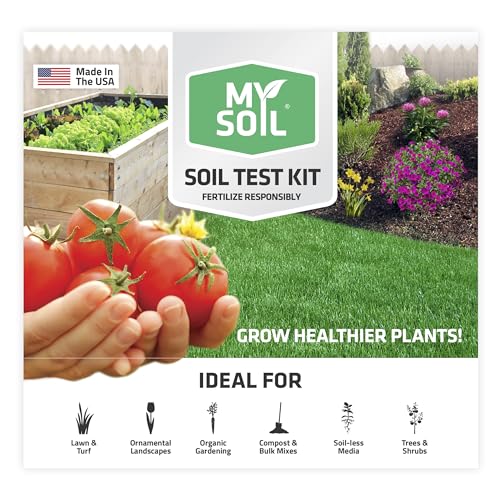
MySoil Soil Test Kit
For soil nutrient and pH information before selecting a starter formula; the mail-in kit provides online laboratory results and fertilizer recommendations.
Sources & research notes
This review draws on published product information and relevant care or operating guidance. We have not conducted a hands-on trial of this product. General guidance explains the intended task; it does not establish this product’s performance.
Amazon: current product identity and package photograph
Commerce identity only; not evidence of product performance.
Buy on AmazonRead 2026-09-23
- MySoil: mail-in laboratory soil test kit
Read 2026-09-23
- Manufacturer: current starter product information
Read 2026-09-23
- The Andersons: matching package label
Read 2026-09-23
- Penn State Extension: turfgrass fertilization, soil testing and fertilizer grades
Read 2026-09-23
Check the product before ordering
Check the package size, formulation and current label directions.