
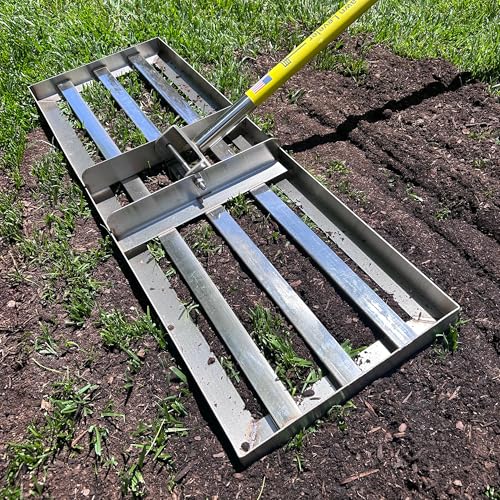
Rocklin Stainless Steel Lawn Leveling Rake
Consider it when a thirty-inch leveling head fits the job and the adjustable handle length is useful for your working space.
- A good fit for
- A homeowner smoothing shallow low spots with a narrower leveling head than the thirty-six-inch Landzie.
- The tradeoff
- Stainless steel is a construction specification, not proof of unlimited outdoor life. The rake also cannot substitute for diagnosing compaction, excess thatch or persistent drainage problems.
We may earn a commission from purchases through our links. How this works
Buy on AmazonResearch-based review · Updated
Confirm the thirty-inch model
The linked Rocklin LawnLevel30 has a thirty-by-ten-inch ground plate and a seventy-eight-inch handle. The current manufacturer page also covers twenty-two- and forty-eight-inch models, so their dimensions should not be copied into this product's description. The retail identity and photograph were checked for the thirty-inch version.
Rocklin describes stainless steel construction and a center-mounted head connection. Those are the hardware features relevant to the buying decision. The review does not turn the manufacturer's non-flipping or durability language into a measured performance result.
The tool's purpose is to distribute soil or other suitable topdressing over the surface. It is not a cutting reel, core aerator or thatching comb. Start with the actual project rather than treating a long handle and metal plate as a general solution for every lawn renovation task.[1][5][2]
Compare working width and reach
- Handle options
- The manufacturer describes seventy-eight-inch and fifty-inch configurations.[5]
- Catalog comparison
- Landzie offers a thirty-six-inch head with a seventy-two-inch sectional handle.[4]
Read the size and reach comparison
A thirty-inch head spans less width than the thirty-six-inch Landzie in this catalog. That can be a useful physical distinction when the work area includes beds, edges or other restrictions, although we have not measured maneuverability or completion time for either tool.
Rocklin's handle can be configured at seventy-eight inches or shortened to fifty inches. The longer configuration increases reach; the shorter one changes the space needed to work the tool. Choose according to the area and your handling needs rather than assuming the longest setting is automatically more comfortable.
The maker's ergonomic promises are not a substitute for your own fit assessment. We have not tested strain reduction or compared users of different heights. The confirmed dimensions let you make a practical comparison without an invented comfort score.[5][4]
Choose topdressing to match the soil
The rake can physically move sand, soil or compost, but the material must suit the intended treatment. Clemson distinguishes filling low spots from improving soil quality. Compost is discussed for the latter, while compatible topsoil or suitable sand can be used for leveling.
In its South Carolina guidance, Clemson says sand topdressing belongs on sandy native soils; for other native soils, it recommends compatible topsoil. Golf-course surfaces are often specially built systems, which is why copying their sand routine onto a home lawn can be the wrong starting point.
The practical order is to choose the material for the soil and purpose, then choose a tool to distribute it. Stainless steel construction does not change that agronomic decision. If you are unsure what the low area contains or why it stays wet, resolve that before spreading a new layer over it.[5][3][2]
Distribute lightly and revisit the result
Identify the job
Separate shallow surface unevenness from a soil or drainage problem.[3][2]
Select and place
Choose suitable topdressing and distribute it lightly through established grass.[3]
Check the result
Make incremental changes rather than assuming one heavy treatment is sufficient.[3]
Read the surface-treatment sequence
For established turf, Clemson recommends lightly and evenly raking topdressing so it settles between the leaf blades. It favors small, repeated changes to the soil profile over time. That approach gives this rake a clear job: distribute the chosen material without treating the whole lawn as a place to unload a thick blanket of fill.
Rocklin describes the tool for filling dips and leveling soil surfaces. Assess the area, place manageable amounts of suitable material and work the head across it. Check what remains uneven before adding more. The quantity needed depends on the actual area and depth, not the thirty-inch width printed on the product.
A smoother-looking surface does not prove that compaction or saturation has been solved. Maryland separates core aeration from those broader drainage questions. Keep the result you are trying to achieve specific enough to evaluate after the work.[5][3][2]
Treat construction claims as specifications
Rocklin advertises stainless steel as resistant to rust and suitable for outdoor work. That supports describing the material, but it does not establish that every part can be left outside indefinitely or that the tool will never show corrosion. We have not run an exposure or lifespan test.
The current page explains the handle length options, but the evidence reviewed does not include a complete model-specific assembly and maintenance manual. Follow the instructions actually supplied with the package; do not borrow torque values or hardware procedures from a different rake.
This is a narrower limitation than saying the tool is difficult to assemble or poorly built. Those outcomes have not been established. The useful buyer information is what can be verified now: the plate dimensions, handle configurations, advertised material and intended leveling task.[1][5]
Choose another format when the task changes
The Landzie is the closest catalog alternative for the same general job. Its wider head, powder-coated steel and pole-storage slots offer a different combination of dimensions and storage features. Compare those details with the Rocklin's narrower plate and shorter handle option.
For small patches of excess thatch, the Walensee is a purposefully different choice. Its curved tines are designed to work the organic surface layer. A leveling plate distributes added material and should not be expected to perform that combing action.
Choose the Rocklin when a thirty-inch leveling format matches the work and you value its handle configuration. Avoid choosing it solely on a promise that stainless steel makes all care unnecessary or that smoothing low spots automatically prepares every lawn for seed.[4][5][6][2]
When to choose something else
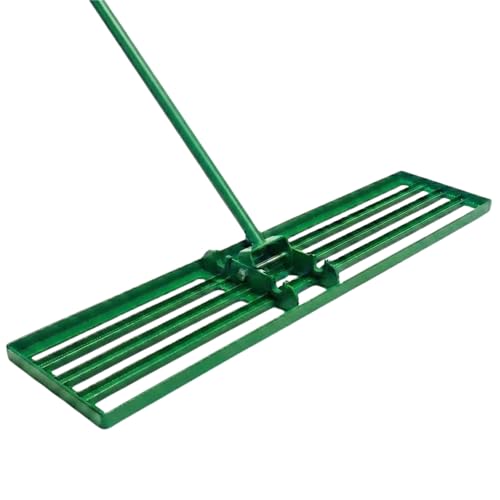
Landzie 36-Inch Lawn Leveling Rake
A wider thirty-six-inch leveling head with powder-coated steel and sectional pole storage.
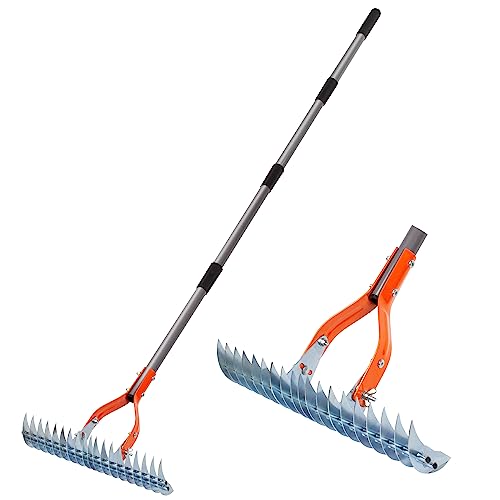
Walensee 15-Inch Thatch Rake
For combing excess thatch from a small area, a different job from surface leveling.
Sources & research notes
This review draws on published product information and relevant care or operating guidance. We have not conducted a hands-on trial of this product. General guidance explains the intended task; it does not establish this product’s performance.
Amazon: current linked product identity and photograph
Commerce identity only; not evidence of product performance.
Buy on AmazonRead 2026-09-23
- University of Maryland: established-lawn aeration and thatch guidance
Read 2026-09-23
- Clemson: topdressing a home lawn, September2020
Read 2026-09-23
- Landzie: model36-inch lawn leveling rake
Read 2026-09-23
- Rocklin:30-inch leveling rake and handle specifications
Read 2026-09-23
- Walensee:15-inch rake and visually reviewed product artwork
Read 2026-09-23
- Greenworks Canada: DT13B00 page and conflicting specifications
Read 2026-09-23
- Agri-Fab: current45-0299 aerator page
Read 2026-09-23
Check the product before ordering
Check the exact model, included parts and compatibility.