
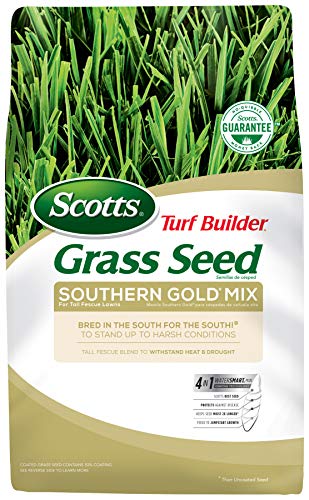
Scotts Turf Builder Southern Gold Mix
Consider the 7 lb WaterSmart Plus version for a suitable transition-region tall-fescue project, with a clear plan for establishment and summer care.
- A good fit for
- New or thin tall-fescue lawns in suitable sun or partial shade, after checking the exact package version.
- The tradeoff
- Southern branding and coating claims do not make tall fescue immune to summer stress or eliminate the need to repair bare areas.
We may earn a commission from purchases through our links. How this works
Buy on AmazonResearch-based review · Updated
Match the WaterSmart bag before comparing directions
The linked seven-pound Southern Gold product uses WaterSmart Plus coating. Scotts also sells Southern Gold under its newer Root-Building Nutrition format, and the current manufacturer page describes that newer combination. A shared Southern Gold name does not make their bag weights, treatment details and directions interchangeable.
The older artwork identifies a tall-fescue blend for transition-region lawns, with a medium-coarse blade texture. It does not give a current-lot cultivar analysis. We therefore do not treat a historical cultivar list as a permanent recipe, or assume this bag contains the same grasses as a similarly named Scotts blend.
Check the name, weight, coating language and seed analysis before buying. This is particularly important when a store combines old photographs with newer product descriptions. The seven-pound identity is the basis of this review; if checkout shows a different version, use that package's own coverage and instructions. The newer product's fertilizer-and-soil-improver description should not be silently copied onto the older bag.[6][7][9][11][4]
What WaterSmart Plus does—and what it does not establish
- Moisture around seed
- Scotts compares the coating with uncoated seed; this is not a measured household irrigation saving.[7]
Read the coating limits
Scotts describes WaterSmart Plus as a coating that retains moisture around the seed, supplies nutrients and protects seedlings against disease. Its artwork compares moisture retention with uncoated seed. That comparison concerns the seed treatment; it does not establish that the mature lawn needs half as much irrigation.
The archived Southern Gold package also shows that this is treated seed. Follow the handling and use restrictions on the actual bag, including keeping it away from food, feed and children. Do not use a seed-treatment claim to choose a separate fungicide program for an established lawn. Those are different decisions, with different labels and conditions.
The useful buying question is whether you want this supplied planting format and can follow its directions. Coating does not replace seed-to-soil contact, watering or an appropriate grass species. Nor does the absence of coating automatically make an alternative inferior. Compare the amount needed for your area and the actual seed analysis, rather than treating equal bag weights as equal amounts of viable seed.[7][10][4][8]
Southern Gold still needs a suitable tall-fescue climate
The product artwork targets transition-zone lawns and promotes tolerance of heat, drought and traffic. That is manufacturer positioning, not proof that tall fescue will succeed everywhere in the South. Assess the local summer conditions and available light before relying on a broad regional name.
NC State's tall-fescue guidance is a useful regional example: hot, humid weather can bring brown patch, and summer maintenance needs attention. Colorado State describes tall fescue as a bunch-type grass with limited recovery into damaged areas. These species traits remain relevant even when a retail blend emphasizes disease resistance or durability.
For an existing lawn, find out why it is thin before ordering more seed. A recurring worn path or unsuitable growing conditions may need a different solution as well as reseeding. Partial shade on the package should not be read as a deep-shade guarantee. The reasonable fit is a lawn where local guidance supports tall fescue and the owner can support establishment and ongoing seasonal care.[6][5][2][3]
Use the seven-pound coverage, not another version’s headline
- 7 lb, new lawn
- 580 sq ft in the matching product record.[9]
- 7 lb, overseeding
- 1,750 sq ft in the matching product record.[9]
- 1,000 sq ft project
- About 12.1 lb new lawn or 4 lb overseeding, calculated from rounded bag coverage.[9]
Read the version and rounding caveats
The retained seven-pound WaterSmart Plus product record lists 580 square feet for a new lawn and 1,750 square feet for overseeding. Those figures make the size of the job clear: the larger number assumes suitable grass already exists. A bare area needs the heavier new-lawn application.
For a 1,000-square-foot project, scaling those rounded coverage figures gives about 12.1 pounds for new lawn or four pounds for overseeding. A single seven-pound bag therefore does not cover that bare-ground project at the listed rate. Confirm the actual package before purchase or application; these are planning calculations from the matching retail record, not a current seed-lot analysis.
An older forty-pound manufacturer label publishes different new-lawn coverage per pound, which is another reason not to scale a historical bag indiscriminately. Newer Root-Building Nutrition sizes should also use their own directions. Separate the bare and thin portions of a mixed project, then compare the total cost of the required quantity without assuming the biggest coverage number applies throughout.[9][10][11][4]
Prepare for seedlings, not instant lawn coverage
Scotts' older product artwork gives six to fourteen days for the first growth and says seedlings can be mowed at three inches. Those are establishment milestones, not a promise of a mature lawn in two weeks. Use the developing stand and local growing conditions to judge progress.
The preparation artwork calls for loosening roughly two inches of surface soil and removing debris. That is soil preparation, not a two-inch seed-burial depth. The archived package says to lightly rake seed into the soil. Match the final planting directions to the bag and ensure the seed can contact soil rather than sitting on old vegetation.
The artwork emphasizes keeping the surface moist, including twice-daily watering during early establishment. Adjust attention to weather and soil conditions instead of assuming two brief sprinkler runs always suffice. Check any recent herbicide use before seeding, and use the applicable reseeding restrictions. A coating may help around the seed, but it does not remove the need to prepare the site and follow through with watering.[6][8][10][3]
Plan summer care and compare a simpler alternative
After establishment, use regional tall-fescue guidance for mowing, fertility and watering. NC State recommends a higher summer mowing height and discusses managing the lawn through heat and disease pressure. The three-inch first-mowing milestone in the product artwork is not a complete maintenance calendar for every location.
Use soil information to guide nutrients, and do not automatically stack every promoted lawn product onto newly planted seed. Check the actual seed package and fertilizer labels together. When thinning recurs, investigate the cause and repair the affected area; tall fescue's limited spreading is a reason to plan repairs, not a guarantee that every lawn must be reseeded every year.
Combat Extreme Transition Zone is a relevant alternative if a currently described coated tall-fescue blend fits your project. It has its own OptiGrowth treatment and application rates. We have not established that it or Southern Gold is a performance winner, nor that their genetics are equivalent. Compare the planting format, current bag and local grass fit before deciding.[5][6][2][4][1]
When to choose something else
Outsidepride Combat Extreme Transition Zone
Compare Combat Extreme Transition Zone for another coated tall-fescue blend, using its own OptiGrowth description, rates and seed analysis. No equivalent genetics or head-to-head superiority is established here.
Sources & research notes
This review draws on published product information and grass-selection guidance. We have not conducted a hands-on trial of this product. Species guidance helps explain the choice; it is not a trial of the bag you buy.
- Outsidepride: Combat Extreme Transition Zone product and planting guide
Read 2026-09-23
- Colorado State University Extension: turfgrass species selection
Read 2026-09-23
- University of Minnesota Extension: renovating a lawn
Read 2026-09-23
- UMass Extension: understanding the turfgrass seed label
Read 2026-09-23
- NC State Extension: Tall fescue lawn maintenance calendar
Read 2026-09-23
- Scotts: Southern Gold WaterSmart Plus product artwork
Read 2026-09-23
- Scotts: WaterSmart Plus coating explanation
Read 2026-09-23
- Scotts: Southern Gold planting steps
Read 2026-09-23
- Lowe’s: retained Scotts Southern Gold 19007 seven-pound product record
Read 2026-09-23
- Scotts: archived WaterSmart Southern Gold 40 lb package, ©2015
Read 2026-09-23
- Scotts: current Southern Gold Root-Building Nutrition product
Read 2026-09-23
Ready to compare the bag?
Check the package size and seed tag before ordering.