
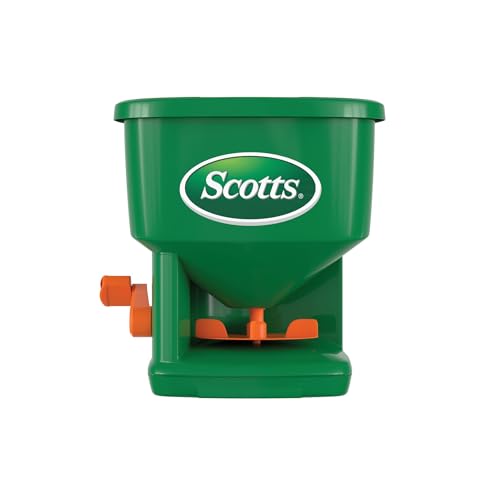
Scotts Whirl Hand-Powered Spreader
Consider it for a small treatment area when carrying the hopper is practical and the product supplies a suitable hand-spreader setting.
- A good fit for
- A homeowner with a small lawn who wants a manual handheld spreading routine rather than a wheeled machine.
- The tradeoff
- The advertised 1,500-square-foot capacity is product-dependent, and the hand-crank workflow adds another speed variable. It is not a precision drop spreader for protected edges.
We may earn a commission from purchases through our links. How this works
Buy on AmazonResearch-based review · Updated
Small enough to carry, still a broadcast pattern
The linked model 71074 is the Scotts Whirl with a hand crank, trigger, flow dial and adjustable arm support. It does not need a tow vehicle or a motor. You carry the material and turn the crank as you walk, causing the spreader to distribute it outward.
That makes it a reasonable format for a small lawn, but handheld does not mean the material lands only directly beneath your hand. It is still a broadcast spreader. Do not assume it is the best tool beside sensitive beds or narrow strips simply because it is portable.
The adjustable support is a documented feature intended to improve comfort; we have not tested fatigue or ergonomics across users. Decide whether carrying the loaded hopper and coordinating the controls fit your own routine. For a larger area, a wheeled model changes that burden rather than merely adding capacity.[1][5][2]
Read the capacity as an upper product estimate
- Hopper claim
- Up to 1,500 square feet of Scotts product, depending on the material and required rate.[5][2]
- Dial scale
- Settings one to five control output; they are not pounds of product.[8]
- Two moving variables
- Walking and cranking speed both affect application.[8]
Read the capacity and control limits
Scotts advertises enough hopper capacity for up to 1,500 square feet of its product. That is not a fixed amount of ground covered by every fertilizer or grass seed. Work out the required quantity from the actual product's label and your measured area before loading.
The linked 2025 Whirl label has dial settings one through five, described in light, moderate and heavy bands. Those numbers regulate flow; they are not pounds, percentages or a universal conversion between different lawn products. The label also says application varies with cranking and walking speed.
A buyer who wants a small, simple tool still needs to check whether the material has suitable instructions for it. The current manufacturer FAQ says that when the product has no hand-crank spreader setting, it is not intended for that use. Do not substitute an improvised dial position for a missing compatibility instruction.[5][8][2]
Check the material before choosing the setting
The current page identifies feeding, seeding and winter ice-melt work as intended uses. It recommends a non-hand-crank broadcast spreader for combination products addressing weeds or insects. That qualification matters more than a generic claim that the Whirl can distribute anything granular.
Read the actual lawn-product label, including its application equipment and setting information. A product's permission to use a broadcast spreader does not necessarily supply a setting for this particular handheld model. Manufacturer settings remain tied to the model and material.
Penn State explains that granular products differ in density, size and nutrient or active-ingredient content. A setting copied from another material can therefore deliver the wrong amount. Choose the Whirl when both the task and the product instructions support it, not as a way to bypass an equipment restriction.[5][2]
Coordinate walking, trigger and crank
Prepare
Measure the area, check hand-spreader compatibility and fill where spills can be recovered.[5][8]
Set and move
Use the correct setting, begin walking, pull the trigger and crank clockwise.[8]
Keep the rhythm
Maintain consistent walking and cranking; check the total material applied.[8][2]
Read the working sequence
The 2025 label directs filling over pavement where a spill can be swept up. Set the orange dial according to the applicable instructions. Begin walking, pull the trigger and turn the crank clockwise. The label specifies a steady walking pace of four feet per second, while the current webpage emphasizes consistent walking and cranking rhythm.
Because both motions affect output, changing one midway through the application changes the working conditions. Do not speed up the crank to empty the hopper while assuming the original rate remains unchanged. Use the amount planned for the measured area as a check on the application.
A measured calibration procedure is preferable to judging coverage only by whether you can see granules. Penn State recommends matching output to the material, equipment and operator. Follow the product's actual instructions for the application, and avoid treating a broad light-to-heavy dial scale as an accuracy guarantee.[5][8][2]
Empty and clean after use
The current Scotts instructions say to return unused material to its bag, rinse the hopper and let it air dry. That is a small maintenance job, but leaving residue for the next treatment is not part of the documented routine. Follow the material's handling requirements while cleaning.
The label tells you to recover spilled product, and Penn State warns against leaving calibration material where it can reach runoff or storm sewers. Plan a fill and cleanup location that allows recovery instead of treating pavement as a disposal area.
The Whirl's documented appeal is a simple manual tool with modest storage demands, not a demonstrated lifetime or a verified low-price advantage. We have not compared its distribution uniformity against a push spreader in a field trial. Its limits should be evaluated from the operating method and your job size.[5][8][2]
Choose wheels or drop placement when the job changes
The DLX is a relevant alternative when carrying and cranking become the wrong routine. It supports a larger advertised amount of Scotts product and adds a right-side EdgeGuard shield, while keeping a push-broadcast approach. It still needs its own setting and application check.
If the central problem is keeping placement in a narrow controlled band, EarthWay's 7312 is a different alternative. It drops material beneath the hopper in a twenty-two-inch path. That reduces the width of the application but increases the number of adjacent passes across a broad lawn.
Choose the Whirl for a compatible small job where the handheld method is useful. Do not choose it on an unsupported claim that hand aiming creates zero scatter, that it is the cheapest accurate option or that every fertilizer can be safely applied with it.[3][6][5][2]
When to choose something else
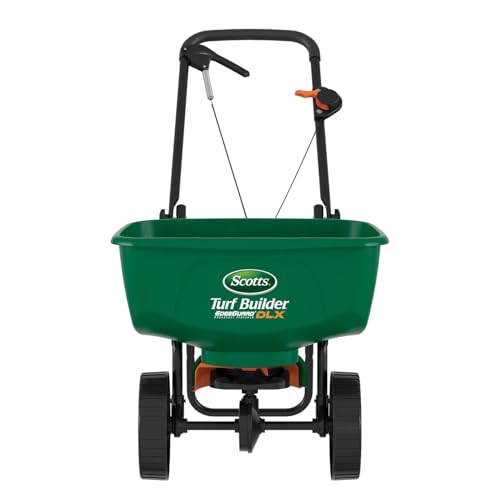
Scotts Turf Builder EdgeGuard DLX Broadcast Spreader
Move to a wheeled broadcast workflow and greater advertised capacity when carrying and cranking no longer suit the area.
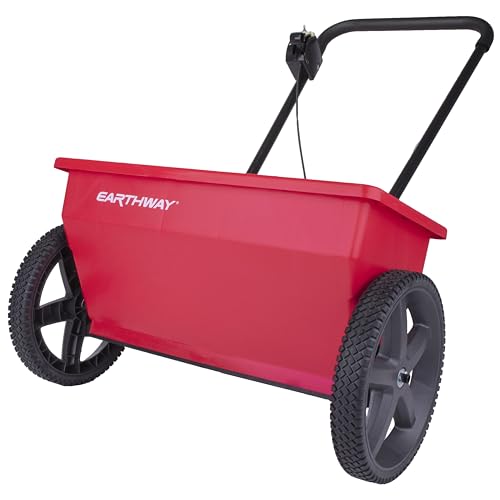
EarthWay 7312 Drop Spreader (75 lb)
Consider a controlled twenty-two-inch drop path when placement near boundaries matters more than a wide broadcast pattern.
Sources & research notes
This review draws on published product information and relevant care or operating guidance. We have not conducted a hands-on trial of this product. General guidance explains the intended task; it does not establish this product’s performance.
Amazon: current linked model and photographed product
Commerce identity only; not evidence of product performance.
Buy on AmazonRead 2026-09-23
- Penn State: calibrating fertilizer spreaders, April30,2025
Read 2026-09-23
- Scotts: current EdgeGuard DLX product page
Read 2026-09-23
- Scotts: current Elite product page
Read 2026-09-23
- Scotts: current Whirl product page
Read 2026-09-23
- EarthWay: current model7312 drop spreader
Read 2026-09-23
- Agri-Fab: model45-0463 specifications
Read 2026-09-23
- Scotts: manufacturer-linked whirl artwork
Read 2026-09-23
Check the product before ordering
Check the exact model, included parts and compatibility.