
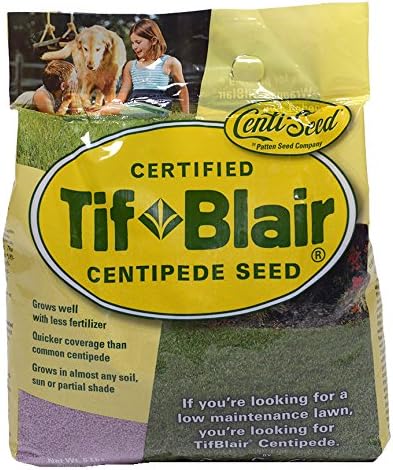
TifBlair Centipede Grass Seed
Consider TifBlair when centipedegrass suits your soil and lawn use, and you can give seedlings a full warm growing window.
- A good fit for
- Sunny southern lawns with suitable acidic soil, light use and a preference for less fertilizer.
- The tradeoff
- Slow establishment, poor tolerance of heavy use and conflicting supplier coverage figures to resolve before spreading.
We may earn a commission from purchases through our links. How this works
Buy on AmazonResearch-based review · Updated
A named centipedegrass with a modest-input appeal
TifBlair gives the buyer a named centipedegrass cultivar, sold by Super-Sod as certified Centi-Seed. The supplier traces its development to Wayne Hanna at the Coastal Plains Experiment Station in Tifton, Georgia. Its certification story concerns genetic identity: look for the certification tag on the bag rather than assuming that every product described simply as centipede seed is the same cultivar.
The practical appeal is a slower-growing lawn with relatively little fertilizer demand. Clemson describes the species as apple-green, coarse-leaved and suited to general-purpose, lower-maintenance turf. That character is a useful buying criterion. Someone seeking a dark, heavily fed lawn with frequent games may be asking it to perform a different job.
Super-Sod markets TifBlair with improved cold tolerance, drought tolerance and earlier spring green-up. Those are supplier claims, not results of a comparative trial we conducted. They do not remove the species' limits: Clemson still lists drought and heavy traffic among its weaknesses. Nor does cultivar certification tell you the germination percentage or treatment details of the particular lot delivered. Read the current seed analysis alongside the brand name.[1][4][5][8]
Check sun, soil and use together
- Sunlight
- Clemson calls for at least 6 hours of full sun despite moderate shade tolerance.[5]
- Use and compaction
- Heavy use and compacted ground are poor fits for the species.[5]
- Water management
- Both too much and too little water can be reasons an existing lawn struggles.[2]
Read the site and soil decisions
Partial-shade wording deserves a closer look. Super-Sod describes use from full sun to partial shade; Clemson qualifies moderate shade tolerance with a need for at least six hours of full sun. A yard that is bright to the eye but shaded by buildings and tree canopies for most of the day is therefore a questionable place to start.
Soil chemistry matters unusually much. Super-Sod's planting guide gives an acidic pH range of 5.0–6.0, while Clemson's maintenance guidance targets 5.5–6.0. These overlapping ranges support testing the soil, not automatically applying lime because a lawn is thin. Clemson also warns about high phosphorus and low potassium. A general-purpose fertilizer routine can be a poor match even where nearby grass looks healthy under it.
Traffic and drainage complete the fit check. Clemson flags traffic and compaction as limitations, while the supplier cautions that both excessive and insufficient water can undermine an existing stand. For a small yard carrying concentrated daily use, reconsider the species before investing in seed. TifBlair's strongest case is a compatible site where slower growth and restrained fertility are useful qualities.[1][2][5]
Two coverage figures, two very different quantities
- Maximum coverage claim
- 5 lb covers up to 20,000 sq ft on the product page.[1]
- Published planting rate
- 0.5 lb per 1,000 sq ft works out to 10,000 sq ft from 5 lb.[2]
- For 10,000 sq ft
- 5 lb at the 0.5 lb-per-1,000-sq-ft rate.[2]
Read the coverage conflict and arithmetic
The current product page advertises up to 4,000 square feet from one pound and up to 20,000 from five pounds. Super-Sod's planting article also recommends half a pound per 1,000 square feet for establishment in two to three months of summer growth. At that rate, a five-pound bag covers 10,000 square feet. Both statements appear in the supplier's own material, including together in the planting article.
For a measured 4,000-square-foot project, the headline implies one pound, while the half-pound rate requires two pounds. For 10,000 square feet, the recommended rate takes five pounds. These are simple conversions of the published figures, not independent evidence that either amount guarantees the advertised establishment time.
Keep the difference visible when comparing bag prices or planning a purchase. Confirm the instructions for the supplied bag and the intended planting method, then calibrate the spreader to that rate. We do not turn the maximum coverage into a universal calculator or label it an overseeding rate. The cited supplier article discusses new and existing centipede lawns but does not clearly assign the two coverage figures to those two jobs.[1][2]
Allow enough warm weather for more than germination
Before sowing
Choose a warm planting window with sufficient time before fall frost.[2]
First weeks
Keep the seedbed moist; the supplier describes emergence after a few weeks.[3]
Beyond emergence
Coverage and density develop gradually; Clemson cautions that a uniform, dense lawn can take years.[5]
Read the establishment time horizons
Super-Sod favors May, June and July and says to leave a minimum of 60 days before the first expected fall frost. That is a planning boundary for the supplier's market, not a promise that any location with 60 frost-free days will establish equally well. The important distinction is between seed that sprouts and a stand strong enough to enter winter.
Its step-by-step guide describes emergence after a few weeks, with frequent watering to keep the seedbed moist. The two-to-three-month lawn expectation in the rate guidance assumes summer growth. Clemson takes a longer view of the species: establishment is slow, and a new seeded lawn may take as long as three years to become uniform and dense. Different definitions of a usable lawn and a mature, dense stand should not be collapsed into one deadline.
Plan watering access and weed management around that gradual development. Slow growth can reduce maintenance later, but it also means you cannot count on seedlings to close bare areas immediately. If the warm season is almost over, buying seed now does not create the growing time the project lacks.[2][3][5]
Spread evenly and keep the seed near the surface
Start with the soil test and a prepared, level surface. The supplier's step-by-step instructions say that fertilizer or lime may not be needed at all. That is more useful than assuming a starter product belongs in every seed order. Address existing vegetation and inspect any weed-control product's seeding restrictions before beginning; a lawn treatment should not undermine the seed you are about to sow.
For distribution, Super-Sod recommends dividing the measured seed into two halves and making passes in perpendicular directions. Lightly rake for soil contact without burying seed deeper than a quarter inch, then roll to smooth and improve contact. Small quantities make careful measurement important: choose the amount from the actual lawn area and chosen rate before adjusting the spreader.
Water immediately without runoff and maintain seedbed moisture. The supplier describes at least two weeks of attentive watering, sometimes several light waterings per day depending on conditions, then a gradual reduction after emergence. That establishment routine differs from watering mature turf. Monitor the soil rather than blindly following a fixed daily count, and be prepared to manage weeds while the slower centipede seedlings develop.[2][3]
Diagnose thin turf before buying another bag
For an existing centipede lawn, Super-Sod explicitly warns that overseeding will not solve excessive shade, high pH, unsuitable watering or excess fertility. Creating seed-to-soil contact also needs care around existing stolons. Treat a failed patch as a site or maintenance question before assuming that more seed is the missing ingredient.
Once established, Clemson places typical mowing height between one and two inches, with the taller end favored in partial shade. It recommends soil-test-based fertility and cautions that too much nitrogen can increase thatch and disease risk. High phosphorus or pH can also contribute to yellowing. A darker color is not a sufficient reason to add more fertilizer without understanding the cause.
If your real priority is wear recovery in a sunny, bermudagrass-suitable climate, compare a named seeded option such as Yukon. Texas A&M describes bermudagrass's traffic tolerance along with its greater mowing and fertility demands. That is a meaningful trade: TifBlair is attractive for compatible lower-input lawns, while a different species may better match a lawn expected to take frequent punishment.[2][5][7][6]
When to choose something else
Outsidepride Yukon Bermudagrass
Compare Yukon where the climate suits bermudagrass and wear recovery is a higher priority. Its mowing and fertility demands make it a different maintenance choice.
Sources & research notes
This review draws on published product information and grass-selection guidance. We have not conducted a hands-on trial of this product. Species guidance helps explain the choice; it is not a trial of the bag you buy.
- Super-Sod: TifBlair Centipede Grass Seed
Read 2026-09-23
- Super-Sod: seeding new or existing TifBlair lawns
Read 2026-09-23
- Super-Sod: how to seed a new TifBlair lawn
Read 2026-09-23
- Super-Sod: TifBlair development and certification
Read 2026-09-23
- Clemson Extension: centipedegrass maintenance calendar
Read 2026-09-23
- Texas A&M AggieTurf: Bermudagrass
Read 2026-09-23
- Outsidepride: Yukon Bermudagrass seed
Read 2026-09-23
- UMass Extension: understanding the turfgrass seed label
Read 2026-09-23
Ready to compare the bag?
Check the package size and seed tag before ordering.