
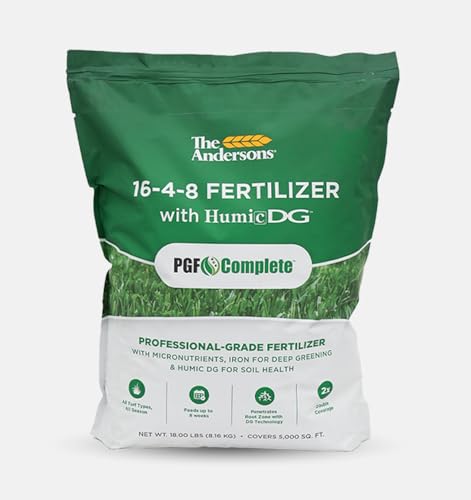
The Andersons PGF Complete 16-4-8
A useful formula to evaluate for an eligible establishment, renovation or phosphorus-deficient turf project. Fine granules and added iron do not override the label’s restrictions or make this the right feeding choice for every established lawn.
- A good fit for
- An actively growing lawn with a use allowed by the current phosphorus notice and a nutrient plan that calls for this 16-4-8 formulation.
- The tradeoff
- The product page promotes broad growing-season use, but the linked label says it is not for routine turf maintenance. Check the actual bag and soil-test need before buying it as a recurring lawn feed.
We may earn a commission from purchases through our links. How this works
Buy on AmazonResearch-based review · Updated
Read the phosphorus notice before the performance claims
PGF Complete is often presented as an all-season fertilizer, and the current manufacturer page discusses application whenever turf is actively growing. The linked 18-pound label, marked C26 and copyright 2026, adds a restriction that changes the purchase decision. Its phosphate notice limits nonagricultural use to first-growing-season turf, areas being repaired or renovated, or turf with a phosphorus deficiency identified by a soil test within the previous three years.
The notice also explicitly says the product is not for routine turf maintenance. That is stronger and more specific than a general suggestion to soil-test occasionally. A healthy established lawn should not automatically receive this formula just because a quick green-up or a fine granule is appealing.
Read the purchased bag and obtain local guidance when the project falls near a boundary. The review reports the manufacturer’s notice rather than presenting a nationwide legal interpretation. A soil-test-driven nutrient plan should establish whether phosphate is needed; the product’s broad marketing is not a substitute for that decision.[3][4][5]
Understand the 16-4-8 formula and mixed nitrogen sources
- Plant nutrients
- The label guarantees 16% nitrogen, 4% available phosphate and 8% soluble potash.[4]
- Additional ingredients
- The analysis includes 3% iron and 7% humic acids; these do not remove the phosphorus-use restriction.[4]
Read the formulation and release details
The grade means 16% nitrogen, 4% available phosphate expressed as P2O5 and 8% soluble potash expressed as K2O by weight. The label also lists 3% iron and a soil-amending analysis of 7% humic acids derived from leonardite. Those are formulation facts, not evidence that the combination is optimal for every soil.
Its nitrogen comes from several sources. The guaranteed analysis includes ammoniacal and urea nitrogen, water-insoluble nitrogen and slowly available nitrogen from methyleneureas. Describing the entire product as slow-release would conceal the quick-response part of the formula. The manufacturer promotes feeding for up to eight weeks; the lawn’s actual nutrient program still depends on species, conditions and management.
The manufacturer’s DG delivery claim concerns granules dispersing into smaller particles after watering. Small particles can be useful for distribution, but the advertised particle-count comparison should not be read as a measured doubling of lawn performance. This review does not establish an independent head-to-head advantage over another fertilizer.[3][4][5]
Choose between two rates, not two different bag sizes
- Low rate
- 1.8 lb product per 1,000 sq ft: an 18 lb bag calculates to 10,000 sq ft and supplies 0.288 lb nitrogen per 1,000 sq ft.[4]
- High rate
- 3.6 lb product per 1,000 sq ft: an 18 lb bag covers 5,000 sq ft and supplies 0.576 lb nitrogen per 1,000 sq ft.[4]
- 2,000 sq ft area
- Calculated product quantity is 3.6 lb at the low rate or 7.2 lb at the high rate; label-use restrictions still apply.[4]
Read the product and nitrogen calculations
The 18-pound package lists 5,000 square feet at its high rate of 3.6 pounds of product per 1,000 square feet. The low-rate spreader column is 1.8 pounds per 1,000, which calculates to 10,000 square feet from the same bag. A 2,000-square-foot project therefore uses 7.2 pounds at the high rate or 3.6 pounds at the low rate.
Nutrient quantity changes with the rate too. Multiplying product weight by the 16% analysis gives 0.576 pound of nitrogen per 1,000 square feet at the high rate and 0.288 pound at the low rate. Neither is a complete annual fertility recommendation. Keep the product’s phosphate contribution in the decision as well.
The label directs low-rate summer applications for cool-season grass, and the web page also specifies the low rate for centipedegrass. These instructions do not authorize phosphorus where the label’s use notice excludes it. Select a permissible, agronomically appropriate application first, then measure the lawn and calibrate the spreader for the amount required.[3][4][5]
Apply to active turf and protect paved surfaces
The label calls for application to actively growing turf with dry foliage. Mow first, use the correct spreader setting and maintain an even walking pace with the specified overlap. The manufacturer notes that settings vary with equipment, terrain and walking speed, so a dial number alone does not verify the application rate.
After spreading, sweep or blow stray granules from concrete and other hard surfaces back onto the lawn. The iron can stain; the label specifically warns against washing misplaced product off with water. Avoid application near water, storm drains or drainage ditches and when heavy rain is expected.
For the intended lawn area, the label specifies at least 0.2 inches of water to activate dispersion. Leave clippings on the lawn for at least one mowing to reduce pickup of particles. Return unused fertilizer to its original package and reseal it for clean, dry storage. Those practical requirements are part of choosing whether this granular format suits the project.[3][4]
Do not turn an eight-week feed claim into an automatic calendar
The maker describes feeding for up to eight weeks and repeat applications at six- to eight-week intervals. That does not resolve whether an additional application is needed or permitted on a particular lawn. Each application remains subject to the current phosphorus notice and the lawn’s nutrient requirements.
Penn State recommends soil testing before turf establishment or renovation and emphasizes interpreting the report’s actual quantities. A recommendation may describe a total to be divided among applications rather than a single treatment. Location and management matter, so use a laboratory familiar with the growing conditions and follow its sampling instructions.
For an overseeding or repair project, account for the whole nutrient program before adding another fertilizer. The PGF formula is a specific nutrient combination, not a universal companion to every bag of seed. Its name and broad turf-type marketing cannot decide whether that combination fits the soil or whether the next feeding should contain phosphorus.[3][4][5]
A soil test may be the more useful first purchase
The MySoil kit provides a different kind of value: its manufacturer describes mail-in laboratory analysis of plant-available nutrients and pH, with online fertilizer recommendations. For a buyer considering PGF as routine feed without knowing phosphorus status, obtaining useful soil information may matter more than selecting between granular brands.
A kit is not an amendment and does not itself improve the lawn. Its usefulness depends on a representative sample and an interpretation appropriate to the site. Penn State’s guidance also makes clear that regional laboratories may use different methods and recommendations; choose a process you can follow consistently and ask for help with an unclear report.
Return to PGF Complete only after the job and nutrient need are clear. Confirm the 18-pound 16-4-8 package, check the current bag’s notices and choose the supported application rate. The product’s fine particles, iron and humic ingredient are secondary features once that fundamental fit is established.[2][5][3][4][1]
When to choose something else
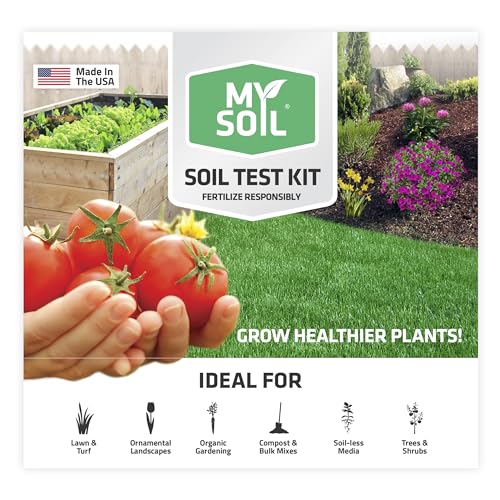
MySoil Soil Test Kit
For nutrient and pH information before buying a phosphorus-containing feed; the manufacturer’s mail-in kit supplies online results and fertilizer recommendations.
Sources & research notes
This review draws on published product information and relevant care or operating guidance. We have not conducted a hands-on trial of this product. General guidance explains the intended task; it does not establish this product’s performance.
Amazon: current product identity and package photograph
Commerce identity only; not evidence of product performance.
Buy on AmazonRead 2026-09-23
- MySoil: mail-in laboratory soil test kit
Read 2026-09-23
- Manufacturer: current pgf product information
Read 2026-09-23
- The Andersons: matching package label
Read 2026-09-23
- Penn State Extension: turfgrass fertilization, soil testing and fertilizer grades
Read 2026-09-23
Check the product before ordering
Check the package size, formulation and current label directions.