
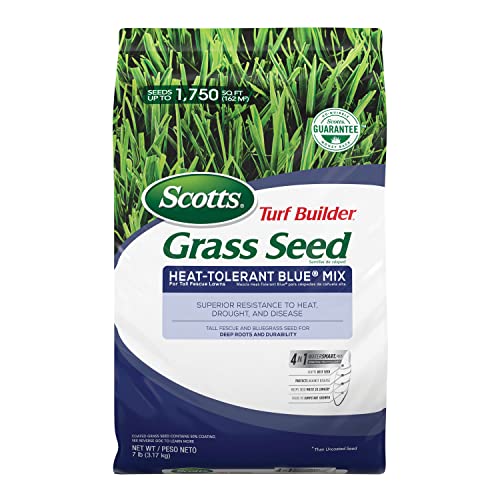
Scotts Turf Builder Heat-Tolerant Blue Mix
Consider this version when a tall-fescue and bluegrass mixture fits the lawn and you can verify the seven-pound package, seed analysis and planting directions.
- A good fit for
- Suitable cool-season lawns in full sun or partial shade, with water and preparation available for establishment.
- The tradeoff
- Half the pictured package weight is coating, and heat-resistance marketing does not establish a maintenance-free or disease-proof lawn.
We may earn a commission from purchases through our links. How this works
Buy on AmazonResearch-based review · Updated
The seven-pound WaterSmart package is a specific version
- Reviewed 7 lb format
- WaterSmart Plus coated tall-fescue and bluegrass seed; 580 sq ft new lawn or 1,750 sq ft overseeding.[4][3]
- Newer format
- Root-Building Nutrition combines seed, fertilizer and soil improver. Read that version’s own package directions.[1]
Read the version and seed-analysis distinction
This review covers the seven-pound Heat-Tolerant Blue Mix for tall-fescue lawns. The pictured Scotts package identifies tall fescue and bluegrass seed, with WaterSmart Plus coating. Its front carries a 1,750-square-foot headline; its back explains that this is overseeding coverage, with a smaller area for a new lawn.
Scotts now also documents Heat-Tolerant Blue Mix with Root-Building Nutrition, described as a combination of seed, fertilizer and soil improver. The current sixteen-pound page is useful for recognizing that newer format, but its package size and instructions should not be pasted onto the older seven-pound listing. Similar product names do not establish that two bags are identical.
The manufacturer artwork we inspected leaves the seed-analysis panel blank. It therefore does not verify the exact cultivars, species percentages or germination test for a bag supplied today. Check those details on the actual package. We do not convert the name Blue Mix into a promise of a particular hybrid-bluegrass cultivar or an exact fescue-to-bluegrass ratio.[4][3][1][8]
What the grass mixture can and cannot do
Tall fescue and bluegrass have different growth habits. Colorado State describes tall fescue as a bunch-type grass and Kentucky bluegrass as a rhizomatous grass that can spread. That provides context for considering a mixture, but it is not a retail-product trial showing how quickly this particular bag will recover from wear.
The package positions the mix for full sun and partial shade, with a medium-bladed texture. Choose it because those conditions and a cool-season lawn fit your site. The words heat tolerant do not by themselves establish suitability for every hot climate, dense shade or a yard that repeatedly loses grass for reasons unrelated to seed quality.
Summer care remains part of the decision. NC State identifies warm, humid conditions as a brown-patch risk for tall fescue. Evaluate recurring damage, light and soil conditions before reseeding, and use local turf guidance where regional suitability is uncertain. A coating that protects seedlings and a grass selected for stress tolerance are not evidence that the mature lawn will be disease-proof or require no repairs.[4][3][6][9][7]
Understand what seven pounds includes
The pictured seven-pound front states that the coated grass seed contains fifty percent coating. That matters when comparing package weights: seven pounds of this format is not the same buying unit as seven pounds of raw seed. It also does not tell you the number of viable seeds without the actual purity and germination analysis.
Scotts describes WaterSmart Plus as a treatment that retains moisture, provides feeding support and helps protect seedlings against disease. The front's twice-as-long moisture claim compares it with uncoated seed. We attribute that claim to the manufacturer; we have not independently measured it, and it does not translate directly into half as much irrigation for the finished lawn.
The back identifies mefenoxam-treated seed and gives handling and application cautions. Follow the delivered label, keep it away from food and feed, and observe its instructions around water, drainage and spilled granules. The practical advantage to weigh is a treated planting format. Soil contact, correct quantities and reliable establishment moisture remain necessary regardless of the coating.[4][3][8]
The headline is three times the new-lawn area
- 7 lb, new lawn
- 580 sq ft on the package.[3]
- 1,000 sq ft, new lawn
- About 12.1 lb, calculated from rounded package coverage.[3]
- 1,000 sq ft, overseeding
- 4 lb at the package’s coverage ratio.[3]
Read the quantity and spreader explanation
The seven-pound back panel gives two clear coverage figures: 580 square feet for a new lawn and 1,750 square feet for overseeding. A buyer starting on bare ground should use the first figure. Spreading one bag across the larger area would apply far less product than the new-lawn directions intend.
Calculated from those package figures, a 1,000-square-foot project needs about 12.1 pounds for new-lawn establishment or four pounds for overseeding. The new-lawn result is approximate because the label's area is rounded. Measure the actual planting space and distinguish bare sections from existing turf that only needs additional seed before deciding how much to order.
Use this package's coverage and spreader instructions together. The back lists different settings and pass counts for different spreaders, so a setting from another Scotts model is not a universal application rate. If a seller offers a different weight or the Root-Building Nutrition format, restart the calculation from that bag's label rather than preserving a seven-pound coverage assumption.[3][1]
Prepare shallow seed contact and sustained moisture
For a new lawn, the back panel says to loosen approximately the top two inches of soil and remove dead grass and debris. That is seedbed preparation, not a two-inch seed-burial instruction. After spreading, it calls for lightly raking the seed just beneath the soil surface. For overseeding, it adds mowing, collecting clippings and opening the surface for seed contact.
The back directs watering to keep the surface moist until seedlings reach at least two inches. The side panel suggests twice-daily watering for at least three weeks and a first mowing when the new grass reaches two to three inches. Those instructions emphasize consistent establishment care; adjust actual watering to keep the seedbed appropriately moist in the soil and weather you have.
Do not judge the whole mixture by the first seedlings or treat first-mowing height as proof that normal traffic is harmless. Choose a locally suitable cool-season planting window and protect developing grass. Plan weed treatments around the exact label's reseeding restrictions. Neither WaterSmart coating nor a germination headline replaces the time needed to develop a lawn.[3][2][7][6]
Check freshness, then plan the mature lawn
For an older package format, freshness deserves explicit attention. The pictured back advises using fresh product, storing it in a cool, dry place and planting within the season after opening. The seed tag's test information matters more than assuming that a familiar brand or an unopened bag establishes current germination quality.
After establishment, follow local care for the actual mixture. The package's first-mowing tip is not a year-round maintenance height. NC State, for example, advises a taller summer cut for tall-fescue lawns and adjusting care to site conditions. Base nutrient decisions on soil information and account for any included or separately applied fertilizer rather than stacking products automatically.
Combat Extreme Transition Zone is a useful comparison if you prefer a currently documented all-tall-fescue blend instead of a fescue-and-bluegrass mixture. Its OptiGrowth coating and planting rates are different, and no price or performance winner follows from the coating names alone. Compare the actual grass composition, seed analysis and area covered at the required rate, then choose the format that fits the lawn you intend to maintain.[3][8][9][5][4]
When to choose something else

Outsidepride Combat Extreme Transition Zone
Compare Combat Transition if you prefer its currently described three-way tall-fescue blend to a tall-fescue and bluegrass mixture. Use its own coated-seed rates and check regional fit.
Sources & research notes
This review draws on published product information and grass-selection guidance. We have not conducted a hands-on trial of this product. Species guidance helps explain the choice; it is not a trial of the bag you buy.
- Scotts: Current Heat-Tolerant Blue Mix with Root-Building Nutrition
Read 2026-09-23
- Scotts: Heat-Tolerant Blue Mix manufacturer package side tips
Read 2026-09-23
- Scotts: 7 lb Heat-Tolerant Blue Mix manufacturer package directions
Read 2026-09-23
- Scotts: 7 lb Heat-Tolerant Blue Mix manufacturer package front
Read 2026-09-23
- Outsidepride: Combat Extreme Transition Zone product and planting guide
Read 2026-09-23
- Colorado State University Extension: turfgrass species selection
Read 2026-09-23
- University of Minnesota Extension: renovating a lawn
Read 2026-09-23
- UMass Extension: understanding the turfgrass seed label
Read 2026-09-23
- NC State Extension: Tall fescue lawn maintenance calendar
Read 2026-09-23
Ready to compare the bag?
Check the package size and seed tag before ordering.