
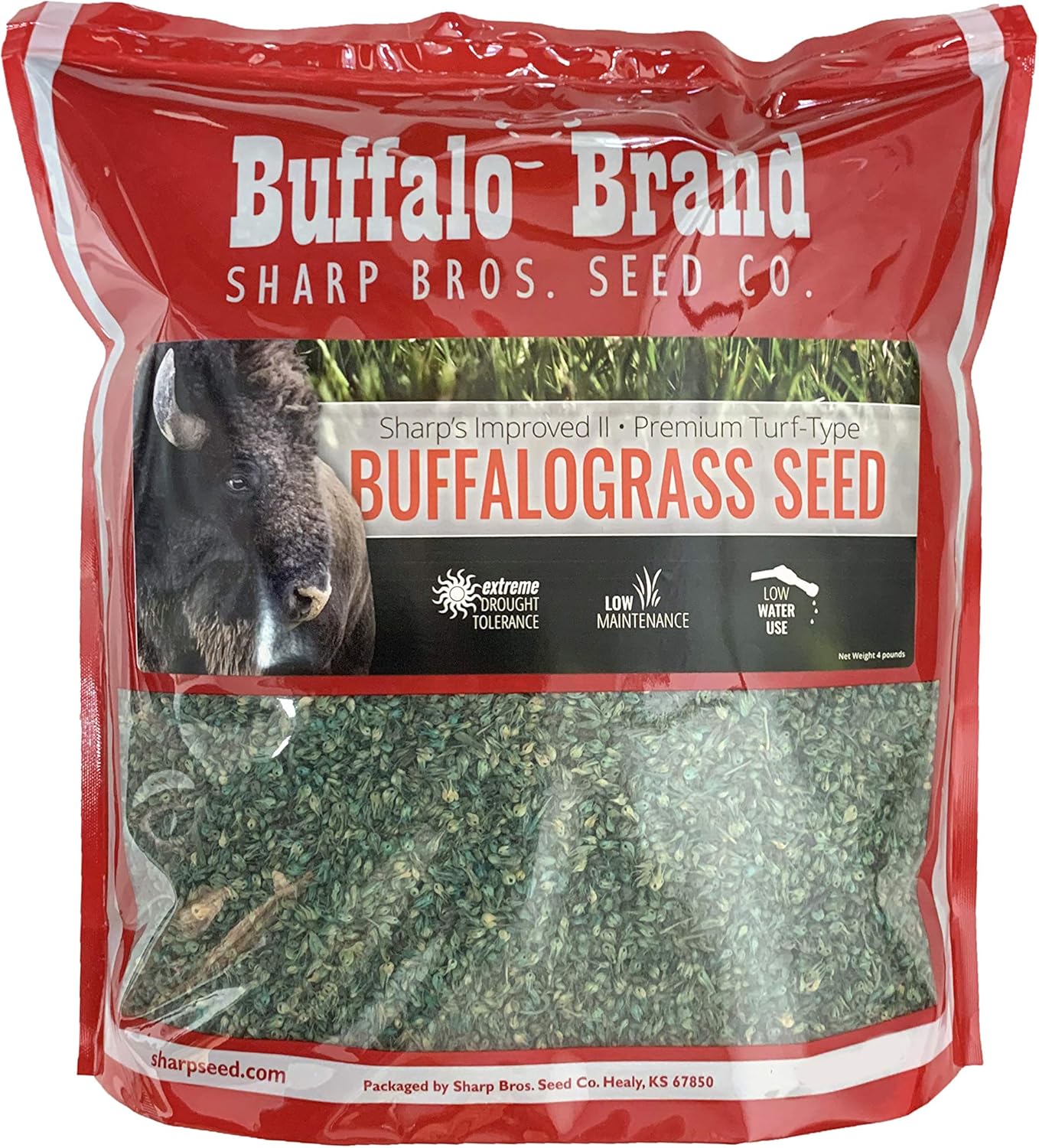
Sharp's Improved II Buffalo Grass
Consider Sharp’s Improved II for a sunny lawn where conserving inputs matters more than a long season of dark-green color.
- A good fit for
- Sunny, well-drained sites suited to a lower-input native prairie grass.
- The tradeoff
- A shorter green season, establishment watering and limited tolerance for concentrated, constant traffic.
We may earn a commission from purchases through our links. How this works
Buy at Sharp SeedResearch-based review · Updated
A turf-type selection of a native prairie grass
Sharp's Improved II is sold as turf-type buffalograss. The species is native to the Great Plains, and K-State lists Sharp's Improved II among its seeded types. That gives the product a clear identity: a named selection for someone who wants a buffalograss lawn, rather than a generic mixture of grasses for a conventional cool-season yard.
Buffalograss spreads by above-ground runners called stolons, which root at points along their length. It can form connected turf, but its appearance and growth calendar differ from Kentucky bluegrass or tall fescue. K-State emphasizes its natural gray-green character and cautions against trying to manage it into an imitation of those lawns. Choose the species because that look and seasonal rhythm appeal to you.
The manufacturer offers 4-, 10- and 25-pound bags. The published product page does not provide a current analysis tag for the lot you would receive, so verify purity, germination and treatment information with the bag. K-State specifically advises checking how buffalograss seed was treated to improve germination. We do not infer a current treatment method or germination percentage from the product name or the color of seed in a photograph.[1][6][5][4]
Expect a shorter green season
Spring
Expect green-up later than nearby bluegrass or fescue lawns.[5][6]
Summer
Active growth needs suitable moisture; drought survival does not guarantee green color.[5][6]
Fall and winter
A hard fall frost brings brown dormancy until the next growing season.[5][6]
Read about the green season and watering tradeoff
The biggest visual commitment is seasonal. In Colorado, CSU describes buffalograss as actively growing from late May into early September, greening later in spring than bluegrass or fescue and turning brown after a hard fall frost. Those months describe that region, not a national calendar. They are still a useful picture of why a warm-season native lawn may look different from neighboring cool-season turf.
Summer color is a separate decision from survival. CSU says established buffalograss can survive without irrigation, but it may become dormant in dry summers and more vulnerable to weed invasion. That does not support a blanket promise that a lawn will stay green on rainfall alone everywhere. K-State likewise ties watering to local weather, soil and the desired level of maintenance.
Nor should the mature-lawn water advantage be applied to germination. CSU stresses that establishing buffalograss can require as much water as establishing bluegrass or tall fescue. The project is an investment in the lawn's later maintenance pattern, not an immediate escape from watering a seedbed. Decide in advance how much seasonal brown color you will accept and how you will supply water during establishment.[5][6]
Screen the site before ordering seed
- Light
- K-State specifies full sun, with 6–8 hours of direct light for acceptable turf.[6]
- Drainage
- Wet, poorly drained ground is a poor fit in K-State guidance.[6]
- Traffic
- CSU cautions against small lawns with concentrated, constant use.[5]
- Elevation
- Colorado guidance generally discourages use above about 6,500 ft; local exposure and season length matter.[5]
Read the soil, traffic and regional limits
Sunlight is the first filter. K-State says buffalograss does best in full sun, with six to eight hours of direct light producing acceptable turf; stands thin as shade increases. CSU also excludes substantially shaded locations. This is not the native-grass answer to every difficult corner beneath trees.
Drainage and soil texture are the next filters. K-State favors well-drained loam and cautions against wet or sandy sites. CSU notes that very droughty sand can need supplemental irrigation, weakening the reason many homeowners choose buffalograss in the first place. Compacted clay may be tolerated after establishment, but that is not a reason to skip preparing a firm, workable seedbed.
Finally, think about how concentrated the use will be. A larger lawn with occasional play is different from a small yard carrying the same dog path or constant games. CSU flags concentrated, constant traffic as a poor fit. Its Colorado guidance also cautions above roughly 6,500 feet, with limited exceptions for protected sunny exposures. Use those limits to ask the right local questions rather than assuming a native species fits every site in its broader home region.[6][5]
Choose a rate with an establishment horizon
Sharp recommends 4 lb per 1,000 sq ft when first-year turf establishment is the goal. Its 1 lb rate is paired with a two-season expectation.[1]
- 4 lb bag
- About 1,000 sq ft at the manufacturer’s first-year rate.[1]
- 10 lb bag
- About 2,500 sq ft at that same rate.[1]
- 25 lb bag
- About 6,250 sq ft at that same rate.[1]
- A 2,000 sq ft project
- 8 lb at the 4 lb-per-1,000-sq-ft rate; no additional buffer assumed.[1]
Read the rate and slower-establishment option
Sharp's product page recommends four pounds per 1,000 square feet where turf establishment is desired in the first year. It also describes one pound per 1,000 square feet as generally producing turf in two seasons. The lower rate is therefore tied to a longer wait; it is not an equivalent instant-coverage bargain.
At the four-pound rate, a 4-pound bag represents 1,000 square feet, a 10-pound bag 2,500 square feet and a 25-pound bag 6,250 square feet. A measured 2,000-square-foot lawn would take eight pounds. These calculations use the manufacturer's stated rate and are planning figures, not a guarantee that a lawn will fill in by a certain date.
Do not silently substitute a general species rate from a different publication. Extension rates vary with establishment method and expectations, and Sharp also gives much lighter rates for large plantings that can tolerate slower coverage. For a home-lawn project, keep the chosen rate, surface preparation and time horizon together. The cited product page does not provide a separately labelled overseeding rate, so we do not invent a discount rate for an existing lawn.[1]
Make the first season a real project
Sharp separates planting advice by access to irrigation. Its central-Plains guidance favors April into May when relying on spring rain, and late May into early June when irrigation is available. K-State similarly distinguishes rainfall-dependent spring planting from summer planting on irrigated sites. These are regional strategies, not evidence that dry seed can be scattered anywhere and left alone.
The manufacturer's preparation instructions call for prior weed control and a firm seedbed, with seed no deeper than roughly a quarter to half an inch. It emphasizes keeping the seed zone moist after planting. CSU gives a seven-to-21-day seedling-emergence range with warm soil and consistent irrigation. Cooler soil can delay that response, so judge the actual conditions as well as the elapsed days.
Weed competition deserves a plan before sowing. Sharp recommends mowing taller weeds so they do not shade the developing buffalograss, and K-State cautions that seedlings are sensitive to weed killers. Do not transfer a weed-control routine from an established cool-season lawn to new buffalograss. Identify the weed, read the exact product label if treatment is needed and use local advice for compatibility. Lower-input mature turf can demand attentive work in its first season.[1][6][5]
Let lower input remain the point
After establishment, Sharp recommends a two-to-three-inch mowing height and warns that a lower cut encourages weeds and reduces drought tolerance. K-State gives a somewhat taller home-lawn range of two and a half to four inches. Choose a locally appropriate maintained or naturalistic appearance rather than repeatedly cutting short to force a different lawn style.
More fertilizer and water are not automatically improvements. K-State warns that excessive inputs can favor weeds and defeat the low-maintenance advantage. Use soil testing for phosphorus and potassium decisions, and respond to growth and weather rather than importing a bluegrass feeding calendar. A modestly colored native lawn is a legitimate objective.
If constant traffic is the non-negotiable requirement, compare a locally suitable bermudagrass such as Yukon with its own maintenance demands. If shade is the main constraint, changing to another sunny warm-season seed is unlikely to solve it. Sharp's Improved II makes the strongest case when you accept buffalograss's appearance, seasonal dormancy and establishment work in exchange for a different long-term maintenance pattern.[1][6][5][2][3]
When to choose something else
Outsidepride Yukon Bermudagrass
Compare named Yukon where bermudagrass fits the climate and wear recovery matters more than minimum inputs. Texas A&M describes bermudagrass’s traffic tolerance alongside its mowing and fertility demands.
Sources & research notes
This review draws on published product information and grass-selection guidance. We have not conducted a hands-on trial of this product. Species guidance helps explain the choice; it is not a trial of the bag you buy.
- Sharp Seed: Sharp’s Improved II Turf-Type Buffalograss
Read 2026-09-23
- Texas A&M AggieTurf: Bermudagrass
Read 2026-09-23
- Outsidepride: Yukon Bermudagrass seed
Read 2026-09-23
- UMass Extension: understanding the turfgrass seed label
Read 2026-09-23
- Colorado State Extension: Buffalograss Lawns
Read 2026-09-23
- K-State Extension: Buffalograss Lawns, MF658
Read 2026-09-23
Ready to compare the bag?
Check the package size and seed tag before ordering.